

Comparing funeral service quotes means obtaining itemized General Price Lists (GPLs) from multiple providers and analyzing each line item to make a fair, transparent cost comparison. The FTC Funeral Rule mandates that providers hand over a printed GPL early in any discussion, giving your family the legal right to review prices on paper rather than under emotional pressure. Knowing how to compare funeral service quotes protects you from unexpected charges and helps you honor your loved one within a budget that reflects your values. This guide walks through every step, from reading a GPL to building a comparison spreadsheet, so your family can make a confident, informed decision.
How to compare funeral service quotes: the itemized GPL method
The GPL is the foundation of every funeral cost comparison. Providers must supply a printed or typewritten GPL at the start of any in-person arrangement discussion, and this document itemizes every good and service with its individual price. The FTC Funeral Rule was designed specifically to eliminate confusion by mandating early disclosure so families can compare documents rather than rely on verbal persuasion. Requesting a GPL from every provider you contact is the single most important first step in evaluating funeral quotes.
Once you have GPLs in hand, treat them as your primary source of truth. Package names like "Dignity Plan" or "Heritage Service" mean nothing until you break them into individual line items. Two packages priced identically can include entirely different services, which is why the itemized GPL method is the only reliable approach to choosing funeral service providers fairly.

What are the essential line items in a funeral service quote?
Every GPL organizes costs into predictable categories. Understanding each one prevents you from comparing a full-service quote against a stripped-down estimate.
Core provider fees are the non-negotiable charges every funeral home applies:
- Basic services fee: The funeral director's professional time, overhead, and administrative work. This fee is non-declinable, meaning you pay it regardless of which services you choose.
- Transportation: Separate charges typically apply for collection of the deceased, transfer to the funeral home, and delivery to the place of service or crematorium.
- Facilities and staff fees: Use of the chapel, viewing room, or graveside staff are often billed separately from the basic services fee.
- Embalming: Not legally required in most jurisdictions, but some providers charge it as a default. Ask directly whether it is included and whether it can be declined.
- Out-of-hours collection: Many providers add a surcharge for collections outside standard business hours. This figure varies widely and is frequently omitted from headline prices.
Merchandise covers caskets, urns, shrouds, and memorial stationery. Merchandise markups vary significantly between providers, so comparing these line items separately from service fees gives a clearer picture of true value.
Cash advance items are third-party costs the funeral home pays on your behalf, such as crematorium fees, cemetery charges, death notices, and clergy or officiant fees. Cash advance items are often listed separately and sometimes carry an additional service charge from the provider. Always ask whether a handling fee applies to each cash advance item.
National averages in 2026 show that a traditional funeral costs $7,736, cremation with a service costs $6,072, and direct cremation costs $1,834. Add-ons like cemetery fees raise totals by $3,000 to $8,000, which means the service type you are comparing must be identical across all quotes or the numbers are meaningless.
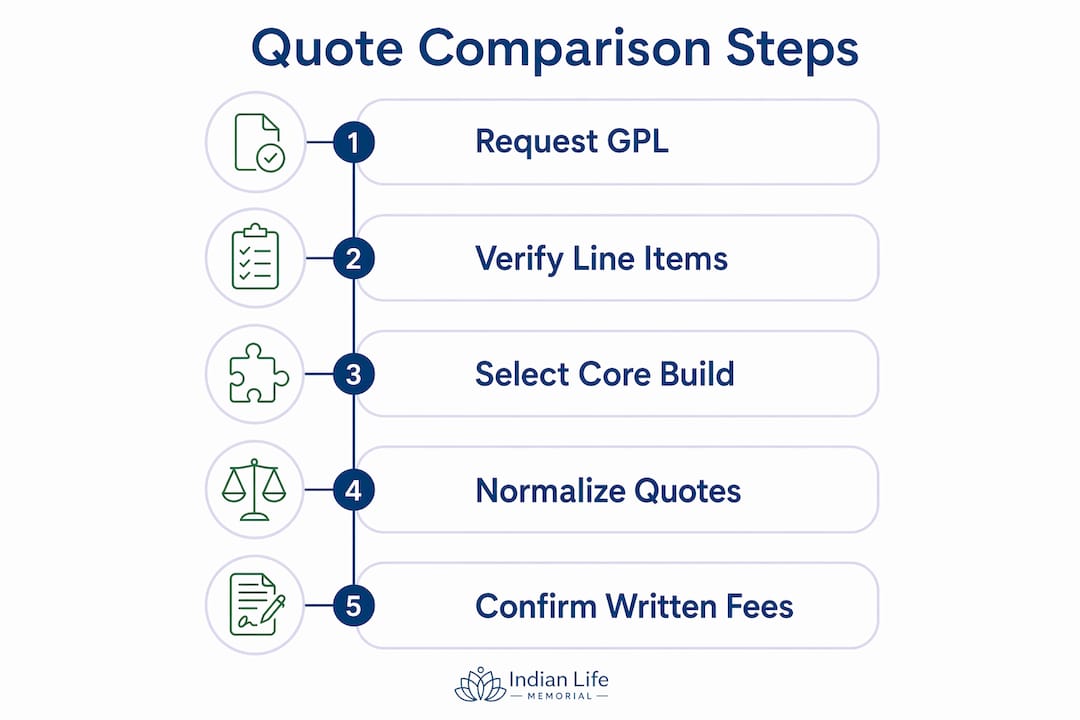
How to normalize quotes for a fair apples-to-apples comparison
The most common mistake families make is comparing headline totals from quotes that cover different scopes. Most differences in quotes come from add-ons and cash advances rather than core provider fees. Normalizing your comparison removes that distortion.
Start by selecting a shared "core build." For cremation, this is typically direct cremation: collection, cremation, and return of ashes. For burial, it is basic graveside burial without viewing or chapel service. Every provider you contact should quote on this identical core build. Then request separately priced optional elements such as a viewing, memorial service, or specific merchandise.
Pro Tip: Ask each provider to quote the core build and every optional element as separate line items. Never accept a bundled package price as your comparison figure. Package labels are marketing; line items are facts.
The table below illustrates how to structure a normalized comparison across three providers:
| Cost category | Provider A | Provider B | Provider C |
|---|---|---|---|
| Basic services fee | $X | $X | $X |
| Transportation (collection + delivery) | $X | $X | $X |
| Cremation or burial fee | $X | $X | $X |
| Optional viewing/chapel | $X | $X | $X |
| Cash advance items (estimated) | $X | $X | $X |
| Total (core build) | $X | $X | $X |
Separating funeral-director fees from cash advances in this format reveals which provider genuinely charges less for their own services versus which one simply passes through lower third-party costs.
What is the difference between fixed quotes and estimates?
A fixed quote guarantees the prices listed for the services specified. An estimate is an approximation that may increase if circumstances change, such as a death occurring out of hours or a body requiring additional preparation. Fixed quotes guarantee prices listed; estimates may increase if costs change, so asking which costs are fixed versus estimated is a non-negotiable part of any quote request.
When reviewing a quote, ask the following questions directly:
- Which line items are guaranteed, and which are subject to change?
- Are third-party disbursements included in the total, or are they estimated separately?
- Does the quote include out-of-hours fees, and under what conditions do they apply?
- Is there a handling fee applied to cash advance items?
- What payment terms apply, and is a deposit required?
Estimates should be treated as ranges. Ask specifically which disbursements can change to avoid invoice surprises. A provider who cannot clearly distinguish their fixed fees from their estimates is a provider who cannot give you a reliable budget. For families managing grief while also managing finances, that clarity is not a luxury. It is a necessity.
How to use spreadsheets and checklists to organize your comparison
A structured comparison spreadsheet is the most reliable tool for evaluating funeral quotes side by side. Building a comparison spreadsheet using line items from each provider's GPL allows you to track funeral home fees and third-party costs in one place. A 2026 worksheet format breaks costs into five columns: professional services, transportation, merchandise, cemetery costs, and other expenses.
Follow these steps to build your own:
- Collect GPLs from at least three providers. Call each one, state the type of service you need, and request their GPL in writing. Document the name of the person you spoke with and the date.
- Create a spreadsheet with one row per line item and one column per provider. Use the GPL categories as your row labels: basic services fee, transportation, embalming, facilities, merchandise, and cash advances.
- Enter every figure exactly as quoted. Do not round or estimate. Mark any item listed as "estimated" in a separate color so it stands out during review.
- Add a cemetery and plot cost row. Cemetery and plot costs are often separate from funeral home quotes but significantly impact total cost. Fees for opening and closing the grave, vaults, and interment rights are usually billed separately and must be included in your total.
- Calculate two totals per provider: a core build total and a full-service total including all optional items and estimated cash advances.
Pro Tip: When calling providers, use the same script for every call. State: "I am requesting an itemized General Price List and a quote for [specific core build]. Can you confirm which fees are fixed and which are estimated?" Consistent questions produce comparable answers.
A checklist of questions to ask during each quote request should include: confirmation of GPL availability, identification of non-declinable fees, handling fees on cash advances, out-of-hours surcharges, payment terms, and whether the final written statement will itemize every selected service. The final written statement required after arrangement selection must list each good and service chosen, the total price, and all cash advance items. Request this document before signing anything.
What common pitfalls should families avoid when comparing quotes?
Many families lose time and money when comparing only headline prices without checking inclusions and disbursement separation. These are the most frequent and costly mistakes to avoid:
- Comparing different service types. A direct cremation quote and a cremation-with-service quote are not comparable. Confirm the scope is identical before placing any figures side by side.
- Ignoring cemetery fees. The biggest comparison error is missing scope. Cemetery fees, vaults, death notices, and clergy fees are often excluded from funeral home quotes but add significant costs. Map the full lifecycle of costs before finalizing any budget.
- Accepting package names at face value. "Premium," "Standard," and "Essential" packages mean different things at different providers. Always request the line-item breakdown behind any package label.
- Overlooking optional surcharges. Out-of-hours collection fees, embalming charges, and memorial stationery costs are frequently listed in small print. Read every line of the GPL, not just the summary total.
- Not getting it in writing. Verbal quotes are not binding. Request a written itemized statement before committing to any provider, and review it carefully for items you did not discuss or request.
For families with specific cultural or religious requirements, such as Hindu Antyesti rites, Samskaras, or the presence of an experienced Pandit, the checklist must also include confirmation that the provider can fulfill those sacred obligations. A lower price that cannot accommodate your family's traditions is not a saving. It is a compromise that cannot be undone.
Key takeaways
Comparing funeral service quotes requires itemized GPLs, a normalized core build, and written confirmation of which fees are fixed versus estimated.
| Point | Details |
|---|---|
| Start with the GPL | Request a printed General Price List from every provider before discussing arrangements. |
| Normalize the core build | Compare quotes on an identical service type to avoid misleading headline price differences. |
| Separate cash advances | Identify third-party disbursements and ask whether handling fees apply to each one. |
| Get everything in writing | A final itemized written statement is legally required and must be reviewed before signing. |
| Include cemetery costs | Plot, vault, and interment fees are often excluded from funeral home quotes but add thousands to the total. |
What I have learned from helping families navigate funeral quotes
Families rarely arrive at this process prepared. They are grieving, often sleep-deprived, and facing decisions that feel both urgent and permanent. What I have seen, time and again, is that the families who ask for itemized quotes in writing and use a simple comparison spreadsheet leave the arrangement process feeling respected rather than overwhelmed.
The most underrated piece of funeral service quote advice is this: ask every provider the same questions in the same order. When you vary your questions, you get incomparable answers. When you standardize them, the differences between providers become obvious within minutes. One provider's "all-inclusive" package may exclude the very ceremony your family considers sacred.
For families honoring Hindu traditions, the presence of an experienced Pandit, the correct sequence of Vedic rites, and the proper handling of the Atman's passage are not optional extras. They are the service. A quote that does not address these elements is an incomplete quote, regardless of its price. Balancing cost, quality, and cultural integrity requires you to ask specific questions, not just compare totals. Providers who welcome those questions are the ones worth trusting.
— Admin
How Indianlifememorial supports transparent funeral planning
Indianlifememorial offers families in Singapore a compassionate, transparent approach to funeral planning that removes the guesswork from comparing costs.

Their full suite funeral services are available 24/7 and cover Hindu, Christian, and all-faith arrangements with honest, upfront pricing starting at $1,888 and no hidden fees. Every family receives a clear breakdown of what is included, making it straightforward to evaluate their offering against other providers using the GPL comparison method described in this article. Indianlifememorial's team of experienced priests and funeral directors also handles the sacred Vedic rites and Antyesti ceremonies that many families require, so cultural integrity and cost transparency come together in one place. Explore their funeral packages or contact their team directly for a personalized, itemized quote.
FAQ
What is a General Price List in funeral planning?
A General Price List (GPL) is a written document that itemizes every funeral good and service a provider offers along with its individual price. Under the FTC Funeral Rule, providers must supply this list at the start of any in-person arrangement discussion.
How many funeral quotes should I request?
Request itemized quotes from at least three providers to get a meaningful range of prices and service options. Use the same core build specification for each request so the figures are directly comparable.
What are cash advance items in a funeral quote?
Cash advance items are third-party costs, such as crematorium fees, cemetery charges, and clergy fees, that the funeral home pays on your behalf. Always ask whether a handling fee is added to each cash advance item, as this can cause significant variance between quotes.
Are funeral package prices negotiable?
Many providers will adjust package contents or pricing when asked directly, particularly for families with specific cultural or religious requirements. Requesting a line-item breakdown of any package gives you a clearer basis for discussion than accepting a bundled price.
What should a final written funeral statement include?
The final written statement must list every good and service selected, the total price, and all cash advance items. Reviewing this document carefully before signing protects your family from unexpected charges on the final invoice.