

Planning a memorial service is one of the most meaningful things your family will do in the days after losing a loved one. It is also one of the most logistically demanding. This memorial service programme planning guide exists to take the weight of uncertainty off your shoulders. A well-organized order of service, known in the funeral industry as a memorial program, gives guests a clear path through the service and gives your family a structure to hold onto when emotions run high. The sections below walk you through every decision, from layout and timing to speaker coordination and livestream compliance.
Table of Contents
- Key Takeaways
- Essential elements of a memorial service programme
- Planning the service flow and timing
- Logistics and coordination for the service
- Personalizing your memorial program
- My perspective on what families often get wrong
- How Indianlifememorial supports your memorial planning
- FAQ
Key Takeaways
| Point | Details |
|---|---|
| Start with structure | Build your program around a clear order of service before adding personal tributes or decorative elements. |
| Keep language plain | Simple labels like "Welcome" and "Eulogy" help guests follow along without confusion or distraction. |
| Plan timing carefully | Most memorial services run 45 to 90 minutes, so assign realistic time blocks to each segment. |
| Assign roles early | Designate an officiant, speakers, ushers, and AV support before the service day to prevent last-minute gaps. |
| Understand livestream rules | A funeral music license does not cover webcasting. A separate license is required to stream music legally online. |
Essential elements of a memorial service programme
A memorial program, sometimes called an order of service booklet, is the printed or digital document that guides guests through the service. Clear program structure typically includes four core areas: service identity, the order of service, music and reading credits, and a closing thank-you note.
What to include
- Service identity: The full name of the deceased, dates of birth and passing, the venue name, and the date and time of the service
- Order of service: A numbered or bulleted list of each segment in sequence, with simple labels
- Participant credits: Names of the officiant, eulogists, musicians, and readers. Listing names and roles honors contributors and helps guests understand who is speaking
- Thank-you note: A brief, sincere acknowledgment from the family, placed on the back panel
What to skip
Avoid printing full song lyrics, lengthy biographical essays, or multiple poems in the main program. These belong in a separate keepsake booklet if your family wants to create one. The program's job is navigation, not narration.
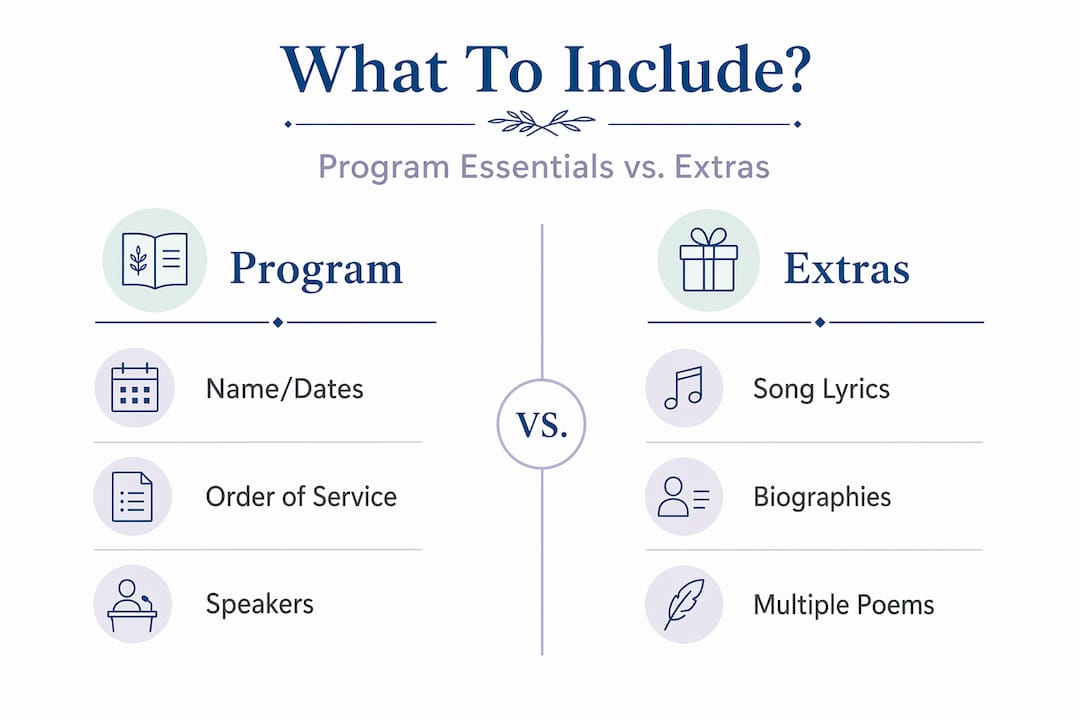
| Element | Include in Program | Move Elsewhere |
|---|---|---|
| Name, dates, venue | Yes | N/A |
| Order of service | Yes | N/A |
| Full song lyrics | No | Keepsake booklet |
| Long life story | No | Eulogy or tribute video |
| Donation or memorial URL | Yes, briefly | N/A |
| Livestream link | Yes, if applicable | N/A |
Layout and readability
A minimum 11 to 12 point font is recommended for both print and digital programs, particularly for older guests. Use adequate white space between sections. A one-page front-and-back format is the most practical for most services.
Pro Tip: Test your digital program on a smartphone screen before the service day. Many guests will pull it up on their phones, and small fonts or cluttered layouts will frustrate them at exactly the wrong moment.
Writing the order of service in plain language transforms the program from a sentimental keepsake into a practical navigation tool for guests. Use simple, direct labels. "Opening Prayer" is clearer than "Invocation of the Divine." "Family Tribute" is warmer than "Eulogistic Remarks."
Planning the service flow and timing
A service that feels rushed or drags on loses its emotional resonance. Most memorial services run between 45 and 90 minutes, and staying within that window respects your guests while giving the service enough room to breathe.
Here is a suggested sequence with approximate timing:
- Welcome and opening remarks (3 to 5 minutes): The officiant greets guests, introduces the purpose of the gathering, and sets the tone.
- Opening music or reading (3 to 5 minutes): A piece of music or a short reading that reflects the spirit of the deceased.
- Eulogies (5 to 10 minutes per speaker, maximum two or three speakers): Prepared remarks from close family members or friends.
- Open sharing (10 to 15 minutes): Guests are invited to share a memory or brief tribute.
- Music, poetry, or video tribute (5 to 8 minutes): A musical performance, recorded song, or photo slideshow.
- Moment of silence or prayer (2 to 3 minutes): A quiet pause for personal reflection.
- Closing remarks and benediction (3 to 5 minutes): The officiant closes the service and directs guests to any reception.
Managing transitions
Brief readings or music between speakers keep the service moving without feeling abrupt. Assign a specific person, ideally the officiant or a designated emcee, to introduce each segment and speaker by name. This prevents awkward pauses and keeps guests oriented.
Pro Tip: For the open sharing segment, quietly ask two or three people in advance to speak first. Pre-identified speakers break the silence and encourage others to follow. Without this, even willing guests may hesitate.
Pacing matters as much as content. A service that moves with intention, with clear transitions and predictable rhythm, feels honoring rather than hurried.
Logistics and coordination for the service
Good logistics planning is what separates a service that runs smoothly from one that causes your family extra stress on an already difficult day.
Venue coordination
Memorial venue reservations typically include dedicated setup and cleanup windows in addition to the service itself. Confirm your venue's exact schedule in writing, including access times for AV setup, floral arrangements, and guest seating. Ask about parking, technical costs, and any restrictions on décor or music.
Roles to assign before the service day
- Officiant or celebrant: Leads the service, manages transitions, and keeps time
- Eulogists and readers: Confirmed speakers with their segments clearly listed in the program
- Ushers or greeters: Welcome guests, distribute programs, and assist with seating
- AV support: Manages audio, microphones, slideshows, and the livestream feed
- Reception coordinator: Manages the post-service gathering if applicable
Assigning roles and logistics responsibilities early reduces day-of stress and helps the service run without disruption.
Music licensing and livestreaming
This is the area where families most commonly encounter unexpected problems. A funeral home music performance license covers live or recorded music played at the physical venue. It does not cover music streamed over the internet. A separate webcasting license is required for any livestreamed service. In 2026, the National Funeral Directors Association (NFDA) lists the music performance license at $350 and the livestreaming license at $65 per website.
Many families assume one license covers both. This common misconception can result in platforms like Facebook or YouTube automatically muting copyrighted music mid-service, which is deeply disruptive. Coordinate with your funeral service provider well in advance to confirm all licensing is in place.
| Requirement | Physical Service | Livestreamed Service |
|---|---|---|
| Music performance license | Required | Required |
| Webcasting license | Not needed | Required |
| Platform muting risk | None | High without license |
| Livestream link in program | N/A | Recommended |
Personalizing your memorial program
A program that reflects who your loved one truly was creates a more meaningful experience for everyone present. Personalization does not mean complexity. It means making deliberate choices about what to include and why.
Here are practical ways to add meaning without cluttering the program:
- A favorite quote or verse: Place it on the front cover beneath the name and dates. Keep it to one or two lines.
- A photograph: A single, well-chosen photo on the cover carries more emotional weight than several scattered throughout.
- A theme or color palette: Reflect a passion, a culture, or a season. For families observing Hindu traditions, colors and symbols tied to the Atman's journey can be incorporated with guidance from an experienced Pandit.
- A donation or memorial URL: Include a brief line directing guests to a charitable fund or memorial page.
- Multi-faith or secular elements: If your family includes members of different faiths or backgrounds, pre-planning your service with a knowledgeable provider helps you incorporate diverse traditions respectfully.
Pro Tip: Write speaker introductions in the program itself, not just their names. A single sentence like "Priya will share a memory from her years as Amma's colleague" helps guests connect with the speaker before they even begin.
Balancing sentimentality with function is the real skill here. Every addition to the program should serve either the guest's understanding or the family's tribute. If it does neither, leave it out.
My perspective on what families often get wrong
I've worked alongside many families during the planning process, and the same challenge comes up again and again. Families pour enormous energy into the sentimental elements, the photos, the music choices, the wording of tributes, and then realize two days before the service that no one has confirmed the AV setup or checked whether the livestream link actually works.
The program itself is often over-designed and under-organized. I've seen beautiful programs that guests couldn't follow because the order of service was buried inside a long biographical text. A program that looks stunning but confuses guests during the service has failed at its most basic job.
My honest advice: finalize the structure and logistics first. Get the roles confirmed, the venue timeline locked, and the licensing sorted. Then personalize. Clarity and simplicity always serve grieving guests better than elaborate design.
The other thing I want families to know is that flexibility on the day is not a failure. Speakers run long. Emotions shift the room. A good officiant and a clear program give you enough structure to adapt without losing the thread of the service. Trust the preparation you've done, and trust the people around you to hold the day with care.
— Admin
How Indianlifememorial supports your memorial planning
Planning a commemorative service involves dozens of decisions, and no family should face them alone. Indianlifememorial offers a full range of funeral and memorial services designed to support families at every stage, from program design and speaker coordination to venue setup and livestream arrangements.
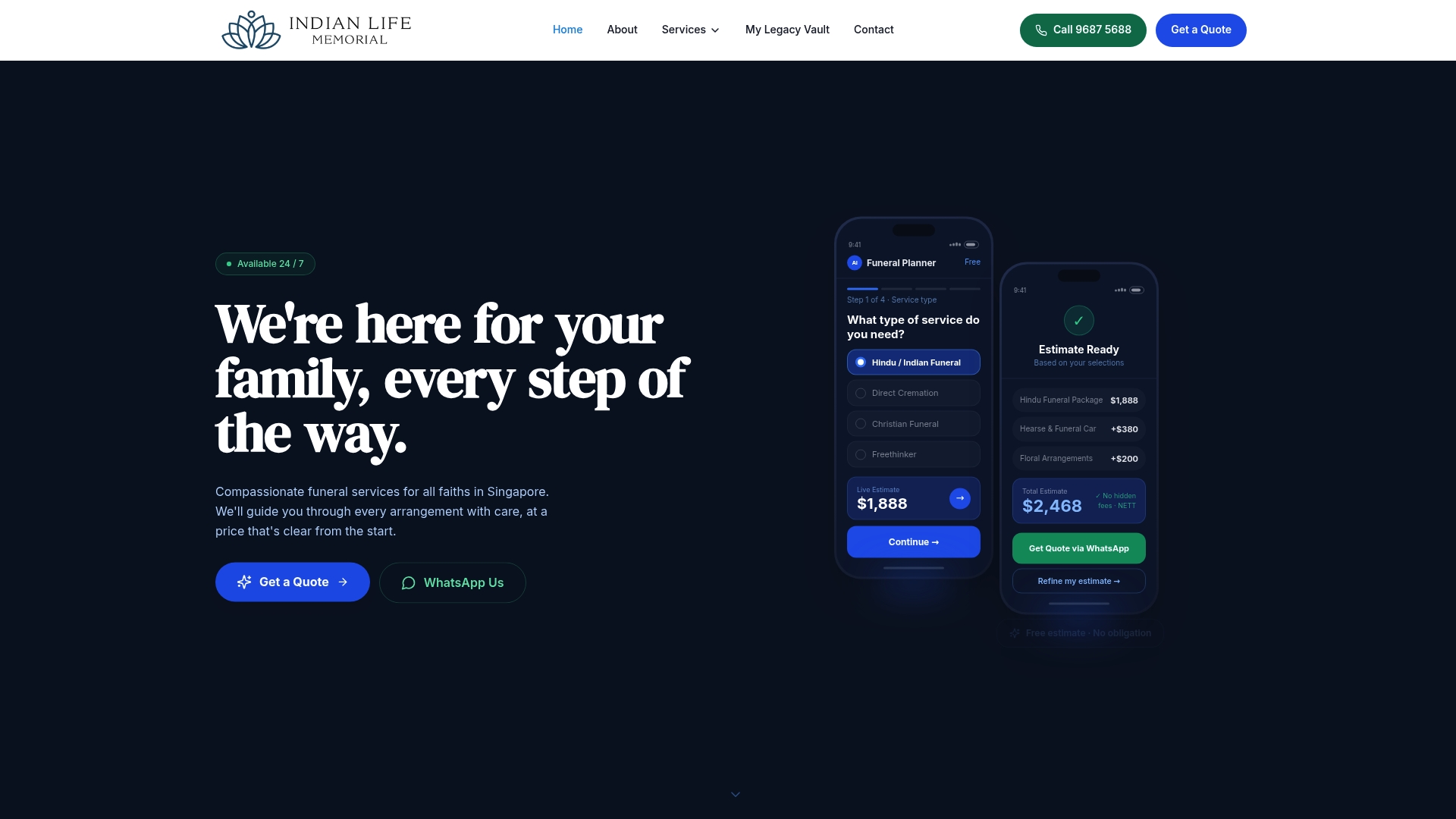
Whether your family follows Hindu, Christian, Roman Catholic, or secular traditions, Indianlifememorial's team brings the cultural knowledge and logistical experience to help you create a service that truly honors your loved one. Their service packages are transparent in pricing, starting from $1,888 with no hidden fees, so your family can focus on what matters most. Reach out to Indianlifememorial to begin planning a service that is organized, meaningful, and deeply personal.
FAQ
How long should a memorial service program be?
Most memorial programs fit on a single page, front and back. Services typically run 45 to 90 minutes, so the program should list each segment clearly without overwhelming guests with text.
What is the difference between a memorial program and an order of service?
They refer to the same document. The order of service is the printed or digital guide that lists each segment of the memorial in sequence, helping guests follow along throughout the service.
Do I need a special license to livestream the memorial service?
Yes. A standard funeral music performance license does not cover internet streaming. A separate webcasting license is required, and without it, platforms may mute copyrighted music during the broadcast.
How do I handle open sharing without awkward silences?
Ask two or three trusted people in advance to speak first during the open sharing segment. Pre-identified speakers create momentum and encourage other guests to participate naturally.
Can a memorial program include multi-faith elements?
Yes. Many families incorporate readings, prayers, or symbols from more than one tradition. Working with an experienced provider who understands diverse faiths helps you blend elements respectfully and thoughtfully.
Recommended
- Indian Life Memorial | Funeral Services Singapore | 24/7 Hindu, Christian, All Faiths
- Indian Life Memorial | Funeral Services Singapore | 24/7 Hindu, Christian, All Faiths
- Indian Life Memorial | Funeral Services Singapore | 24/7 Hindu, Christian, All Faiths
- Indian Life Memorial | Funeral Services Singapore | 24/7 Hindu, Christian, All Faiths