

The single most important step your family can take right now is to choose a cremation package that explicitly names the faith-specific rites it covers, itemizes the National Environment Agency (NEA) cremation fee separately, and confirms urn, columbarium niche, or scattering options before you sign. Singapore's multicultural families deserve more than a generic ceremony. The top culturally sensitive cremation packages in Singapore are built around your tradition, not around a provider's convenience.
Three quick checks you can run on any quote today:
- Is the NEA/Mandai fee itemized? The NEA cremation fee at Mandai Crematorium is set separately for adults and children, commonly cited as a standard mandatory fee not always included in package prices. Many packages advertise a starting price and list this mandatory fee as an excluded extra. If it is not on the quote, ask for it in writing.
- Does the package name the clergy or rite? A package that says "priest available" is not the same as one that names a Pandit for Vedic Antyesti rites or a monk for Buddhist chanting. Specificity is the trust signal.
- Are memorialization options confirmed? Columbarium niche placement, inland garden scattering options with a fixed booking fee, and sea burial near Pulau Semakau each carry different costs, eligibility rules, and booking windows. Confirm which options the package covers before committing.
Indianlifememorial is one provider in Singapore that approaches this with genuine cultural orientation, offering transparent starting prices from S$1,888 and experienced clergy for Hindu and multi-faith families.
Table of Contents
- What package tiers exist, and how do they differ for cultural families?
- What do faith-specific cremation packages typically include?
- What does a cremation package include, and what are the real costs?
- What urn, niche, and memorial options respect your family's cultural needs?
- When your tradition prefers burial: what to weigh before choosing cremation
- How do you pick a cremation package that truly fits your faith?
- How can your family manage costs and plan ahead?
- Why does cultural sensitivity in cremation services matter?
- What are the legal steps and timeline for cremation in Singapore?
- Key Takeaways
- Why cultural fidelity and transparent pricing define good bereavement care
- Authoritative resources and links for booking, rules, and further reading
What package tiers exist, and how do they differ for cultural families?
Not every cremation package is built the same way, and the tier you choose will determine how much of your tradition is honored versus improvised on the day.
Direct (no-wake) cremation is the most affordable tier. Body collection, paperwork, NEA permit handling, and cremation booking are included, but there is no wake, no clergy, and no altar setup. Starting prices in Singapore's private market for direct cremation packages are advertised from just under two thousand dollars, typically excluding the NEA cremation fee. Families who choose direct cremation often hold a separate memorial gathering at home or at a religious venue afterward.
Standard packages add a basic wake setup, transport, a simple casket, and sometimes a chapel or void-deck hire. Some include a clergy stipend; many do not. Cultural sensitivity at this tier depends entirely on whether the provider has named ritual partners.
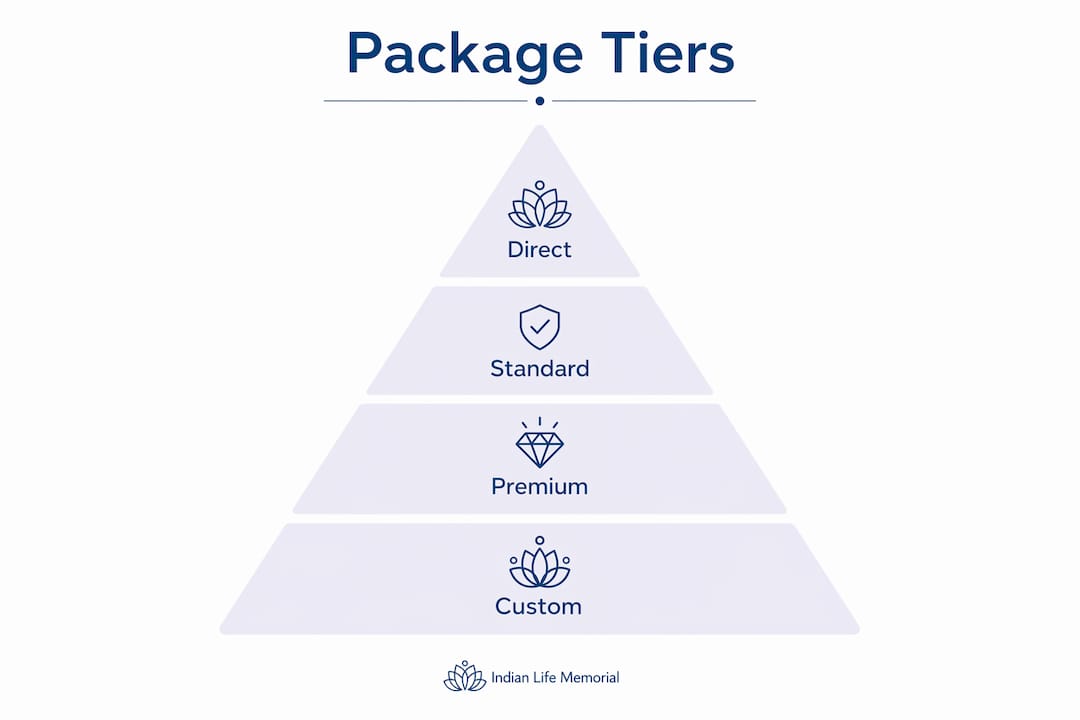
Premium packages extend the wake duration, include bespoke ritual items (incense, altar setup, ceremonial offerings), and guarantee a named clergy member. Bone-collection rituals, specific auspicious timing, and multi-faith accommodations are more reliably handled here.
Custom packages are built around your family's specific needs: cross-faith ceremonies, repatriation, or traditions that fall outside the standard Buddhist/Christian/Hindu categories. Full-suite funeral services at this level commonly cover body collection, casket selection, wake setup, transport, embalming, and complete cremation coordination.
Singapore operates four crematoria: two government-managed (including Mandai Crematorium, booked through NEA) and two private, each with separate fee structures and booking procedures. Private crematoria fees for cremation-only services are substantially higher than the government rate at Mandai.
| Package Tier | Typical Starting Price (SGD) | NEA Fee Included? | Clergy/Rites | Cultural Customization |
|---|---|---|---|---|
| Direct / no-wake | From S$1,888 | Usually excluded | Not included | Minimal |
| Standard | From S$3,000 | Sometimes included | Basic or optional | Moderate |
| Premium | — | Usually included | Named clergy | High |
| Custom / full-suite | Quoted on request | Included | Specialist clergy | Fully tailored |
Price bands reflect typical private market ranges in Singapore. Always confirm NEA fee status in writing.
What do faith-specific cremation packages typically include?
Your tradition shapes every element of the ceremony, from the timing of the cremation to what happens after the ashes are collected. Here is what families should expect, by faith.
Hindu
Hindu cremation follows the Antyesti Samskaras, the sacred last rites that guide the Atman toward its next transition. A culturally appropriate package should include a Pandit (Hindu priest) who leads mantras, a proper altar with ritual items (ghee lamp, flowers, sacred thread), and coordination for the bone-collection ritual if your family observes it. Post-cremation, ash immersion in a river or sea is traditional. Confirm with your provider whether the Pandit is named and whether the package covers immersion logistics. Indianlifememorial's Hindu funeral services are built specifically around Vedic rites and experienced priests.
Pro Tip: Notify your provider at least 48 hours before the cremation if your family intends to perform bone collection at the crematorium. The ritual requires specific timing coordination with the crematorium staff, and not all providers arrange this by default.
Buddhist
Buddhist packages typically include monk chanting during the wake and at the cremation. Bone-collection practices vary by tradition: in some Chinese Buddhist families, family members collect bone fragments from the ash tray in a specific order, a ritual that can be emotionally intense. Practitioners strongly recommend that providers brief families on this process in advance.
Taoist and Chinese-traditional
These ceremonies often require a Taoist priest, paper offerings (paper money, symbolic items), a structured altar layout, and specific timing based on the Chinese almanac. Providers should be able to source ceremonial items and coordinate with the family on auspicious dates.
Christian and Catholic
Christian packages center on pastor-led prayers, scripture readings, and hymns. Catholic families may request a Requiem Mass before or after the cremation. Indianlifememorial offers dedicated Christian funeral services and Roman Catholic services with clergy coordination built in.
Sikh
Sikh funerals follow the Antam Sanskar rites, with prayers from the Guru Granth Sahib and kirtan (devotional singing). Cremation is the traditional practice. Confirm that the provider can source a Granthi (reader) and arrange for the Akhand Path if your family observes it.
Jewish
Traditional Jewish law (Halacha) generally prohibits cremation, though some Reform and secular Jewish families do choose it. If your family is considering cremation, speak with your rabbi first. A culturally sensitive provider should respect this complexity and not pressure a decision.
Muslim
Cremation is not permitted under Islamic law. Muslim families in Singapore arrange burial through the Islamic Religious Council of Singapore (MUIS) and designated Muslim cemeteries. A provider who genuinely understands Singapore's multicultural context will tell you this clearly rather than offer a workaround.
Freethinker and secular
Non-religious families have real options. A secular package can include a celebrant-led tribute, music of the family's choosing, and a personalized memorial without religious rites. Indianlifememorial's freethinker services are designed for families who want a dignified, meaningful ceremony without a specific faith framework.
Cultural sensitivity notes: Always confirm language preferences for the eulogy and printed materials. Some families prefer Mandarin, Tamil, or Malay alongside English. For multi-faith families (e.g., a Hindu father and a Christian mother), ask whether the provider has experience blending rites respectfully, and request a written ceremony outline before the day.
What does a cremation package include, and what are the real costs?
Transparent, itemized pricing is one of the clearest signs of a trustworthy provider. Here is what a complete package should cover and where hidden costs tend to appear.
Standard inclusions to expect
- Body collection and transport to the funeral parlour or void deck
- Basic casket (upgrade options available at extra cost)
- Chapel or void-deck setup for the wake
- Paperwork and NEA permit submission
- Cremation booking (Mandai or private crematorium)
- Clergy fee, if explicitly stated
- Urn (basic model; upgrades usually cost extra)
Common exclusions to watch for
- NEA cremation fee (S$100 adult / S$50 child under 10 at Mandai)
- Columbarium niche allocation fee
- Ash-scattering session fee (S$320 per inland session including GST)
- Additional clergy stipends beyond the package allowance
- Transport outside the provider's standard zone
- Embalming (sometimes listed separately)
- Additional days at the parlour beyond the package duration
| Fee Item | Amount (SGD) | Notes |
|---|---|---|
| NEA cremation fee (adult) | S$100 | Mandai Crematorium; often excluded from package |
| NEA cremation fee (child under 10) | S$50 | Mandai Crematorium |
| Private crematorium fee | — | Cremation-only; varies by facility |
| Direct cremation package (starting) | From S$1,888 | NEA fee typically excluded |
| Inland ash scattering session | S$320 (incl. GST) | NEA-managed sessions |
| Public columbarium niche | From S$500 | NEA-managed |
| Private air-conditioned niche | From S$3,000 | Private multi-faith complexes |
Pro Tip: When comparing quotes from two or three providers, add the NEA fee to every quote that excludes it. A package priced at S$2,500 with the NEA fee excluded is not cheaper than one at S$2,600 with it included.
Lower-tier packages frequently list the NEA cremation fee as "excluded." Families who do not catch this during the quote stage often face an unexpected charge at the crematorium. Transparency about this fee up front is one of the most reliable trust signals when evaluating providers.
What urn, niche, and memorial options respect your family's cultural needs?
After cremation, your family has several paths for honoring your loved one's remains. You do not need to decide immediately: many columbarium and scattering options allow a 30–60 day window after cremation before placement or booking is required.
Memorial options at a glance
- Public columbarium niches (NEA-managed): From S$500. Accessible and affordable, though space is limited and the aesthetic is utilitarian.
- Private air-conditioned niches: From S$3,000 at multi-faith private complexes. Better climate control and more personalized settings.
- Church or temple columbaria: Often S$2,000 and above. Many require proof of membership or long-standing congregant status before permitting interment. Verify eligibility before planning placement.
- Inland garden scattering sessions: S$320 per session including GST, booked through NEA. A peaceful option for families who prefer not to maintain a niche.
- Sea burial near Pulau Semakau: Costs vary by provider. A meaningful choice for families with a connection to the sea or traditions that favor ash immersion.
Choosing the right urn
- Home altar placement: Choose a sealed, durable urn in a material appropriate to your tradition (brass for Hindu families, ceramic for Buddhist or Chinese-traditional).
- Scattering or sea burial: Biodegradable urns or simple containers are practical and environmentally respectful.
- Columbarium niche: Confirm the niche's interior dimensions before purchasing an urn. Some niches have strict size limits.
- Family grouping: Some columbaria allow couples or family members to share a niche. Ask about this option early.
Pro Tip: If you are considering a church or temple columbarium, contact the institution's office before the cremation takes place. Eligibility verification can take time, and some institutions have waiting lists. Discovering an eligibility issue after the cremation adds unnecessary stress.
When your tradition prefers burial: what to weigh before choosing cremation
Singapore's land constraints make burial increasingly difficult to arrange, but that does not mean every family should default to cremation. Understanding where your tradition stands, and what the law requires, helps your family make a decision with clarity.
Faiths that generally prohibit or discourage cremation:
- Muslim: Cremation is not permitted under Islamic law. Burial arrangements in Singapore are coordinated through MUIS and designated Muslim cemeteries.
- Orthodox Jewish: Traditional Halacha prohibits cremation. Families should consult their rabbi and contact the Jewish Welfare Board for burial guidance.
- Some Christian denominations: Most mainstream Christian traditions now accept cremation, but some conservative denominations prefer burial. Confirm with your pastor or priest.
Legal steps and documents required for cremation in Singapore:
- A certified death certificate issued by the Registry of Births and Deaths
- A burial or cremation permit submitted through the NEA ePortal (typically handled by the funeral director)
- Cremation booking confirmation from Mandai Crematorium or the chosen private crematorium
- For foreign nationals, additional documentation may be required
Timing and availability:
- Cremation slots at Mandai and private crematoria fill quickly during cultural peak periods. The Hungry Ghost Festival and major cultural holidays can significantly reduce available slots. If your family is planning during or near these periods, contact a funeral director immediately.
- Standard permit processing is typically completed within one to two working days when documentation is complete.
Respectful compromises when burial is not feasible:
- An extended memorial service before cremation that incorporates traditional burial rites symbolically
- A dedicated memorial space at home or at a religious institution
- Ash immersion or sea burial as a spiritually meaningful alternative to ground burial for some traditions
How do you pick a cremation package that truly fits your faith?
The right package is one where the provider can answer every question below without hesitation. If they cannot, that is your answer.
Selection criteria
- Verified licensing and NEA permit-handling capability
- Named clergy or ritual partners (not just "clergy available on request")
- Transparent, itemized pricing that separates the NEA fee from the package price
- Demonstrated experience with your specific faith or cultural tradition
- Clear urn and columbarium options with eligibility guidance
- Flexibility to accommodate family-specific requests (bone collection, auspicious timing, multi-faith elements)
Questions to ask every provider
- Do you handle Mandai booking and NEA permit submission directly, or does the family need to arrange this?
- Can you provide a written list of every ritual item and service included in this package?
- Is the NEA cremation fee included in the quoted price, or is it billed separately?
- Who is the named clergy member for our tradition, and what are their qualifications?
- Are there additional fees for bone collection, extended wake days, or transport outside your standard zone?
- Which columbarium or scattering options do you work with, and can you confirm eligibility for our family?
- What happens if the cremation slot we need is unavailable due to peak-period demand?
Red flags to watch for
- Vague pricing with no itemized breakdown
- Refusal to name the specific clergy or ritual partner
- A single "multi-faith" ceremony template applied to every tradition without adaptation
- Pressure to decide on a columbarium niche before the family has had time to consider options
- No written confirmation of what is and is not included
A short process checklist when comparing providers
- Collect itemized written quotes from at least two providers.
- Add the NEA fee to any quote that excludes it, so you are comparing true totals.
- Confirm clergy names and ritual item lists in writing.
- Ask each provider to confirm columbarium or scattering eligibility for your family's situation.
- Check availability for your preferred dates, especially during cultural peak periods.
How can your family manage costs and plan ahead?
Pre-planning a culturally appropriate cremation is one of the most considerate things a family can do, both financially and emotionally.
Benefits of pre-planning:
- Locks in package details and clergy availability before a crisis arises
- Allows time to verify columbarium eligibility and niche availability
- Reduces the risk of peak-period surcharges when cremation slots are scarce
- Gives the family space to make decisions about rites and memorialization thoughtfully
Payment and financing:
- Most Singapore funeral providers require a deposit at the time of booking, with the balance due before or at the time of service.
- Some providers offer installment arrangements; ask specifically whether this is available and what the terms are.
- CPF funds are generally not directly applicable to funeral expenses, but life insurance policies or personal savings earmarked for this purpose can be documented in advance.
- Keep copies of all signed agreements, itemized quotes, and payment receipts. These documents protect your family if disputes arise.
Sources of financial assistance and guidance:
- Community religious bodies (temples, churches, mosques, gurdwaras) sometimes maintain welfare funds for members facing financial hardship.
- Social service agencies and community development councils (CDCs) in Singapore may offer bereavement assistance for qualifying families.
- Ask your funeral provider directly whether concessions are available for low-income families or for specific community groups.
For official NEA cremation booking procedures, columbarium allocation rules, and scattering session scheduling, the NEA's Burial, Cremation and Ash Management portal is the authoritative source. Indianlifememorial's full-suite funeral services page and packages overview are practical starting points for families who want transparent, faith-aligned options in one place.
Why does cultural sensitivity in cremation services matter?
Cremation's rise in Singapore is driven in large part by land scarcity and evolving theological views across communities. For families who forego a multi-day wake, the memorialization choices that follow cremation become the emotional centerpiece of the entire farewell. Getting those details right is not a luxury; it is the foundation of genuine closure.
Providers who name their clergy partners and list ritual items in writing are consistently easier for families to evaluate for cultural fit. Vague assurances do not hold up under the pressure of grief. Transparency about NEA and Mandai fees from the first conversation reduces post-quote disputes and signals that a provider respects the family's need for clarity.
Practitioners in Singapore's funeral sector consistently observe that the families who feel most at peace after a cremation are those who were briefed in advance on every step: the ritual sequence, the family's role during bone collection, and exactly what the crematorium experience involves. Proactive conversation between provider and family, before the day of cremation, is what separates a ceremony that honors a life from one that simply processes a death.
The bone-collection ritual in some Buddhist traditions, for example, requires family members to collect fragments from the crematorium ash tray in a specific order. Providers who brief families on this in advance allow them to participate with intention rather than be caught off guard. That kind of preparation is what cultural sensitivity actually looks like in practice.
What are the legal steps and timeline for cremation in Singapore?
Singapore's cremation process follows a clear sequence, though the timeline can shift depending on documentation readiness and crematorium availability.
Typical timeline:
- Day of passing: The funeral director is contacted and body collection is arranged. The death must be certified by a registered medical practitioner.
- Within 24 hours: The death certificate is issued by the Registry of Births and Deaths. The funeral director submits the burial or cremation permit application through the NEA ePortal.
- Days 1–3: Wake setup (if applicable), clergy coordination, and cremation slot booking at Mandai or a private crematorium.
- Day 3–5 (typical): Cremation takes place. Bone collection occurs on the same day for families who observe this rite.
- 30–60 days after cremation: Families decide on niche placement, scattering, or sea burial. This window gives families time to confirm eligibility and book sessions without pressure.
Key documents required:
- Certified death certificate
- Burial or cremation permit (NEA ePortal submission)
- Identification documents for the next of kin
- For foreign nationals: passport and relevant immigration documents
State variation is not applicable in Singapore's centralized system, but crematorium availability does vary. Private crematoria may have shorter waiting times during peak periods when Mandai slots are fully booked. Your funeral director should advise on the fastest available option given your family's timeline and cultural requirements.
Key Takeaways
Choosing a culturally sensitive cremation package in Singapore means verifying faith-specific rites, itemized NEA fees, named clergy, and confirmed memorialization options before signing any agreement.
| Point | Details |
|---|---|
| Verify the NEA fee | The Mandai cremation fee is S$100 for adults and S$50 for children under 10; confirm whether it is included or excluded in your quote. |
| Confirm clergy and rites in writing | A named Pandit, monk, pastor, or celebrant listed in the contract is a stronger guarantee than a verbal assurance. |
| Check columbarium eligibility early | Church and temple columbaria often require proof of membership; verify before the cremation takes place. |
| Watch for hidden fees | Casket upgrades, additional wake days, bone-collection coordination, and scattering sessions are common extras not always listed upfront. |
| Pre-plan to avoid peak-period gaps | Cremation slots fill quickly during the Hungry Ghost Festival and cultural holidays; pre-planning locks in availability and clergy. |
Why cultural fidelity and transparent pricing define good bereavement care
The families who reach out to Indianlifememorial are not simply looking for a service provider. They are looking for someone who understands that a Hindu Antyesti, a Buddhist bone-collection ritual, or a Christian Requiem Mass is not interchangeable with a generic ceremony. The difference between a package that names the rites and one that gestures toward them is the difference between a farewell that honors a life and one that merely marks it.
What strikes me most, having studied Singapore's funeral sector closely, is how often families discover hidden costs and vague clergy arrangements only after they have signed. The providers who earn lasting trust are the ones who put every item in writing from the first conversation: the NEA fee, the clergy's name, the ritual items, the columbarium options. Indianlifememorial's approach, with transparent starting prices from S$1,888 and experienced priests for Vedic and multi-faith rites, reflects exactly this standard.
Cultural sensitivity is not a premium add-on. It is the baseline that every family deserves.
Authoritative resources and links for booking, rules, and further reading
- NEA Burial, Cremation and Ash Management portal: The official source for Mandai Crematorium booking, cremation permit applications, public columbarium niche allocation, and inland scattering session scheduling. All fees and eligibility rules are published here.
- Indianlifememorial full-suite funeral services: A complete overview of end-to-end culturally sensitive packages for Hindu, Christian, Buddhist, and multi-faith families in Singapore, with transparent pricing and clergy coordination.
- Indianlifememorial packages page: Compare tiered offerings, request a quote, and confirm what is included for your family's tradition.
- Indianlifememorial Hindu funeral guide: Practical guidance on Vedic rites, Pandit coordination, and what to prepare for an Antyesti ceremony in Singapore.
- Indianlifememorial blog: A resource for deeper reading on Singaporean condolence culture, wake etiquette, and faith-specific funeral planning.
- MUIS (Islamic Religious Council of Singapore): The authoritative body for Muslim burial arrangements in Singapore, including cemetery allocation and religious guidance.
- Jewish Welfare Board Singapore: Guidance for Jewish families navigating burial or memorial arrangements in Singapore's context.
Recommended
- Indian Life Memorial | Funeral Services Singapore | 24/7 Hindu, Christian, All Faiths
- Indian Life Memorial | Funeral Services Singapore | 24/7 Hindu, Christian, All Faiths
- Indian Life Memorial | Funeral Services Singapore | 24/7 Hindu, Christian, All Faiths
- Indian Life Memorial | Funeral Services Singapore | 24/7 Hindu, Christian, All Faiths