
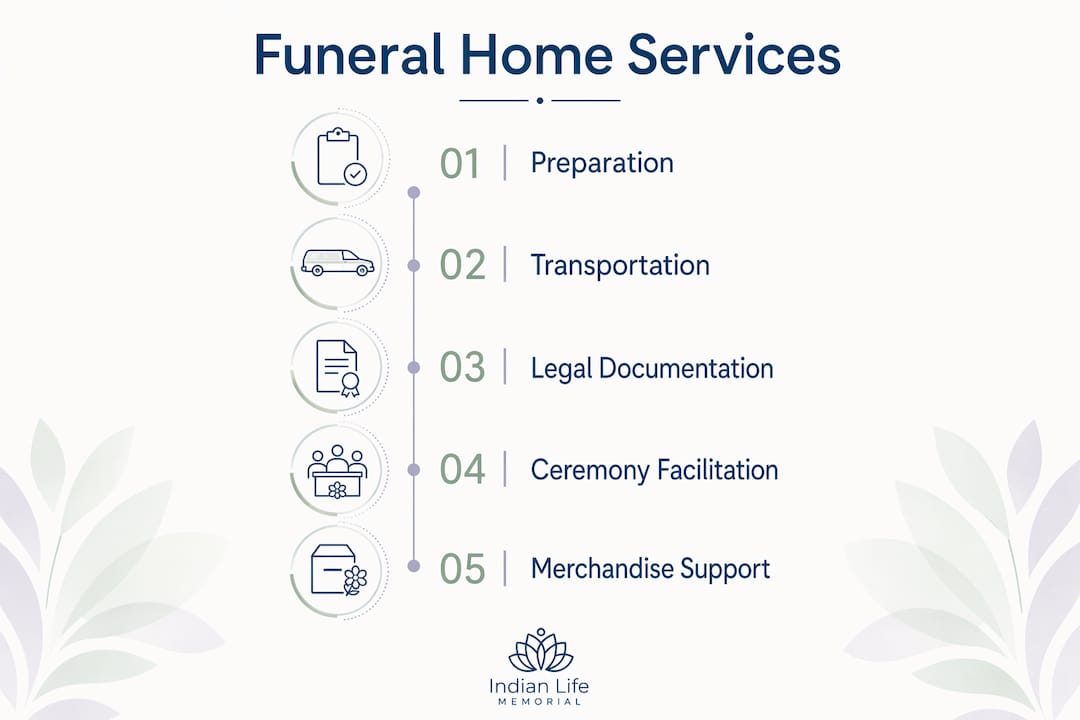
A funeral home provides professional coordination of a deceased person's disposition, legal documentation, memorial ceremonies, and merchandise, all governed by federal consumer protection rules. Families who understand what funeral home services include can make informed decisions during one of the most difficult times of their lives. The services offered by funeral homes span everything from filing death certificates to arranging culturally specific ceremonies. Knowing what to expect from a funeral home before you need one removes uncertainty and helps your family focus on honoring your loved one with dignity and care.
What does a funeral home provide for families?
A funeral home delivers three core categories of assistance: professional coordination of remains, legal document management, and ceremony facilitation. These services are not a single bundled package. Under the FTC Funeral Rule, funeral homes must offer itemized pricing so families can select exactly the services they need.
The types of funeral services available fall into two broad groups: mandatory and optional. The only charge you cannot decline is the basic services fee, which covers core coordination tasks such as securing permits, sheltering remains, filing notices, and coordinating with cemeteries or crematories. Every other service is optional and priced separately.
Here is a clear breakdown of what most funeral homes offer:
- Preparation of remains: Embalming, refrigeration, cosmetic restoration, and dressing
- Transportation: Hearse transfer from the place of death, limousines for family members, and transfer vehicles for out-of-state arrangements
- Ceremony services: Funeral services, memorial services, graveside ceremonies, and committal services
- Viewing and visitation: Use of facilities and staff for wakes, viewings, and receiving hours
- Merchandise: Caskets, urns, outer burial containers, and memorial keepsakes
- Documentation: Death certificate filing, cremation authorization, burial and transit permits
Common funeral goods and services such as embalming, transportation, and ceremony facilitation are defined categories under the Funeral Rule's General Price List. This means every licensed funeral home in the United States must present these categories with clear pricing on request.
Pro Tip: Ask for the General Price List before you commit to any funeral home. You are legally entitled to receive it in person or over the phone, and comparing two or three providers using this list can save your family hundreds or thousands of dollars.

How funeral homes manage legal documents and permits
Funeral homes handle or coordinate all critical legal paperwork required before disposition can proceed. Death certificates and cremation authorizations are required by law, and neither burial nor cremation can legally begin without them. This coordination is one of the most valuable services a funeral director provides, because errors or delays in documentation directly delay the entire process.
The division of responsibility works as follows:
- The physician or medical certifier completes the cause of death section of the death certificate
- The funeral director compiles all personal details, files the certificate with the appropriate government office, and obtains certified copies
- The family provides personal identifying information such as the deceased's full legal name, date of birth, Social Security number, and occupation
- The funeral home then secures the burial permit, cremation permit, or transit permit depending on the chosen disposition method
Errors in death certificate details from any of these three parties create delays that require formal amendments, which slow the entire disposition timeline. This is why accuracy at the initial arrangement meeting matters so much.
For cremation specifically, a separate cremation authorization form must be signed by the legally authorized next of kin. The funeral home manages this document and confirms authorization before proceeding. Families who are organized and bring personal records to the arrangement meeting help the funeral director file accurately and quickly.
Pro Tip: Bring a copy of the deceased's birth certificate, passport, or national identification card to your first meeting with the funeral director. Having accurate legal details on hand prevents the most common source of documentation delays.
Understanding the funeral home's coordination role in legal paperwork greatly reduces family stress and keeps the process compliant with state requirements. You do not need to navigate government offices alone. Your funeral director handles that on your behalf.
What families should know about funeral home pricing and the FTC Funeral Rule
The Federal Trade Commission's Funeral Rule is the primary consumer protection law governing funeral home pricing in the United States. It mandates that every funeral home provide a written, itemized General Price List covering all service categories, the basic services fee, and all merchandise offered. This rule exists specifically to prevent families from being surprised by costs during a vulnerable time.
Families often assume funeral pricing works like a hotel package, where one price covers everything. The Funeral Rule ensures the opposite. Itemized pricing and transparency are required so families can select only the goods and services they actually want.
Here is what the General Price List must include:
- The non-declinable basic services fee
- Embalming and other body preparation fees
- Use of facilities for viewings, ceremonies, and memorial services
- Transportation charges (hearse, transfer vehicle, limousine)
- Casket and outer burial container price lists (provided separately)
- Cremation and disposition fees
Beyond the funeral home's own charges, you will also see cash advance items on your final statement. These are pass-through costs the funeral home pays on your behalf to third parties.
| Fee Type | What It Covers | Who Charges It |
|---|---|---|
| Basic services fee | Core coordination, permits, staff overhead | Funeral home (non-declinable) |
| Preparation fees | Embalming, refrigeration, dressing | Funeral home (optional) |
| Ceremony facility fee | Use of chapel or parlor for services | Funeral home (optional) |
| Cash advance items | Cemetery fees, clergy honoraria, death certificate copies | Third parties, passed through |
| Merchandise fees | Caskets, urns, burial containers | Funeral home or third-party supplier |
Cash advance fees for third parties such as clergy honoraria, cemetery fees, and certified death certificate copies must be disclosed separately from the funeral home's own charges. Mixing these two categories is a common source of confusion when families review their final invoice.
Comparing funeral providers requires reviewing the GPL and itemized statement line by line, not just comparing total quotes. A lower total quote may exclude services that another provider includes, making the true cost higher once you add them back.
How funeral homes facilitate visitation, ceremonies, and memorials
Funeral homes provide dedicated spaces and trained staff to host the full range of memorial events your family may need. These services go beyond logistics. They create a structured, respectful environment where grief can be expressed and a life can be honored with intention.
The ceremony and hospitality services most funeral homes offer include:
- Chapels and parlors: Private rooms for viewings, wakes, and funeral services, accommodating small family gatherings or larger community services
- Graveside ceremony coordination: Staff and equipment to facilitate committal services at the cemetery
- Religious and cultural accommodations: Space and scheduling for priests, pastors, imams, pandits, or other officiants to conduct rites according to your faith tradition
- Multimedia tributes: Photo slideshows, video tributes, and music programs that personalize the service
- Floral arrangements: Coordination of floral tributes as part of the memorial setting
- Guest reception support: Seating, refreshments, and reception area setup for post-service gatherings
- Transportation coordination: Hearse procession and limousine service for family members traveling to the cemetery or crematorium
The funeral parlour and ceremony space your family chooses shapes the tone of the entire service. A well-staffed facility with culturally sensitive staff makes a meaningful difference, particularly for families observing specific religious rites such as Hindu Antyesti ceremonies, Christian committal prayers, or other faith-based traditions.
These services matter beyond the practical. Research in grief counseling consistently shows that structured memorial rituals support bereavement recovery. The funeral home's role in creating that structure is not ceremonial. It is genuinely therapeutic for the people left behind.
Key takeaways
A funeral home provides legally mandated, itemized services covering coordination, documentation, ceremony, and merchandise, and families have the right to select only what they need.
| Point | Details |
|---|---|
| Core services are itemized | Funeral homes must provide a General Price List covering all service and merchandise categories. |
| Basic services fee is non-declinable | This fee covers core coordination, permits, and overhead and cannot be waived under the FTC Funeral Rule. |
| Document coordination is handled by the funeral home | Funeral directors file death certificates, secure permits, and manage cremation authorizations on the family's behalf. |
| Cash advance items are third-party costs | Cemetery fees, clergy honoraria, and death certificate copies are pass-through charges, not funeral home profits. |
| Cultural and religious services are available | Funeral homes can accommodate faith-specific rites, from Hindu Antyesti to Christian committal prayers, with appropriate staff and spaces. |
Why understanding funeral home services matters more than most families realize
Most families I have worked with arrive at the arrangement meeting overwhelmed, not because the process is inherently complicated, but because no one explained it to them beforehand. The single most useful thing I can tell you is this: the basic services fee is not a hidden charge. It is the foundation of everything the funeral home does on your behalf, from the moment they receive your loved one to the moment disposition is complete. Treating it as suspicious or negotiable misunderstands what it actually covers.
The second thing families consistently overlook is the difference between funeral home charges and cash advance items. When you see a line on your invoice for cemetery opening fees or a clergy honorarium, that money does not stay with the funeral home. It goes directly to the third party. Knowing this prevents unnecessary friction during an already difficult conversation.
My strongest advice is to request the General Price List from at least two providers before making a decision. Do not compare totals. Compare line items. A provider quoting $3,500 all-in may be excluding embalming, transportation, and the ceremony facility fee that another provider includes at $4,200. The second quote may actually be the better value once you account for what is genuinely included.
For families with specific cultural or religious needs, the choice of funeral home is even more consequential. A provider unfamiliar with Vedic rites, for example, cannot properly support a Hindu Antyesti ceremony. Asking directly about the funeral home's experience with your tradition is not an unreasonable request. It is a necessary one.
— Admin
How Indianlifememorial supports your family through every step
When your family needs guidance, Indianlifememorial is available 24 hours a day, 7 days a week, for families of all faiths in Singapore. Their full suite funeral services cover every element discussed in this article: professional coordination, legal documentation, ceremony facilitation, and merchandise, all presented with transparent, itemized pricing starting at $1,888 with no hidden fees.

Indianlifememorial specializes in Hindu and Indian funerals, with experienced Pandits who perform authentic Vedic rites and Samskaras with devotion and care. Their team also serves Christian, freethinker, and multi-faith families with the same compassion. You can review their funeral packages online to understand exactly what each option includes before your first conversation with their team.
FAQ
What services does a funeral home typically provide?
A funeral home provides body preparation, transportation, legal documentation, ceremony facilitation, and merchandise such as caskets and urns. The FTC Funeral Rule requires all these categories to be itemized and priced transparently on a General Price List.
What is the basic services fee at a funeral home?
The basic services fee is the only non-declinable charge under the FTC Funeral Rule, covering core coordination tasks including permit procurement, remains sheltering, and cemetery or crematory coordination.
Does a funeral home handle the death certificate?
Yes. The funeral director compiles personal details, coordinates with the certifying physician, and files the death certificate with the appropriate government office. The family provides identifying information, and the funeral home manages the filing and permit process.
What are cash advance items on a funeral invoice?
Cash advance items are third-party pass-through costs such as cemetery fees, clergy honoraria, and certified death certificate copies. These must be disclosed separately from the funeral home's own charges on your itemized statement.
How do I choose the right funeral home for my family?
Request the General Price List from at least two providers and compare services line by line rather than by total quote. For families with specific religious or cultural needs, confirm the funeral home's direct experience with your tradition before making a commitment.