

A funeral quote estimate is a detailed, itemized pricing statement that funeral providers give families to clarify the costs of selected goods and services before any final arrangements are made. This document is built from the General Price List (GPL), which the Federal Trade Commission's Funeral Rule requires every funeral home to maintain and present before arrangements begin. Understanding this estimate gives your family the clarity to make informed, budget-conscious decisions during one of the most emotionally demanding times you will face. Indianlifememorial believes that transparent pricing is not a courtesy. It is a right every family deserves.
What is a funeral quote estimate and what does it include?
A funeral quote estimate is a preliminary, itemized price document reflecting the specific goods and services a family selects, drawn directly from the funeral home's GPL. The FTC Funeral Rule mandates that providers supply accurate pricing by phone and a written itemized statement before any payment is made. This legal requirement exists to prevent "mystery pricing" and to give families the power to choose only what they genuinely need.
A complete funeral quote typically contains several distinct categories of charges:
- Basic services fee: The non-declinable charge covering funeral home overhead, staff coordination, and administrative work. This fee averages $2,495 and appears on every estimate regardless of the services chosen.
- Preparation charges: Fees for embalming, refrigeration, or other body preparation. Embalming is not legally required in most situations, and the GPL must state this clearly.
- Facilities and staff fees: Charges for use of the funeral home chapel, visitation rooms, and staff time during viewings or funeral ceremonies.
- Transportation costs: Includes the hearse, transfer vehicle for moving the deceased from the place of death, and any additional transport required.
- Merchandise: Caskets, burial vaults, urns, and outer burial containers. A metal casket averages $2,500, a burial vault averages $1,695, and a cremation urn averages $295.
- Cash advance items: Third-party costs paid by the funeral home on your behalf. These include death certificates and permits, clergy honoraria, cemetery fees, and obituary notices. Providers must distinguish these from their own direct charges.
- Alternative container pricing: For families choosing cremation, the GPL must list the price of an unfinished wood box or alternative container as a lower-cost option.
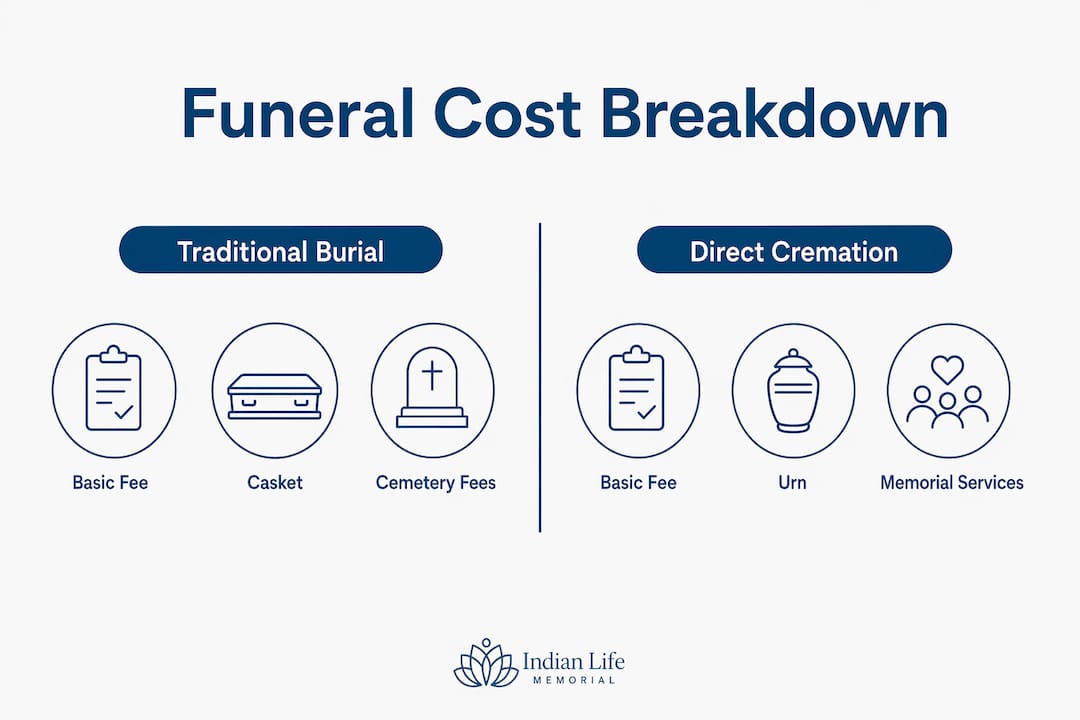
The table below shows how these categories compare between a traditional burial and a direct cremation arrangement:
| Cost Category | Traditional Burial | Direct Cremation |
|---|---|---|
| Basic services fee | ~$2,495 | ~$2,495 |
| Body preparation | Embalming (~$775) | Refrigeration only |
| Casket | ~$2,500 | Not required |
| Burial vault | ~$1,695 | Not required |
| Urn | Not required | ~$295 |
| Transportation | Hearse + transfer | Transfer only |
| Cash advance items | Cemetery, permits, clergy | Permits, crematory fee |
Understanding each line item prevents the shock of a total that seems unexpectedly high. Every charge on the estimate has a source, and you have the right to remove optional items.
How to interpret and compare funeral cost estimates effectively
Comparing funeral cost estimates across providers is only meaningful when you compare identical selections. Accurate quote comparison requires matching the same categories: basic services, transportation, embalming, casket or urn, memorial facilities, and cash advance items. A lower total from one funeral home may simply reflect fewer services included, not a genuinely better price.

Start by requesting the GPL from each provider you are considering. The GPL is the foundation of every estimate, and the FTC requires funeral homes to give it to anyone who asks, in person or by phone. Once you have two or three GPLs side by side, build a comparison using the same service selections across all of them.
Pro Tip: Ask each funeral home to prepare a written estimate for the exact same package of services. This removes ambiguity and gives you a true apples-to-apples comparison.
Watch for these common pitfalls when reviewing estimates:
- Mandatory versus optional fees: The basic services fee is non-declinable. Embalming, upgraded caskets, and additional viewing sessions are optional. Know which is which before you agree to anything.
- Cash advance estimates: These are good-faith estimates for third-party costs the funeral home does not control. The final amount may differ slightly. Ask the provider to flag which cash advance items are estimates versus confirmed costs.
- Bundled packages: Some funeral homes offer packages that appear economical but include services you do not need. Request an itemized breakdown of any package before accepting it.
- Total price without itemization: A single total figure tells you nothing about where the money goes. Always request the full line-item statement, not just a summary.
Families who ask detailed questions early in the process consistently avoid the most common source of financial stress: unexpected charges discovered after arrangements are finalized. The GPL requirement exists precisely to prevent this, so use it fully.
What are typical funeral cost ranges and what affects them?
Funeral costs vary significantly based on service type, merchandise choices, and geography. The median funeral cost with burial and viewing was $8,300 in 2023, while a funeral with cremation averaged $6,280. These figures represent a national median, meaning actual costs in your area may be higher or lower depending on local market conditions.
Direct cremation commonly costs roughly $2,200 and excludes memorial services, making it the lowest-cost option available. This significant difference reflects the absence of embalming, a casket, a hearse, and facility fees for a formal viewing. Families who choose direct cremation can still hold a separate memorial service at a location of their choosing, which keeps costs flexible.
The factors that most influence your funeral cost estimate include:
Service type. A traditional funeral with burial involves the most line items and the highest total. A graveside service with no formal viewing reduces facility and staff fees. A memorial service held after cremation can be as simple or as elaborate as your family chooses.
Merchandise selections. The casket is often the single largest variable cost in a burial estimate. Prices range from under $1,000 for a basic model to over $10,000 for premium options. Funeral homes are required to offer a range of price points, and you may also purchase a casket from a third-party retailer.
Geography and cemetery fees. Cemetery costs, including grave opening and closing fees, grave liners, and perpetual care charges, are cash advance items not controlled by the funeral home. These vary widely by location and are not included in the funeral home's direct charges.
Inflation and future planning. Funeral costs have risen steadily over the past decade. Families who pre-plan arrangements lock in current pricing, which protects against future increases. Online funeral cost calculators from providers like Progressive and Choice Mutual offer useful ballpark figures for planning purposes, though they should not replace a formal GPL-based estimate.
Practical steps to request and use a funeral quote estimate
Obtaining a clear, usable funeral cost estimate requires a few deliberate steps. Following this process protects your family from confusion and gives you the information needed to make confident decisions.
- Request the GPL immediately. Contact each funeral home you are considering and ask for their General Price List. You are legally entitled to receive it without making any commitment. If a provider hesitates, that is a warning sign.
- Define your service preferences first. Before requesting estimates, decide on the basic parameters: burial or cremation, formal viewing or not, religious or secular ceremony. This gives you a consistent baseline for comparison.
- Ask for a written itemized estimate. Once you have shared your preferences, ask the funeral home to prepare a written estimate listing every charge. Verbal quotes are not sufficient for comparison or budgeting.
- Separate direct charges from cash advance items. Review the estimate carefully and identify which costs the funeral home controls and which are third-party estimates. Ask for confirmation on any cash advance item that seems unusually high.
- Confirm everything in writing before signing. The FTC Funeral Rule requires a written statement of goods and services selected before payment. Do not authorize any charges without this document in hand.
- Know your right to decline optional services. The GPL must disclose your right to select only the items you want. You cannot be required to purchase a package that includes services you do not need.
- Seek guidance if needed. Organizations like the Funeral Consumers Alliance provide free consumer education on reading GPLs and understanding estimates. If you feel uncertain, a funeral advisor or consumer advocate can review estimates with you before you commit.
Keeping all quotes, GPLs, and written estimates organized in a single folder, physical or digital, makes it easier to compare providers and refer back to agreed terms if questions arise later.
Key takeaways
A funeral quote estimate is only useful when it is itemized, GPL-based, and compared across providers using identical service selections.
| Point | Details |
|---|---|
| GPL is the foundation | Every funeral estimate must be drawn from the General Price List, which the FTC requires all providers to maintain and share. |
| Itemization prevents surprises | Request a full line-item breakdown, not a package total, to understand exactly what each charge covers. |
| Median costs vary by service type | Burial with viewing averages $8,300; direct cremation averages $2,200, reflecting the absence of major service elements. |
| Cash advance items are estimates | Third-party fees like cemetery costs and permits are good-faith estimates and may differ from the final amount. |
| Comparison requires identical selections | Matching the same categories across providers is the only way to make a meaningful price comparison. |
Why transparency in funeral pricing matters more than most families realize
Having worked alongside grieving families for years, I have seen one pattern repeat itself more than any other: families who did not ask for an itemized estimate early in the process end up paying for services they never wanted. Not because funeral homes are dishonest, but because grief makes it genuinely hard to ask questions. When someone you love has just passed, the instinct is to say yes to everything that sounds respectful or appropriate.
The GPL and the itemized estimate exist specifically to interrupt that dynamic. They give you a moment of clarity in a time of emotional weight. What I have found is that families who request the GPL within the first conversation with a funeral home feel measurably more in control of the process. They ask better questions. They make choices that reflect their values and their budget, rather than defaulting to the most expensive option out of uncertainty.
The uncomfortable truth about funeral pricing is that the total cost of a funeral is rarely determined by one large decision. It is determined by dozens of small ones, each with a price attached. A second viewing session. An upgraded urn. A memorial folder. None of these are wrong choices. But they should be your choices, made with full knowledge of the cost. That is what a well-prepared funeral cost estimate makes possible.
My advice to any family beginning this process: get the GPL first, build your estimate from it, and do not feel pressured to finalize anything before you have compared at least two providers. Honoring your loved one does not require spending beyond your means. It requires making thoughtful, informed decisions, and the estimate is the tool that makes that possible.
— Admin
How Indianlifememorial supports your family with clear, honest pricing
Indianlifememorial was built on the belief that every family deserves to understand exactly what they are paying for, without confusion or hidden fees. From the first conversation, the team provides a transparent, itemized breakdown of all services so your family can plan with confidence.

Whether your family is considering a direct cremation service or a full-suite funeral with Vedic rites and experienced priests, Indianlifememorial presents pricing clearly, starting at $1,888 with no hidden fees. You can also review all available funeral packages to find the option that best honors your loved one within your family's means. The team is available 24/7 to answer questions, walk you through the estimate, and provide the compassionate guidance your family needs at every step.
FAQ
What is a funeral quote estimate?
A funeral quote estimate is an itemized pricing document prepared by a funeral home, reflecting the costs of selected goods and services based on the provider's General Price List. The FTC Funeral Rule requires this to be provided in writing before any arrangements are finalized.
What is the average cost of a funeral?
The median funeral cost with burial and viewing was $8,300 in 2023, while a funeral with cremation averaged $6,280. Direct cremation, the lowest-cost option, commonly costs around $2,200.
Can I decline services listed on a funeral estimate?
Yes. The GPL must disclose your right to select only the items you want, and funeral homes cannot require you to purchase bundled packages that include services you do not need.
What are cash advance items on a funeral estimate?
Cash advance items are third-party costs, such as cemetery fees, death certificates, and clergy honoraria, that the funeral home pays on your behalf. These are good-faith estimates and may differ slightly from the final amount.
How do I compare funeral estimates from different providers?
Request the GPL from each provider and ask for a written estimate based on identical service selections. Comparing the same categories, including basic fees, transportation, preparation, and merchandise, is the only way to make a meaningful price comparison.
Recommended
- Indian Life Memorial | Funeral Services Singapore | 24/7 Hindu, Christian, All Faiths
- Indian Life Memorial | Funeral Services Singapore | 24/7 Hindu, Christian, All Faiths
- Indian Life Memorial | Funeral Services Singapore | 24/7 Hindu, Christian, All Faiths
- Indian Life Memorial | Funeral Services Singapore | 24/7 Hindu, Christian, All Faiths