

An advance medical directive (AMD) is a legal document that lets any Singapore adult aged 21 or older refuse extraordinary life-sustaining treatment if they become terminally ill, are unconscious, and cannot communicate. The Advance Medical Directive Act 1996 gives this document its legal force. To get started: download Form 1 from the Ministry of Health (MOH) website, arrange for a doctor and one other independent adult to witness your signature at the same sitting, then send the original in a sealed envelope to the Registrar of Advance Medical Directives at MOH. Registration is free.
Key Takeaways
An AMD is a narrow legal refusal of extraordinary life-sustaining treatment, valid only at end of life, and it must be registered with MOH to be enforceable.
| Point | Details |
|---|---|
| AMD scope is narrow | Applies only when you are terminally ill, death is imminent, and you cannot communicate. |
| Eligibility requirements | You must be at least 21 years old and of sound mind when you sign Form 1. |
| Witness rules are strict | Two witnesses must be present at the same sitting: one doctor, one independent adult aged 21 or older. |
| No government fee | MOH registers AMDs at no charge; incidental clinic consultation fees vary by provider. |
| Plan AMD with LPA and ACP | AMD alone leaves most future health decisions uncovered; use all three documents for complete planning. |
| Indianlifememorial's role | Offers guided pre-planning consultations and My Legacy Vault setup alongside culturally sensitive funeral services. |
Table of Contents
- What an advance medical directive in Singapore actually covers
- Who is eligible to make an AMD
- When does an AMD actually take effect?
- How to make and register your AMD: step by step
- How to change, update, or revoke an AMD
- How hospitals and doctors handle AMDs, including objections
- How AMD differs from ACP, LPA, and DNR orders
- Where to get forms, help, and official contact points
- Your practical checklist before making an AMD
- Why AMD is legally narrow, and why that matters for your planning
- Why clear end-of-life documents honor your family and your traditions
- Guided end-of-life planning with Indianlifememorial
- Authoritative sources and official forms
What an advance medical directive in Singapore actually covers
An AMD is narrow by design. It applies only when three conditions are simultaneously true: you have a terminal illness, death is imminent and inevitable, and you are unconscious or otherwise unable to communicate your wishes. Outside those three conditions, the document has no legal effect at all.
What the AMD authorizes is a refusal of extraordinary life-sustaining treatment. Think of measures such as mechanical ventilation, cardiopulmonary resuscitation, or artificial nutrition when the sole purpose is to delay an inevitable death. The Advance Medical Directive Act 1996 is explicit that the AMD does not authorize euthanasia or assisted suicide. It also does not stop palliative care. Comfort measures, pain relief, and symptom management continue regardless of whether an AMD is in place.
A practical illustration helps here. If you are on a ventilator following a terminal cancer diagnosis, are unconscious, and your treating team has certified that death is imminent, a registered AMD instructs them not to continue extraordinary measures. Routine nursing care, hydration for comfort, and pain medication are unaffected.
Key legal limits at a glance:
- AMD applies only in terminal illness with imminent death and loss of capacity to communicate.
- It does not permit euthanasia or abetment of suicide.
- Palliative and comfort care continues regardless.
- The document has no effect during temporary unconsciousness or recoverable illness.
Who is eligible to make an AMD
Eligibility under the Advance Medical Directive Act 1996 is straightforward but non-negotiable.
- You must be an adult aged at least 21 years at the time of signing.
- You must be of sound mind, meaning you understand the nature and consequences of the directive you are making.
- You must not be suffering from a mental disorder that impairs your ability to make this decision.
- You must sign voluntarily, free from coercion or undue influence.
If any of these conditions is absent at the moment of signing, the AMD is invalid. The witnessing doctor plays a key role here: part of their duty is to attest that you have the mental capacity to make the directive. This is not a formality. A doctor who has doubts about your capacity should decline to witness until capacity is established.
When does an AMD actually take effect?
An AMD does not spring into action the moment it is registered. It sits dormant until a specific clinical situation arises.
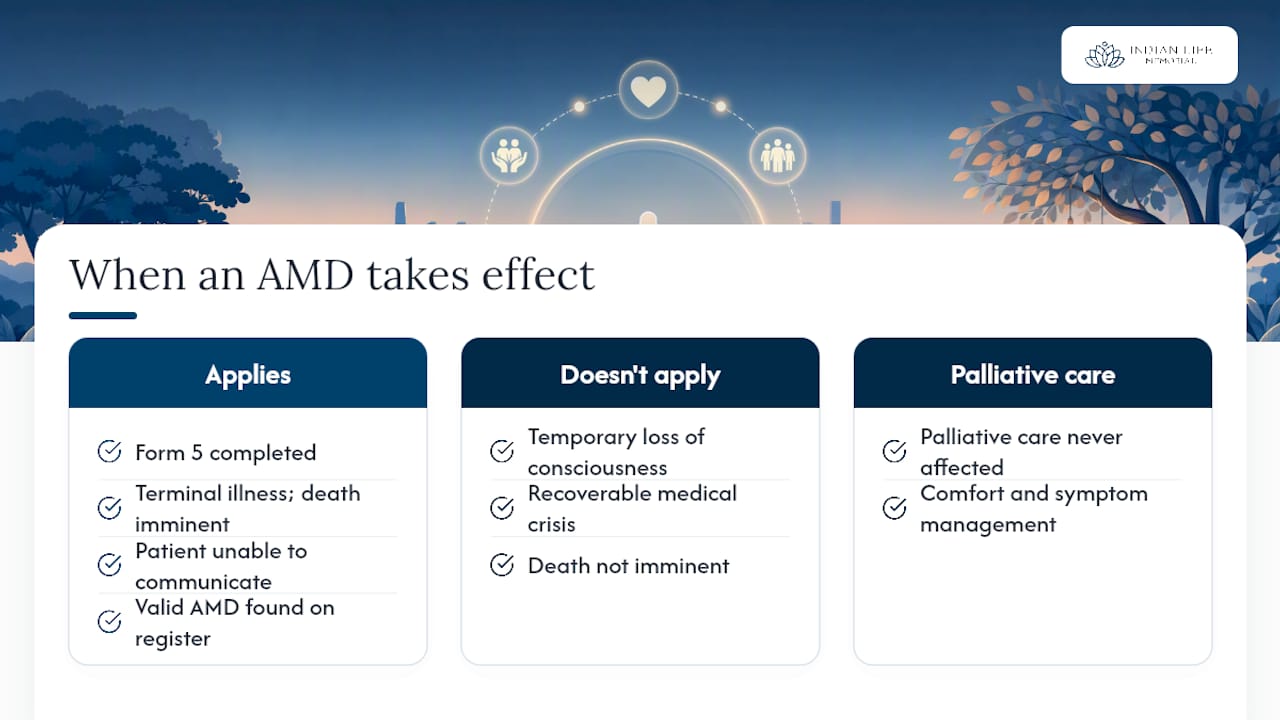
The trigger is a formal certification process. When your treating medical practitioner believes you are terminally ill and that death is imminent, and you are no longer able to communicate, they complete Form 5, which is the Certification of Terminal Illness and Request for Search. This form prompts a search of the AMD register. If a valid AMD is found in your name, the treating team is then legally authorized to withhold or withdraw the extraordinary life-sustaining treatment you refused.
This means that a temporary loss of consciousness, a recoverable medical crisis, or any situation where death is not imminent falls entirely outside the AMD's reach. The directive is irrelevant in those circumstances, and your treating team will proceed with standard care.
Palliative care is never affected. The Act is clear: an AMD does not alter the obligation to provide comfort and symptom management.
How to make and register your AMD: step by step
The process is more straightforward than many people expect. Follow these steps carefully, because errors in witness procedure are the most common reason an AMD is later found invalid.
- Download or collect Form 1. The form is available on the MOH website, at polyclinics, restructured hospitals, and many GP clinics across Singapore.
- Read the form carefully before your appointment. You must understand what you are signing. The witnessing doctor will confirm this.
- Arrange two witnesses to be present at the same sitting. Both must be physically present when you sign. One must be a registered medical practitioner. The second must be at least 21 years old and must have no vested interest in your death (no financial benefit, no inheritance stake).
- Sign Form 1 in the presence of both witnesses simultaneously. All three signatures must occur at the same sitting. Signing separately or at different times is invalid.
- Place the original signed form in a sealed envelope addressed to the Registrar of Advance Medical Directives, Ministry of Health, Singapore.
- Send by hand or by mail. Faxed copies are not accepted.
- Wait for your acknowledgment letter. Once the Registrar processes your AMD, you will receive written confirmation that it has been registered.
Where to get the form: MOH's AMD page, any public hospital, most polyclinics, and many GP clinics.
Costs: MOH charges no registration fee. However, you may pay a consultation fee to the doctor who witnesses your form. One GP clinic publicly mentions charging a fee for this service, although fees vary by provider. Budget for a standard consultation charge when you book your appointment.
Who to tell after registration:
- Your next-of-kin and close family members
- Your regular GP or specialist
- Any Donee appointed under a Lasting Power of Attorney (LPA)
- Your ACP Nominated Healthcare Spokesperson, if you have one
Pro Tip: Keep a photocopy of your signed Form 1 in a safe place at home and tell at least one trusted family member where it is. The AMD register is searchable by clinicians, but your family knowing it exists can prevent confusion in a crisis.
How to change, update, or revoke an AMD
Your wishes may change over time. The AMD system allows for revocation at any point while you still have mental capacity.
- To revoke: Complete Form 3 (Notice of Revocation) in the presence of at least one witness, then send it to the Registrar. Alternatively, you may revoke by a signed letter witnessed by at least one person.
- To update: There is no amendment process. Revoke the existing AMD using Form 3, then submit a fresh Form 1 with new witnesses.
- After revocation: The Registrar will send an acknowledgment confirming the AMD has been removed from the register. Inform your GP, family members, and any LPA Donee that the previous AMD is no longer valid.
Acting promptly after revocation matters. If a treating team searches the register before your revocation is processed, the old AMD may still appear. Send your revocation as soon as your decision is made, and follow up to confirm the acknowledgment has arrived.
How hospitals and doctors handle AMDs, including objections
When a clinical team suspects a patient is terminal and lacks capacity, a formal workflow begins.
- Search: The treating practitioner completes Form 5 and requests a search of the AMD register.
- Certify: The terminal illness and imminent death are certified by the medical practitioner.
- Act: If a valid AMD is found, the team withholds or withdraws the extraordinary life-sustaining treatment specified.
Clinicians who follow a valid AMD in good faith are legally protected under the Advance Medical Directive Act 1996. They cannot be held criminally or civilly liable for acting on a properly registered directive.
If a treating practitioner has a conscientious objection to acting on an AMD, they are not forced to do so. However, they must register that objection using the prescribed form (Form 10) with the Registrar. Once an objection is registered, the responsibility transfers to another clinician who is willing to act on the directive. This safeguard protects both the patient's rights and the clinician's conscience.
MOH guidance also reminds the public: no doctor should ask for money or bank details in connection with AMD witnessing. If you encounter such a request, report it to MOH.
How AMD differs from ACP, LPA, and DNR orders
These four documents are often confused, yet each serves a distinct purpose. Knowing which one you need, and when, prevents gaps in your end-of-life planning.
| Document | Legal status | Scope | When it takes effect |
|---|---|---|---|
| AMD | Legally binding | Narrow: refusal of extraordinary life-sustaining treatment at end of life | Terminal illness, imminent death, loss of capacity |
| LPA | Legally binding | Broad: personal welfare and/or property and financial decisions | Upon certified loss of mental capacity |
| ACP | Non-legal (guidance document) | Broad: values, preferences, Nominated Healthcare Spokesperson | Guides clinicians and family at any point |
| DNR | Clinical instruction | Specific: no cardiopulmonary resuscitation | As clinically indicated, per treating team |
Practical guidance:
- Use an AMD to legally refuse extraordinary measures at the very end of life.
- Use an LPA, registered with the Office of the Public Guardian (OPG), to appoint a trusted Donee who can make welfare or financial decisions if you lose capacity at any stage, not just at end of life.
- Use an ACP, prepared through myACP on the MyLegacy platform, to document your broader values, preferences, and to nominate a Healthcare Spokesperson who can speak for you.
- A DNR is a clinical order issued by a doctor, not a personal legal document. It addresses resuscitation only and does not cover the wider range of life-sustaining treatments an AMD addresses.
Best practice, as recommended by practitioners and the Singapore Medical Association, is to have all three personal documents: AMD, LPA, and ACP. Together they cover the full spectrum of future medical decision-making.
Where to get forms, help, and official contact points
Official forms and registration:
- MOH AMD page: The primary source for Form 1, Form 3, Form 5, and Form 10 downloads, plus the Registrar's mailing address.
- Registrar of Advance Medical Directives: Ministry of Health, College of Medicine Building, 16 College Road, Singapore 169854. Send originals by hand or post.
- Public hospitals and polyclinics: Staff can provide printed forms and direct you to a doctor who can witness your AMD.
Supportive services:
- myACP / MyLegacy: The Singapore government's platform for preparing and storing an Advance Care Plan. Registered ACPs can be shared with your Nominated Healthcare Spokesperson.
- Office of the Public Guardian (OPG): Manages LPA registration and provides guidance on appointing Donees. Accessible through the MyLegacy platform.
- ACP facilitators: Trained facilitators at selected hospitals and community care organizations can guide you through the ACP process and answer questions about how AMD, ACP, and LPA work together.
- Your regular GP: Often the most accessible starting point. Your GP can witness your AMD, discuss your medical situation, and refer you to ACP facilitators if needed.
Pro Tip: When you visit a clinic to have your AMD witnessed, bring your NRIC, a completed draft of Form 1, and a list of questions for your doctor. A single appointment can cover AMD witnessing and an initial ACP conversation, saving you a separate trip.
Your practical checklist before making an AMD
Preparation before your clinic appointment makes the process smooth and reduces the chance of errors.
- Confirm you are at least 21 years old and currently of sound mind.
- Download and read Form 1 from the MOH website before your appointment.
- Choose your doctor witness: your regular GP is often the most practical choice.
- Identify a second witness who is 21 or older and has no financial interest in your estate.
- Discuss your wishes with your family or next-of-kin before signing, so they understand and can support your decision.
- Consider whether you also want to prepare an LPA and an ACP at the same time.
- Bring your NRIC and any photocopies you want to keep for your own records.
- After registration, store your acknowledgment letter safely and tell your GP and a trusted family member that your AMD is on the register.
Pro Tip: Booking a single planning session to handle your AMD, LPA, and Will together, with your doctor and a lawyer present or consulted in sequence, is the most time-efficient approach. The Office of the Public Guardian and many law firms in Singapore offer combined consultations for exactly this purpose.
Why AMD is legally narrow, and why that matters for your planning
This is the point that practitioners, the Singapore Medical Association, and clinical ethicists consistently emphasize. An AMD is not a general healthcare proxy. It does not appoint anyone to speak for you. It does not document your values or preferences for non-terminal situations. It does one thing: it legally refuses extraordinary life-sustaining treatment when you are dying and cannot speak.
The practical implication is clear. AMD + ACP + LPA together form a legally and practically complete plan. Each document fills a gap the others leave open. Treating them as interchangeable, or assuming one is enough, is the most common planning mistake Singapore adults make.
Why clear end-of-life documents honor your family and your traditions
At Indianlifememorial, we work with families at their most vulnerable moments, and we see firsthand how much clarity matters. When an AMD, ACP, and LPA are in place, families spend less time navigating uncertainty and more time honoring the person they have lost. For Hindu and Indian families in Singapore, where Vedic rites and Antyesti ceremonies carry deep spiritual significance, knowing that your loved one's wishes were respected, and that the soul's transition was honored without procedural confusion, brings genuine comfort.

End-of-life document planning is an act of love. It protects your family from having to make impossible decisions under grief. Understanding what happens after death in Singapore can help you see how AMD registration connects to the practical steps your family will take.
Guided end-of-life planning with Indianlifememorial
Advertorial: the following section describes services offered by Indianlifememorial.
When documents and arrangements are handled together, families face far less stress at the hardest moment. Indianlifememorial offers guided funeral pre-planning services that go beyond the ceremony itself. Our team helps you organize your My Legacy Vault, walks you through the documents your family will need, and coordinates culturally sensitive funeral arrangements for Hindu, Indian, and multi-faith families across Singapore, with transparent pricing starting at $1,888 and no hidden fees.
Whether you are pre-planning for yourself or helping an elderly parent get their affairs in order, our advisors are available 24/7. Speak to our team today about combining AMD document organization with a full funeral pre-planning consultation so your family has everything they need, clearly documented and compassionately arranged.
Authoritative sources and official forms
All forms and official guidance are available directly from Singapore government sources.
- Form 1 — (AMD application): MOH AMD page, public hospitals, polyclinics, and many GP clinics.
- Advance Medical Directive Act 1996: — Full statutory text available on Singapore Statutes Online (SSO), maintained by the Attorney-General's Chambers.
- myACP / MyLegacy: — Singapore government platform for Advance Care Planning and LPA information.
- Office of the Public Guardian (OPG): — LPA registration and Donee guidance, accessible via the MyLegacy platform.
This article is general information, not a substitute for advice from a qualified doctor. Consult a qualified healthcare professional about your own circumstances before acting on anything here.