
The mortuary transfer process in Singapore is defined as the legally governed movement of human remains from a hospital mortuary or overseas location to a funeral home, crematorium, or burial site. The National Environment Agency (NEA) requires specific permits for every transfer involving cremation or burial. Singapore's death registration process is fully digital, meaning funeral directors and crematoriums legally accept death certificates sent by email or WhatsApp, removing the need for printed documents. Compliance with the Coroners Act 2010 is mandatory when investigations are triggered. Knowing these requirements before you need them protects your family from delays, unexpected fees, and unnecessary distress.
What permits and documents are required for mortuary transfer in Singapore?
The NEA issues all permits required to transfer remains for cremation or burial. No customs permit or GST payment applies when human remains enter Singapore, which simplifies the import process considerably for families repatriating a loved one from abroad.
The core documents your family or funeral director must prepare include:
- Permit to Bury or Cremate: Issued by the NEA; required before any cremation or burial can proceed.
- Death certificate: Fully digital in Singapore; digital acceptance by funeral directors removes the need for physical prints.
- Authorization letter: Required when a funeral director applies for permits on behalf of the next of kin.
- Identification documents: The next of kin must provide valid ID alongside any authorization.
For overseas transfers, the document list expands significantly. Families must obtain an embalming certificate, a sealing certificate confirming the casket is properly sealed, and an export permit from the country of origin. The NEA ePortal handles permit applications for both local and overseas cases.
| Document | Purpose | Who Obtains It |
|---|---|---|
| Permit to Bury or Cremate | Legal authorization for final disposition | NEA (via funeral director or family) |
| Digital death certificate | Proof of death for all administrative steps | Attending doctor, registered digitally |
| Coffin Import Permit | Required for remains entering Singapore | NEA ePortal application |
| Embalming certificate | Confirms preservation for overseas transfer | Foreign licensed embalmer |
| Sealing certificate | Confirms casket integrity for transport | Foreign funeral authority |
| Authorization letter | Allows funeral director to act for next of kin | Next of kin |
Pro Tip: Apply for the Permit to Bury or Cremate as soon as the death certificate is issued. Delays in permit approval are the single most common cause of extended hospital storage fees.
How do hospital mortuaries in Singapore manage body transfer?
Hospital mortuaries in Singapore follow a defined sequence from death certification to body release. The attending doctor certifies death online, which triggers registration and starts the administrative clock for your family.
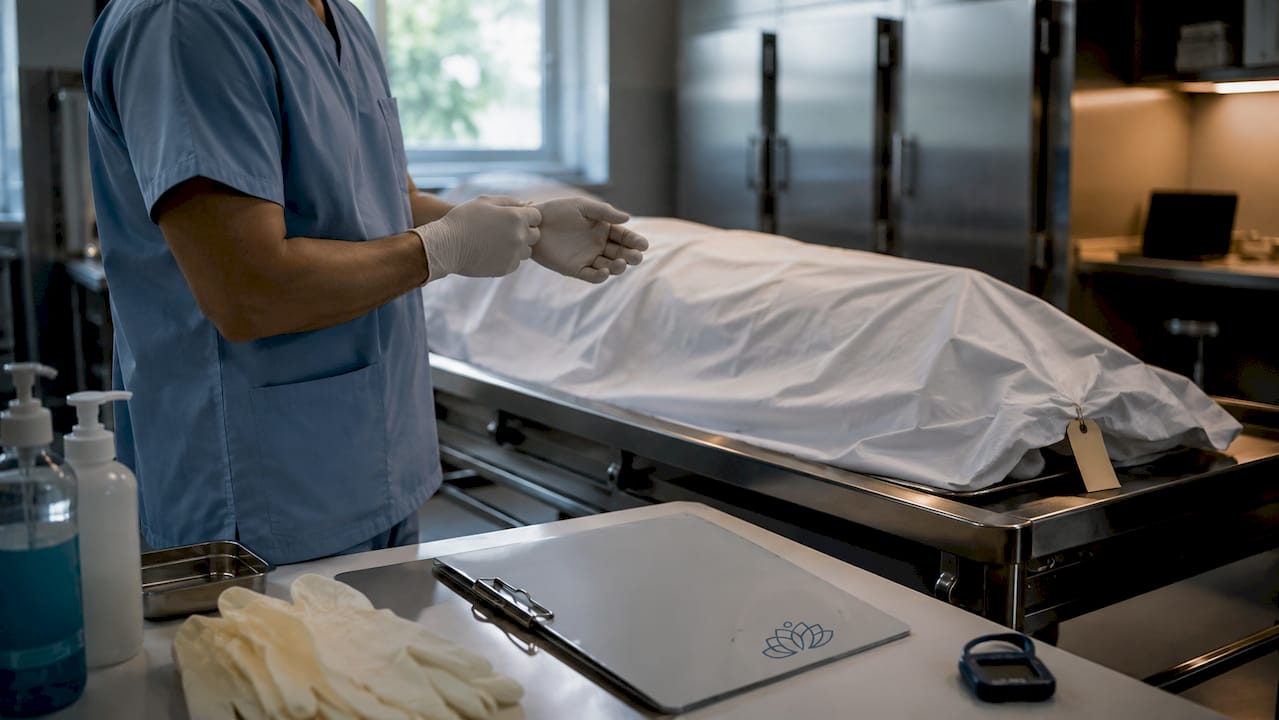
Hospitals typically store remains for 1–3 days before storage fees begin to apply. Ward staff notify families, usually within 30–60 minutes after death, that the body is ready for release. Acting quickly on that notification prevents avoidable costs.
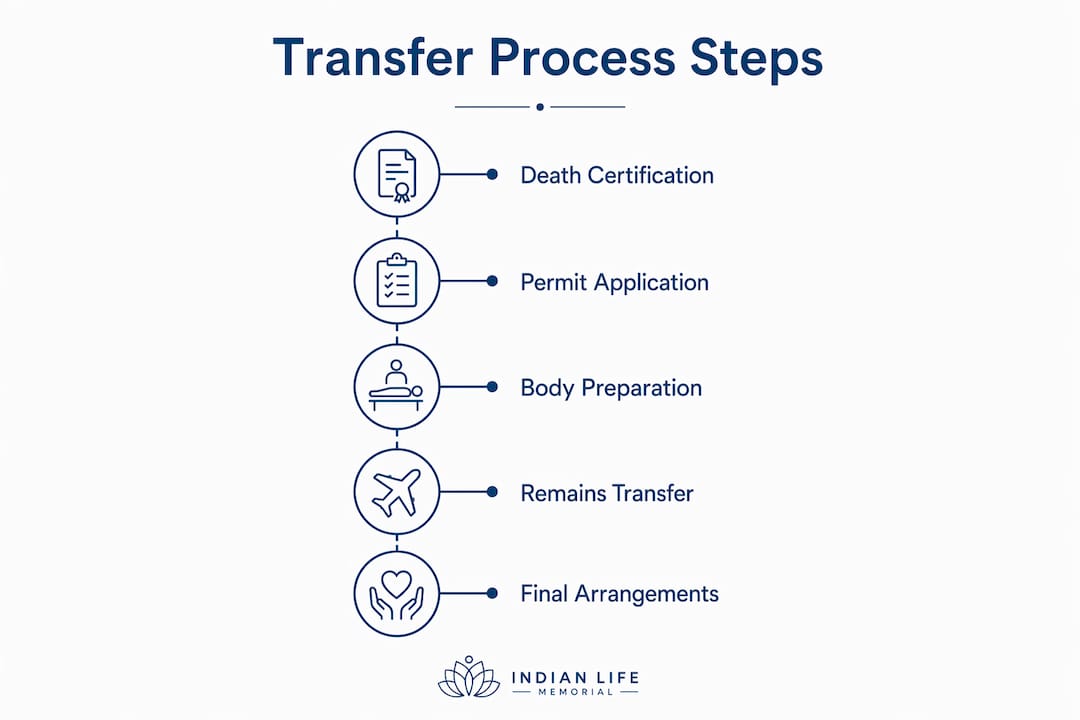
The Coroners Act 2010 places strict restrictions on body movement when an investigation is required. Under this law, the body must not be moved in a way that violates statutory procedures, as the condition of the remains is vital evidence. Families dealing with a coroner's inquiry should engage a funeral director immediately to understand what is and is not permitted during that period.
The standard sequence in a Singapore public hospital runs as follows:
- Attending doctor certifies death and registers it digitally.
- Ward staff inform the family and confirm the body is in the mortuary.
- Family contacts a licensed funeral director to arrange collection.
- Funeral director coordinates transport from the hospital mortuary to the funeral venue or crematorium.
- Permits are verified before the body leaves hospital grounds.
Pro Tip: Ask the ward staff for the exact timestamp of death certification. That timestamp determines when the 1–3 day storage window begins, so you can plan collection without incurring fees.
For families navigating coroner involvement after an unexpected death, the timeline may extend beyond the standard window. Budget for potential additional storage costs and keep your funeral director informed at every stage.
How do you transfer remains from overseas to Singapore?
Repatriating remains to Singapore involves two parallel tracks: completing legal formalities in the country where death occurred, and satisfying Singapore's import requirements. Both tracks must be completed before the body can enter Singapore.
Follow these steps in order:
- Register the death locally. File a death report with the foreign country's civil registration authority and obtain an official foreign death certificate.
- Notify the Singapore Embassy or High Commission. The embassy can assist with documentation and advise on country-specific requirements.
- Arrange embalming and casket sealing. A licensed embalmer in the country of origin must prepare the remains. Obtain both the embalming certificate and the sealing certificate.
- Apply for the Coffin Import Permit and Permit to Bury or Cremate via the NEA ePortal. Funeral directors handle these applications on behalf of the next of kin with a signed authorization letter.
- Arrange air freight and airport clearance. The funeral director coordinates with the airline and Singapore Customs for clearance on arrival. No GST or customs duty applies to human remains.
- Collect remains at Changi Airport. The funeral director receives the remains and transports them to the funeral venue or crematorium.
| Step | Location | Responsible Party |
|---|---|---|
| Death registration | Country of origin | Family or local funeral agent |
| Embassy notification | Country of origin | Family |
| Embalming and sealing | Country of origin | Licensed embalmer |
| NEA permit applications | Singapore (online) | Funeral director with authorization |
| Airport clearance | Changi Airport | Funeral director |
| Final transport | Singapore | Funeral director |
Pro Tip: Prepare a signed authorization letter before contacting the NEA. Without it, permit applications by your funeral director cannot proceed, adding days to an already difficult process.
Families dealing with a foreign national's death in Singapore face a related but distinct set of procedures. A dedicated guide on foreign national deaths in Singapore covers those specifics in full.
Common challenges in the mortuary transfer process and how to avoid them
Document delays are the leading cause of extended hospital storage fees. Families often delay the process by assuming they need printed death certificates or by waiting for physical documents that are no longer required.
The most frequent pitfalls include:
- Unnecessary printing of death certificates. Singapore's system is fully digital. Sending the certificate by email or WhatsApp to your funeral director is legally sufficient.
- Late authorization letters. Funeral directors cannot apply for permits without a signed authorization from the next of kin. Prepare this document on the day of death.
- Ignoring the storage window. Public hospitals apply fees after the 1–3 day window. Confirm the exact start date with ward staff and plan collection accordingly.
- Underestimating overseas timelines. Cross-border repatriation typically takes several days longer than a local transfer. Build buffer time into your planning.
- Choosing an inexperienced funeral director. Not all funeral directors handle overseas repatriation or coroner cases regularly. Verify experience before engaging.
Compliance with the Coroners Act 2010 is not optional. Families who move or disturb remains during an active investigation risk legal consequences and may compromise the inquiry. Engage a funeral director who understands these restrictions from the outset.
Digital processes for death registration have significantly reduced administrative burdens compared to paper-based systems. Families who understand this avoid the most common source of delay. Knowing what to do when someone dies in Singapore gives your family a clear starting point before grief makes clear thinking harder.
Key Takeaways
The mortuary transfer process in Singapore requires NEA permits, digital death certification, and timely coordination with a licensed funeral director to avoid storage fees and legal complications.
| Point | Details |
|---|---|
| NEA permits are mandatory | Apply for the Permit to Bury or Cremate immediately after death certification to avoid delays. |
| Digital certificates are legally valid | Send the death certificate by email or WhatsApp; physical prints are not required. |
| Hospital storage window is 1–3 days | Confirm the start date with ward staff and arrange collection before fees apply. |
| Overseas transfers need extra documents | Embalming certificates, sealing certificates, and a Coffin Import Permit are all required. |
| Authorization letters unlock permit applications | Sign and provide this document on the day of death so your funeral director can act immediately. |
What I've learned about mortuary transfers that most families find out too late
Most families arrive at the mortuary transfer process with two assumptions: that paperwork will take days, and that they need to be physically present for every step. Both assumptions cost time and money.
The shift to digital death registration has changed everything. A funeral director who knows the system can begin permit applications within hours of death, not days. The families I have seen struggle most are those who waited for a printed death certificate before contacting anyone. By the time the document arrived, the storage window had already started eating into their budget.
The Coroners Act 2010 is the other area where families are caught off guard. When a coroner's inquiry is opened, the body cannot be moved freely. Families sometimes push back against this restriction out of grief and urgency. The law exists to protect both the integrity of the investigation and, ultimately, the family's right to answers. Respecting it is the right call, even when it is painful.
My honest view is that the single best decision a family can make is to engage an experienced funeral director before they think they need one. Not after the hospital calls. Not after the permits are delayed. The families who do this spend less, grieve with fewer interruptions, and feel more in control of a process that can otherwise feel completely out of their hands.
— Admin
How Indianlifememorial supports families through every transfer step
Indianlifememorial provides 24/7 funeral home services in Singapore for all faiths, with transparent pricing starting at $1,888 and no hidden fees.
Their licensed funeral directors manage the full scope of the body transfer process, from NEA permit applications and hospital mortuary coordination to overseas repatriation and airport clearance. Families receive clear guidance at every stage, so nothing is left to chance. Indianlifememorial's full-suite funeral services cover every step from death certification through final disposition, with culturally sensitive options for Hindu, Christian, and all-faith families. View the complete range of funeral service packages to find the right fit for your family's needs and budget.
FAQ
What is the mortuary transfer process in Singapore?
The mortuary transfer process is the legally regulated movement of human remains from a hospital mortuary or overseas location to a crematorium or burial site in Singapore. It requires NEA permits and compliance with hospital protocols and, where applicable, the Coroners Act 2010.
How long does a hospital mortuary hold a body in Singapore?
Public hospitals store remains for 1–3 days before storage fees apply. Ward staff notify families within approximately 30–60 minutes of death certification, so prompt action keeps costs down.
Do I need a printed death certificate for mortuary transfer in Singapore?
No. Singapore's death registration is fully digital, and funeral directors and crematoriums legally accept death certificates sent by email or WhatsApp. Printing is not required.
What documents are needed to transfer remains from overseas to Singapore?
Families need a foreign death certificate, embalming certificate, sealing certificate, Coffin Import Permit, and Permit to Bury or Cremate. Funeral directors apply for Singapore permits on behalf of the next of kin with a signed authorization letter.
When does the Coroners Act apply to a mortuary transfer?
The Coroners Act 2010 applies when the cause of death is unclear or suspicious. During an active inquiry, the body must not be moved outside statutory procedures. Families should engage a funeral director experienced in coroner cases to navigate this period correctly.