

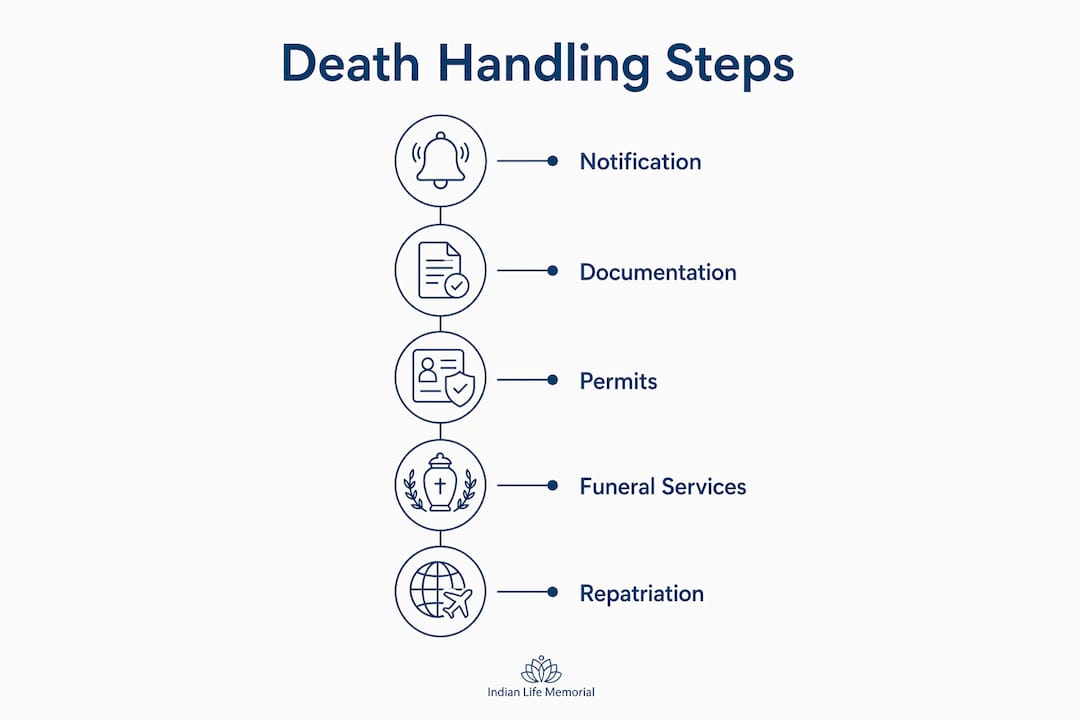
Handling a foreign national death in Singapore follows a defined legal framework that begins within hours of the passing. Death must be registered with ICA within 24 hours, permits for cremation or burial must be obtained through the National Environment Agency (NEA), and funeral directors play a central coordinating role across every step. Whether you are a family member, an employer, or a funeral coordinator, understanding this process removes uncertainty during one of the hardest moments your family will face.
How is a foreign national death handled in Singapore?
Death registration in Singapore is the first mandatory step, and the timeline is strict. The Immigration and Checkpoints Authority (ICA) requires all deaths registered within 24 hours of the passing. Medical practitioners complete this registration online, which triggers an automatic digital death certificate.
The process works as follows:
- Medical practitioner certifies the death online. This happens at the hospital or clinic where the death is confirmed.
- ICA issues a digital death certificate automatically. No manual application is needed at this stage.
- The family downloads the certificate via My Legacy. This must happen within 30 days of issuance.
- If the 30-day window is missed, a paid official extract is required. This adds both cost and delay to an already difficult process.
- Supporting documents must be ready. These include the deceased's passport, identification documents, and the medical confirmation of death.
For foreign nationals specifically, the passport serves as the primary identification document. Families should also prepare a copy of the deceased's work pass or visa if applicable, as this may be requested during registration.
Pro Tip: Download the digital death certificate from My Legacy as soon as it becomes available. Missing the 30-day window means applying for a paid official extract, which creates avoidable administrative delays for your family.
What are the funeral and body disposal options for foreigners in Singapore?
Singapore's land constraints make cremation the most practical option for foreign nationals. The NEA manages all permits related to body disposal, and only funeral directors are authorized to submit applications for cremation, burial, and import or export permits.
Key facts about disposal options:
- Cremation is the standard recommendation. Singapore's limited cemetery space means burial is heavily restricted for non-residents.
- Burial is only permitted under specific conditions. A foreign national may be buried only if their immediate next-of-kin are Singapore Citizens or Permanent Residents.
- A Coffin (Import) Permit is required if the body is being brought into Singapore from overseas for funeral rites.
- Foreigners cannot purchase niches in government columbaria. Only private columbarium niches are available to foreign nationals who wish to have ashes interred in Singapore.
- Permit to Cremate or Bury must be applied for through a licensed funeral director before any disposal can proceed.
The funeral director's role here is not optional. They manage the permit applications, coordinate with NEA, and handle the documentation chain that makes legal disposal possible. Attempting to manage this independently is not permitted under Singapore regulations.
Pro Tip: Engage a funeral director experienced in foreign national cases before making any arrangements. They know which permits apply to your situation and can prevent costly errors in the application process.
What responsibilities do employers have when a foreign worker dies in Singapore?
Employers carry significant legal obligations when a foreign worker dies on their watch. Singapore's Ministry of Manpower (MOM) requires immediate notification upon an employee's death. Failing to comply triggers financial and legal consequences.

| Employer Obligation | Details |
|---|---|
| Notify MOM promptly | Required immediately upon the worker's death |
| Security bond compliance | $5,000 bond per non-Malaysian worker; breach leads to forfeiture |
| WICA death benefit | SGD 76,000 to SGD 261,000 payable to dependants |
| Work permit cancellation | Must be completed as part of post-death procedures |
Under the Work Injury Compensation Act (WICA), death benefits range from SGD 76,000 to SGD 261,000 and are paid directly to the worker's dependants. This figure reflects the severity of the loss and provides a structured financial safety net.
Common misconceptions employers and families hold:
- Insurance covers everything. Compulsory foreign worker insurance does not always cover repatriation or funeral costs. Families must verify repatriation riders in the policy before assuming coverage.
- The security bond is automatically released. The bond is only released after the work permit is cancelled, the worker has departed or been repatriated, and all MOM conditions are met.
- Repatriation is the employer's automatic responsibility. While employers have obligations, the specific scope depends on the employment contract and insurance policy terms.
Employers should review their foreign worker insurance policies carefully and confirm whether repatriation and funeral expenses are included as riders. Many families discover gaps in coverage only after costs have been incurred.
How is repatriation of a foreign national's remains handled from Singapore?
Repatriation is the process of returning a deceased foreign national's remains to their home country. It requires coordination across multiple authorities and is best managed by an experienced funeral director. The repatriation process from Singapore involves the following steps:
- Register the death with both Singapore and the deceased's home country authorities. The Singapore death certificate must be obtained first.
- Contact the deceased's embassy or consulate in Singapore. The embassy issues repatriation documents, including a letter of no objection and any country-specific requirements.
- Apply for an export permit through the funeral director. Only licensed funeral directors can submit Coffin (Import/Export) Permit applications to NEA.
- Prepare the airway bill and customs documentation. Airlines require specific documentation before accepting human remains as cargo.
- Coordinate with the receiving country's funeral home. The home country's funeral director must be ready to receive and process the remains upon arrival.
Timing matters significantly. Some countries require embalming before transport. Others have specific container or sealing requirements. Customs clearance at the destination can also add days to the process if documentation is incomplete. An experienced funeral director anticipates these requirements and prepares the paperwork in advance, preventing delays that add grief to an already painful situation.
The cost of repatriation varies based on destination, airline, and documentation complexity. Families should request a full cost breakdown from their funeral director before committing to any arrangement.
Key Takeaways
Handling a foreign national death in Singapore requires strict compliance with ICA registration deadlines, NEA permit processes, and MOM employer obligations, with funeral directors serving as the essential coordinators throughout.
| Point | Details |
|---|---|
| Register death within 24 hours | ICA requires registration immediately; the digital certificate must be downloaded within 30 days. |
| Cremation is the practical default | Burial is restricted for foreigners without citizen or PR next-of-kin; private columbaria are the only ashes option. |
| Employers have legal obligations | MOM notification, security bond compliance, and WICA benefit processing are all mandatory after a worker's death. |
| Insurance gaps are common | Foreign worker insurance often excludes repatriation and funeral costs; verify policy riders before assuming coverage. |
| Funeral directors are legally required | Only licensed funeral directors can submit NEA permit applications for cremation, burial, or body transport. |
What I've learned from watching families navigate this process
Most families arrive at this process with two assumptions that turn out to be wrong. The first is that the employer's insurance will cover everything. The second is that the government process is straightforward enough to manage without professional help.
The insurance gap is the more painful discovery. Families learn after the fact that the policy covered hospitalization but not the flight home. Verifying the policy before a crisis happens is the only way to avoid that shock. Employers should treat this as a routine compliance check, not an afterthought.
The permit process is genuinely complex. Singapore's regulations are well-structured, but they require a licensed funeral director at every permit stage. Families who try to manage this independently quickly find that NEA will not accept applications from private individuals. Engaging a funeral director early, ideally within the first few hours, prevents the kind of procedural backlog that turns a two-day process into a week-long ordeal.
The digital death certificate window is also underestimated. Thirty days sounds like plenty of time. Grief does not operate on a calendar. Downloading the certificate as soon as it is available, and storing it securely, is one of the simplest ways to protect your family from unnecessary paperwork later.
What I find most important is this: the process is manageable when you know the sequence. Death registration, permits, employer notifications, embassy contact, and repatriation documentation each have a defined order. Following that order with the right support makes the difference between a dignified farewell and weeks of administrative confusion.
— Admin
How Indianlifememorial supports families through foreign national arrangements
When a foreign national passes away in Singapore, your family deserves support that goes beyond paperwork.
Indianlifememorial provides full-suite funeral services designed specifically for these situations, including NEA permit applications, embassy liaison, and repatriation coordination. The team is available 24/7 and serves families across Hindu, Christian, and all faith traditions with transparent pricing starting at $1,888 and no hidden fees. Whether your loved one requires cremation in Singapore or repatriation to their home country, Indianlifememorial manages every step with care, clarity, and respect. Reach out to the team at any hour to receive guidance tailored to your family's specific needs and faith traditions.
FAQ
How soon must a death be registered in Singapore?
Death must be registered with ICA within 24 hours of the passing. Medical practitioners complete this registration online, and the digital death certificate is issued automatically.
Can a foreign national be buried in Singapore?
Burial is only permitted if the deceased's immediate next-of-kin are Singapore Citizens or Permanent Residents. Otherwise, cremation is the required option for foreign nationals.
Does employer insurance cover repatriation costs for foreign workers?
Not always. Compulsory foreign worker insurance typically covers medical costs but may exclude repatriation and funeral expenses. Families should verify whether repatriation riders are included in the policy.
Who can apply for cremation or burial permits in Singapore?
Only licensed funeral directors can submit permit applications to NEA. Private individuals cannot apply directly for Coffin (Import/Export) Permits or Permits to Cremate or Bury.
What documents are needed to repatriate remains from Singapore?
Required documents include the Singapore death certificate, an embassy-issued repatriation letter, an NEA export permit, and an airway bill. A licensed funeral director coordinates all of these on your family's behalf.