

Estate administration after death in Singapore is the legal process by which a deceased person's assets are identified, debts settled, and remaining assets distributed to rightful beneficiaries under Singapore law. The formal term for this process is "estate administration," governed primarily by the Probate and Administration Act and overseen by the Family Justice Courts. Two key legal documents drive the process: a Grant of Probate when a valid will exists, or Letters of Administration when the deceased died without one. Understanding these requirements early protects your family from costly delays, personal liability, and disputes over inheritance. This guide walks you through every stage, from the first steps after a death to final asset distribution.
What are the first steps in estate administration after death in Singapore?
Proper preparation before filing any court application saves weeks of delay. The steps below cover the most time-sensitive tasks your family must complete immediately after a death.
- Register the death and obtain certified copies of the death certificate. Singapore law requires death registration within 24 hours. You will need multiple certified copies because banks, insurers, and government agencies each require an original. The death registration process in Singapore involves the attending doctor and the Registry of Births and Deaths.
- Locate the original will or confirm intestacy. Search the Wills Registry at the Singapore Academy of Law. If no will exists, the Intestate Succession Act governs distribution, which may not align with the deceased's verbal wishes.
- Secure all assets immediately. Freeze bank accounts where possible, safeguard physical valuables, and notify relevant institutions. Unauthorized access to assets before legal authority is granted exposes your family to legal risk.
- Compile a preliminary asset and debt list. List all known property, bank accounts, investments, CPF balances, insurance policies, and outstanding debts. This list forms the foundation of the Schedule of Assets filed with the court.
- Identify the executor or administrator. The executor is named in the will. If there is no will, a family member applies to the Family Justice Courts to become the administrator. Both roles carry significant legal obligations.
- Consider the Public Trustee's Office for small estates. The Public Trustee's Office administers estates valued at S$50,000 or less, offering a simplified route that bypasses full court probate. This option suits families with modest, straightforward estates.
Pro Tip: Request at least six to eight certified copies of the death certificate at registration. Running short later means repeat trips and delays at a time when your family needs to focus on grieving.
How do you apply for a Grant of Probate or Letters of Administration?

Gaining legal authority to manage the estate requires a formal court application. The type of application depends on whether the deceased left a valid will.
Grant of Probate vs. Letters of Administration
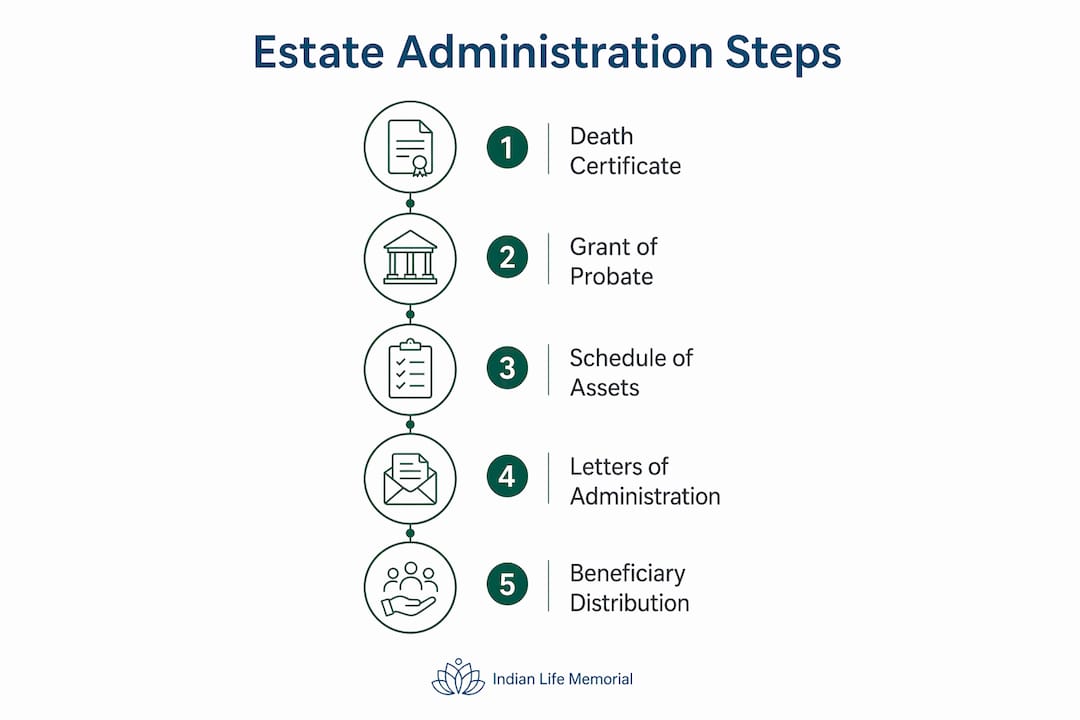
A Grant of Probate confirms the executor's authority to act on behalf of the estate when a valid will exists. Letters of Administration grant equivalent authority to a court-appointed administrator when there is no will, or when the named executor is unable or unwilling to act. A third variant, Letters of Administration with Will Annexed, applies when a will exists but names no executor or the executor has died.
Step-by-step application process
- Engage a probate lawyer. While self-representation is technically possible, legal fees for simple cases range from S$3,000 to S$6,000, and professional guidance reduces the risk of procedural errors that cause rejection.
- Conduct registry searches. Search the Wills Registry and the Caveats Registry. These searches confirm whether a will exists and whether any party has lodged a caveat against the estate.
- Prepare the application documents. Required documents include the original will (if any), certified death certificate, Originating Summons, Statement, Oath of Executor or Administrator, and the Schedule of Assets.
- File with the Family Justice Courts. Submit all documents and pay court filing fees. The court reviews the application and may request additional affidavits or clarifications.
- Attend the hearing if required. Most straightforward applications are processed without a hearing, but contested matters or defective wills require court attendance.
- Receive the Grant or Letters. The initial extraction phase takes approximately 8–12 weeks for a standard application. Complex cases involving overseas assets or disputes take considerably longer.
Key documents at a glance
| Document | Purpose |
|---|---|
| Certified death certificate | Confirms the fact of death for all institutions |
| Original will | Establishes testamentary wishes and names executor |
| Schedule of Assets | Lists all estate assets with valuations at date of death |
| Oath of Executor or Administrator | Sworn commitment to administer the estate lawfully |
| Originating Summons | Formal court application to commence probate proceedings |
Pro Tip: File the Schedule of Assets carefully. The executor must submit this document within six months of Grant issuance, and errors or omissions can trigger legal challenges from beneficiaries or IRAS.
What happens after the Grant or Letters are issued?
Legal authority in hand, the executor or administrator moves into the practical phase of collecting assets, settling debts, and distributing what remains.
Collecting and valuing assets
Present the Grant or Letters to every institution holding estate assets: banks, CPF Board, insurance companies, and the Singapore Land Authority for property. Each institution has its own internal process, so allow two to four weeks per institution.
One critical distinction: CPF monies are excluded from the deceased estate and distributed separately by the Public Trustee's Office if no valid CPF nomination exists. This surprises many families who assume CPF savings pass through the will. They do not. The nominated beneficiary receives CPF funds directly, outside the probate process entirely.
Settling debts and taxes
Before distributing a single dollar to beneficiaries, the executor must pay all proven debts, liabilities, and taxes. Distributing assets prematurely exposes the executor to personal legal liability for any shortfall creditors later claim. The Inland Revenue Authority of Singapore (IRAS) must also be satisfied. The period of estate administration ends on December 31 of the year the Grant or Letters is issued, which affects tax treatment of income generated by estate assets during administration.
Handling overseas assets
A Singapore Grant of Probate does not automatically extend to assets held in other countries. Separate grant applications or resealing procedures in each relevant jurisdiction are required, and this process can delay administration by over a year. Families with overseas property or foreign bank accounts should engage lawyers in those jurisdictions early.
Distributing to beneficiaries
Once all debts and taxes are cleared, the executor distributes the remaining assets according to the will or, if intestate, the Intestate Succession Act. Distributing assets before the Grant is issued is a major legal risk. Executors who do so face personal liability for any resulting loss to creditors or beneficiaries.
What are common questions and challenges in estate administration?
Intestacy and the Intestate Succession Act
Without a will, the Intestate Succession Act governs asset distribution strictly. The Act follows a fixed hierarchy: spouse and children share the estate in defined proportions, and more distant relatives inherit only if closer relatives do not exist. Verbal wishes carry no legal weight. Many families discover this too late, after assets have already been distributed in ways the deceased never intended.
How long does probate take in Singapore?
The full process, from death to final distribution, typically takes 3–9 months for straightforward estates. Contested wills, overseas assets, or missing documents extend this timeline significantly. The 8–12 week initial extraction phase is just the beginning.
Common reasons for delays include:
- Defects in the will, such as improper witnessing or ambiguous clauses
- Disputes among beneficiaries or creditors
- Overseas assets requiring separate legal proceedings
- Missing or incomplete documentation at filing
- Estates with complex investment portfolios requiring professional valuation
Joint accounts and nominated assets
Joint bank accounts often bypass probate entirely under the Rule of Survivorship. The surviving account holder can access funds by presenting the death certificate and their NRIC to the bank, without any court order. Insurance policies and CPF savings with valid nominations also pass outside the estate. Knowing which assets bypass probate helps your family plan cash flow during the administration period.
Pro Tip: If you are named as an administrator and feel uncertain about any step, consult a probate lawyer before acting. Executors and administrators face personal liability for mistakes, and professional advice costs far less than litigation.
Key Takeaways
Estate administration in Singapore requires legal authority before any asset can be touched, and the process demands careful compliance at every stage to protect both the estate and the executor personally.
| Point | Details |
|---|---|
| Legal authority is mandatory | No asset can be distributed without a Grant of Probate or Letters of Administration from the Family Justice Courts. |
| CPF bypasses the estate | CPF savings pass to nominated beneficiaries directly and are not governed by the will or probate process. |
| Premature distribution is a legal risk | Distributing assets before the Grant is issued exposes the executor to personal liability for creditor claims. |
| Intestacy follows strict rules | Without a will, the Intestate Succession Act determines distribution, regardless of verbal wishes or family expectations. |
| Overseas assets require separate action | A Singapore Grant does not cover foreign assets; separate legal proceedings in each jurisdiction are required. |
Why I think most families underestimate estate administration
Most families I have encountered approach estate administration with a quiet assumption: that love, trust, and common sense will carry the process. They believe that because everyone in the family agrees, the law will simply follow along. The Intestate Succession Act does not work that way, and neither do banks or the courts.
The single most damaging mistake is distributing assets before the Grant or Letters are issued. It feels natural to help a grieving spouse access funds immediately. Legally, it can expose the executor to personal liability that outlasts the grief by years. Professional legal advice is not a luxury here. It is the difference between a clean administration and a dispute that fractures families.
The second mistake is ignoring the will's quality until it is too late. A will witnessed by a beneficiary, or one with ambiguous clauses, can be challenged and delay distribution by months. Making a clear, properly witnessed will now, and reviewing it after major life events, is the most respectful thing you can do for the people you leave behind.
Families dealing with what to do after a death in Singapore often feel the administrative burden on top of grief. Starting the asset list and securing documents within the first week makes every subsequent step faster and less painful.
— Admin
How Indianlifememorial supports families through loss and beyond
Grief and legal paperwork arrive at the same time. Indianlifememorial exists to carry the weight of the funeral so your family can focus on what matters most.

Indianlifememorial provides compassionate, transparent funeral services in Singapore for Hindu, Christian, and all-faith families, available 24 hours a day, 7 days a week. Packages start at $1,888 with no hidden fees, covering everything from experienced priests and proper Vedic rites to practical coordination that complements the estate administration process. When the funeral is handled with care and clarity, your family gains the space to grieve properly and address legal obligations without added confusion. Explore Indianlifememorial's funeral packages to find the right level of support for your family's needs and faith tradition.
FAQ
What is the difference between a Grant of Probate and Letters of Administration?
A Grant of Probate confirms an executor's authority when the deceased left a valid will. Letters of Administration grant equivalent authority to a court-appointed administrator when there is no will or the named executor cannot act.
How long does estate administration take in Singapore?
The initial Grant extraction takes approximately 8–12 weeks, with the full process including asset collection and distribution typically taking 3–9 months for straightforward estates.
Are CPF savings included in the deceased's estate?
No. CPF monies are excluded from the estate and distributed separately by the Public Trustee's Office if no valid nomination exists, bypassing the probate process entirely.
Can joint bank accounts be accessed without probate?
Yes. Under the Rule of Survivorship, the surviving account holder can access a joint bank account by presenting the death certificate and their NRIC, without a court order.
What happens if someone dies without a will in Singapore?
The Intestate Succession Act governs distribution strictly, following a fixed hierarchy of spouse, children, and more distant relatives. Verbal wishes carry no legal weight under this legislation.