

Funeral package pricing is defined as the total cost families pay for a combination of professional services, merchandise, and third-party fees arranged by a funeral home. Understanding how funeral packages are priced gives your family the clarity to make informed decisions without overspending during an already difficult time. The FTC Funeral Rule mandates that every funeral home provide an itemized General Price List (GPL) upon request, making transparent comparison a legal right, not a privilege. Knowing what drives each line item puts your family in control from the very first conversation with a provider.
What are the main components included in funeral package pricing?
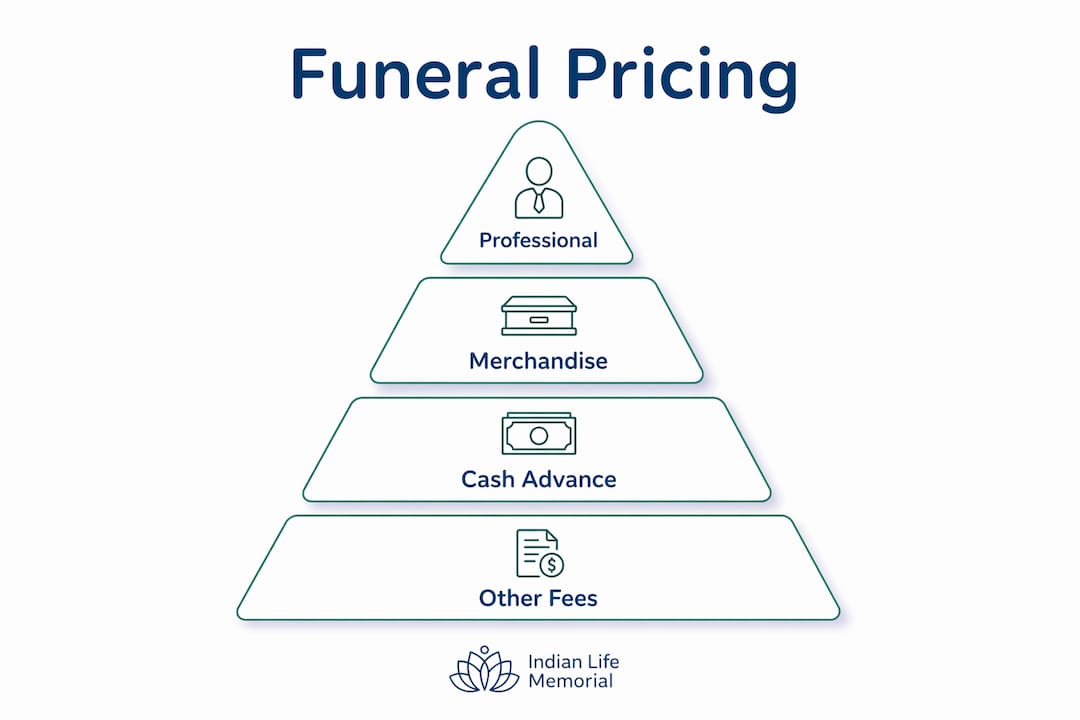
Funeral pricing breaks into three distinct categories: professional services fees, merchandise costs, and cash advance items. Each category carries its own cost range and level of flexibility. Understanding all three is the foundation of any funeral cost breakdown.
Professional services fees
The Basic Services Fee is a non-declinable charge that every funeral home applies regardless of the type of service selected. It covers administrative overhead, staff availability, and the coordination work that begins the moment your family contacts the provider. This fee typically ranges from $1,000 to $3,000 and is embedded in every package a funeral home offers. Beyond the basic fee, additional professional service charges may include embalming, body preparation, transportation, and the use of facilities for viewing or ceremonies.
Merchandise costs
Merchandise is often the largest variable in total funeral expenses. Caskets, urns, burial vaults, and printed stationery all fall into this category. Casket prices alone can range from a few hundred dollars for a simple model to several thousand for a premium selection. Families have the legal right to purchase a casket from a third-party retailer and have it accepted by the funeral home without penalty, which is a cost-saving option many families do not realize exists.

Cash advance items
Cash advance items are fees the funeral home pays to outside parties on your behalf and then bills back to you. Common examples include clergy honoraria, obituary notices, flowers, and permits. Providers are required to disclose any markup they add above the actual third-party cost. Always request written estimates for these items before finalizing arrangements.
- Professional services fee: $1,000–$3,000, mandatory and non-negotiable
- Merchandise: Highly variable; caskets and urns drive the widest cost range
- Cash advance items: Clergy, obituaries, flowers, and permits; subject to provider markups
- Embalming and preparation: Optional in most cases unless public viewing is planned
- Transportation: Local transfer fees differ from long-distance or airport transfer costs
Pro Tip: Ask the funeral home to separate cash advance items from their own service fees on every written estimate. This one step prevents the most common billing surprises families face.
Bundled packages vs. itemized pricing: which costs more?
Funeral homes present pricing in two formats: bundled packages and itemized GPL pricing. Each approach has real trade-offs that affect what your family ultimately pays.
A bundled funeral package groups multiple services and merchandise into a single price. This format is marketed as convenient, and it can be, but convenience has a cost. Package pricing is a marketing convenience; comparing package prices to itemized GPL lists is the only reliable way to confirm your family is not paying for services you do not need.
The GPL is the legally binding document that lists every service and product the funeral home offers with individual prices. The GPL must be provided at the first in-person inquiry and forms the basis for any contract. Families who skip reviewing the GPL before selecting a package often pay for services they would have declined if offered individually.
| Format | Advantages | Watch out for |
|---|---|---|
| Bundled package | Single price, easier to compare across providers | May include services you do not want or need |
| Itemized GPL pricing | Full transparency, pay only for what you select | Requires more time and attention to review |
| Hybrid approach | Customize a package from GPL line items | Confirm the Basic Services Fee is not double-counted |
Pro Tip: When comparing a package price to the GPL, add up only the line items you actually want. If the package costs more than your custom total, ask the funeral home to price your selections individually.
A critical nuance many families miss: the Basic Services Fee is embedded in every package but also appears as a separate line item in itemized pricing. Direct comparison requires care to avoid counting that fee twice when building your own itemized total.
What factors affect the total cost of a funeral package?
Several variables determine where your family's final bill lands within the national range. The national median funeral cost is approximately $6,280 with cremation and $8,300 with burial. Those figures are medians, meaning actual costs in your area may be meaningfully higher or lower.
The factors affecting funeral costs include:
- Geographic location: Urban funeral homes in high cost-of-living cities charge more than rural providers for identical services. Pricing for similar services can vary widely even within the same city.
- Type of disposition: Cremation packages are consistently less expensive than burial packages because they eliminate cemetery plot, vault, and casket costs.
- Merchandise selection: Upgrading from a standard casket to a premium model can add thousands to the total. The same applies to urns and burial vaults.
- Service level: A graveside service costs less than a full funeral with visitation, ceremony, and reception facilities.
- Cash advance variances: Clergy fees, obituary lengths, and floral arrangements vary by provider and region. Markups on these items differ across funeral homes.
- Cemetery and legal requirements: Some municipalities require burial vaults or specific permits that add mandatory costs outside the funeral home's control.
The type of disposition is the single largest lever families can pull to control total cost. Choosing direct cremation, for example, eliminates several of the most expensive line items entirely. Families planning services that honor specific religious or cultural traditions, such as Hindu Antyesti rites or Christian burial customs, should also factor in the cost of experienced clergy or a Pandit, which varies by provider.
How can families control costs and make informed decisions?
Cost control in funeral planning starts before any arrangements are signed. The GPL is the primary document families should request to avoid overspending. Funeral experts treat it as the single most important consumer protection tool available.
- Request the GPL immediately. Ask for it by name at the first contact. Every funeral home is legally required to provide it. Review it before discussing any packages.
- Separate provider fees from cash advance costs. These are two different expense categories. Mixing them makes it harder to see where your money is actually going.
- Compare multiple providers. Many families mistakenly believe they must use the closest funeral home. Shopping and comparing can save thousands, even within the same area.
- Build your own itemized list. Select only the services and merchandise your family genuinely wants. Use the GPL to price each item individually before looking at packages.
- Negotiate specific line items. Funeral homes do have flexibility on some charges, particularly merchandise and certain service fees. Reviewing funeral service cost negotiation strategies before your meeting gives your family a clear advantage.
- Get written estimates for all cash advance items. The FTC Funeral Rule requires providers to supply good-faith written estimates for third-party charges. Never accept verbal estimates for these costs.
Pro Tip: Pre-planning your own funeral arrangements, even informally, removes the time pressure that leads families to accept the first package offered. A calm review of multiple GPLs almost always produces a better outcome.
The most common confusion arises over cash advance items. Clear written estimates from providers prevent billing surprises that families often discover only after arrangements are finalized. Reviewing a detailed funeral fees breakdown before your first provider meeting gives your family a significant advantage.
Key Takeaways
Funeral packages are priced across three categories: professional services fees, merchandise, and cash advance items, and families who request the GPL and compare itemized costs consistently pay less than those who accept the first package offered.
| Point | Details |
|---|---|
| Three pricing categories | Every funeral bill includes professional fees, merchandise, and cash advance items. |
| Basic Services Fee is mandatory | This non-declinable charge ranges from $1,000 to $3,000 and appears in every package. |
| GPL is your legal right | Request the General Price List at first contact to compare costs and avoid unnecessary fees. |
| Packages may include unwanted services | Always compare package prices against your own itemized GPL total before signing. |
| Shopping around saves money | Pricing for similar services varies widely; comparing multiple providers reduces total cost. |
Why transparent pricing matters more than families realize
Families rarely enter a funeral home with a clear sense of what they are about to spend. The grief is real, the time pressure is real, and the instinct to simply say yes to the first package presented is completely understandable. I have seen this dynamic play out repeatedly, and the financial regret that follows is one of the most preventable outcomes in end-of-life planning.
The most important shift I have observed is this: families who arrive with even a basic understanding of the GPL, the three pricing categories, and their right to compare providers make fundamentally better decisions. They are not less grieving. They are simply better prepared. Preparation is not disrespectful to the deceased. It is one of the most loving things a family can do.
The trend toward greater pricing transparency is real and growing. Providers who publish clear, upfront pricing, including those who list starting prices with no hidden fees, are earning the trust of families who have been burned before. That trust is not built through marketing language. It is built through honest numbers presented at the right moment.
My recommendation is simple: request the GPL before you discuss any package. Read it the way you would read a contract, because it is one. Ask about every cash advance item in writing. And if a provider resists any of these requests, that resistance tells you something important.
— Admin
Indianlifememorial's approach to funeral package pricing
Indianlifememorial offers families in Singapore a clear, upfront pricing structure with funeral packages starting at $1,888 and no hidden fees. Every arrangement is built around transparency, so your family knows exactly what is included before any agreement is signed.

Indianlifememorial specializes in Hindu and Indian funeral rites, including proper Vedic ceremonies conducted by experienced Pandits, as well as services for Christian, Freethinker, and multi-faith families. The team is available 24/7 to guide your family through each step with compassion and clarity. For families who want to understand every cost before committing, Indianlifememorial's full-suite funeral services provide the structure and support your family deserves during a sacred and difficult time.
FAQ
What does a funeral package price typically include?
A funeral package price includes professional services fees, merchandise such as caskets or urns, and cash advance items like clergy fees, obituary notices, and permits. The exact inclusions vary by provider and package tier.
How much does a funeral cost on average?
The national median funeral cost is approximately $6,280 with cremation and $8,300 with burial, according to National Funeral Directors Association 2023 data. Actual costs vary significantly by location, service level, and merchandise selected.
What is the General Price List and why does it matter?
The General Price List (GPL) is a legally required document that itemizes every service and product a funeral home offers with individual prices. Requesting it at first contact is the most effective way to compare providers and avoid paying for unwanted services.
Are cash advance items negotiable?
Cash advance items are paid to third parties, so the base cost is generally fixed, but funeral homes must disclose any markup they add above the actual third-party cost. Asking for written estimates and comparing markups across providers can reduce this portion of the bill.
Can families buy a casket from an outside retailer?
Families have the legal right to purchase a casket from a third-party retailer and require the funeral home to accept it without charging a handling fee. This option can produce meaningful savings on one of the most expensive single items in a funeral package.