

Funeral repatriation is defined as the formal process of transporting a deceased person's remains from the country where they died back to their home country for burial or cremation. The repatriation funeral home coordination steps cover everything from securing legal release to booking cargo space and transferring custody to a receiving funeral director. Funeral directors act as central coordinators, managing hospitals, coroners, embassies, airlines, consulates, and receiving funeral homes on your family's behalf. Without this coordination, families face a web of legal, logistical, and cultural requirements that can delay the return of their loved one by days or weeks. This guide walks you through every phase so you know exactly what to expect.
What documentation and legal permits are required for repatriation?
Documentation is the foundation of every successful repatriation. Missing or inconsistent paperwork is the single most common cause of delays, and in some jurisdictions, it can trigger a formal inquest. The funeral home's first task is gathering and verifying every required document before any transport is arranged.
The core documents required for international repatriation include:
- Death certificate issued by the local authority where the death occurred
- Embalming certificate confirming the body has been prepared to international transport standards
- Sanitary transport certificate or health certificate issued by a public health authority
- Consular approval or No Objection Certificate (NOC) from the embassy of the destination country
- Coroner's release or equivalent authorization from the local jurisdiction
Required documents include the death certificate, embalming certificate, sanitary transport certificate, and coroner's release Form 104 in England and Wales. Each jurisdiction has its own version of this release, and the funeral director must know which form applies. In England and Wales, for example, the coroner must be notified upon arrival of a repatriated body and can authorize release or request additional documents or an inquest.
Translated documents are equally critical. If the death occurred in a country with a different official language, certified translations of all certificates must accompany the originals. Consulates often require translations before issuing approvals. The funeral home coordinates these translations and confirms that every document matches the physical details of the deceased exactly.
Pro Tip: Ask your funeral director for a complete document checklist on day one. Specialist coordination prevents delays by ensuring legal release and documentation comply with multiple authorities early in the process. A single missing signature can hold remains at customs for 48 hours or more.
How is the deceased prepared and packaged for international transport?
Body preparation for repatriation follows strict health and aviation standards. The goal is to preserve the dignity of the deceased while meeting the sanitary requirements of every country the remains will pass through.
Embalming is the standard method of preservation for full-body repatriation. It slows decomposition and satisfies the health requirements of most destination countries. Embalming and sealed zinc coffins are a prerequisite for air transport in almost all cases. The zinc lining creates a hermetically sealed inner coffin that contains any biological material and prevents contamination during the flight.
The outer coffin or casket must then meet airline cargo specifications. Airlines require specific dimensions, weight limits, and labeling. The funeral home liaises directly with the airline's cargo division to confirm these requirements before packaging is finalized.
| Preparation requirement | Full-body repatriation | Cremated remains (ashes) |
|---|---|---|
| Embalming | Required in most cases | Not applicable |
| Zinc-lined sealed coffin | Required for air transport | Not required |
| Sanitary certificate | Required | Simplified certificate |
| Consular approval | Usually required | Often simpler process |
| Estimated cost and time | Higher cost, longer process | Lower cost, faster process |
International air transport requires hermetically sealed coffins and documentation including the death certificate, embalming certificate, transit documents, and consular approvals. Additional rules apply for cases involving infectious diseases, which require extra containment measures and specific health authority clearances.
Pro Tip: Cremation abroad followed by repatriation of ashes is simpler, faster, and less costly than full-body repatriation. If your family's faith and traditions permit it, discuss this option with your funeral director early. It can reduce both the timeline and the financial burden significantly.
What logistical steps do funeral homes take to coordinate transport and handover?
Transport coordination is where the funeral home's expertise becomes most visible. Families cannot arrange this stage themselves. Airline cargo shipments of human remains require "known shipper" status, and families cannot book flights directly. Funeral homes must handle bookings to comply with aviation security rules.

The funeral director books cargo space on a suitable flight, confirms the packaging meets airline specifications, and delivers the remains to the cargo terminal with all accompanying documentation. Customs clearance at both the departure and arrival airports requires a separate set of forms and health declarations. The funeral home prepares these in advance to avoid holds at the border.
| Stakeholder | Role in repatriation transport |
|---|---|
| Sending funeral director | Prepares body, gathers documents, books cargo, clears departure customs |
| Airline cargo division | Confirms packaging compliance, transports remains as regulated cargo |
| Destination customs authority | Reviews documentation, clears arrival, releases remains |
| Receiving funeral director | Takes custody, inspects packaging, confirms condition matches documents |
| Coroner at destination | Reviews documents, authorizes release for funeral proceedings |
The handover to the receiving funeral director is a formal process. The reception funeral director inspects packaging to confirm the condition matches the documentation and reports any inconsistencies before funeral proceedings begin. This inspection is a forensic safeguard, not a formality. Discrepancies must be reported to the coroner before any further arrangements proceed.
Repatriation specialists divide responsibility clearly: local mortuary arrangements and body preparation are handled locally, while cross-border logistics are managed by the repatriation team. Success depends on alignment of documentation and preparation standards across both jurisdictions.
What challenges do families face without funeral home coordination?
Attempting to manage repatriation without an experienced funeral director creates serious risks. The legal and logistical requirements are not intuitive, and errors at any stage can cause significant delays or legal complications.
The most common pitfalls families encounter include:
- Incomplete documentation: Missing a single certificate or an unsigned form can halt the process at customs or trigger a coroner's inquest at the destination.
- Packaging failures: Coffins that do not meet airline or destination country standards are rejected at the cargo terminal, requiring repacking and rebooking.
- Missed notifications: Families commonly underestimate the checkpoints for documentary review at coroners, customs, and airlines. Proactive funeral home management is critical to meeting each deadline.
- Airline booking barriers: Without known shipper status, families cannot place a cargo booking. This alone makes independent repatriation impossible in most countries.
- Emotional toll: Managing bureaucratic processes while grieving is exhausting. Unclear communication from multiple agencies compounds the distress.
Missing or inconsistent paperwork can lead to coroner delays or inquests. These delays extend the time before your family can hold a funeral, which affects grieving, religious observance, and the practical plans of family members traveling from abroad. A funeral home with repatriation experience removes these risks by managing every checkpoint on your behalf.
How do families engage with funeral homes during repatriation?
Choosing the right funeral home is the most consequential decision your family will make in this process. Not every funeral director has repatriation experience. You need a specialist who understands the legal requirements of both the country of death and the destination country.
When selecting a funeral home for repatriation, look for:
- Documented experience with international repatriation cases
- Established relationships with airlines, consulates, and receiving funeral directors abroad
- Clear, written communication about each step and expected timeline
- Transparent pricing with no hidden fees for documentation or cargo handling
- Availability around the clock, since deaths abroad rarely happen at convenient times
Your family's responsibilities during the process are limited but important. You will need to provide identity documents for the deceased, confirm the destination funeral home, and make decisions about preparation preferences such as full-body repatriation versus cremation. The funeral director will guide you through each decision point and explain the implications clearly.
Local mortuary arrangements and cross-border logistics work best when both sides communicate consistently. Ask your funeral director for a written timeline and request updates at each stage. You should also confirm that the receiving funeral home at the destination is briefed and ready before the remains depart.
Pro Tip: Before engaging a funeral home, ask these three questions: Do you have direct experience with repatriation to our destination country? Who is your contact at the receiving end? What is your process if a document is rejected? The answers will tell you immediately whether you are speaking with a genuine specialist. For families coordinating from Singapore, the repatriation from Singapore guide outlines the specific procedural steps in detail.
Key takeaways
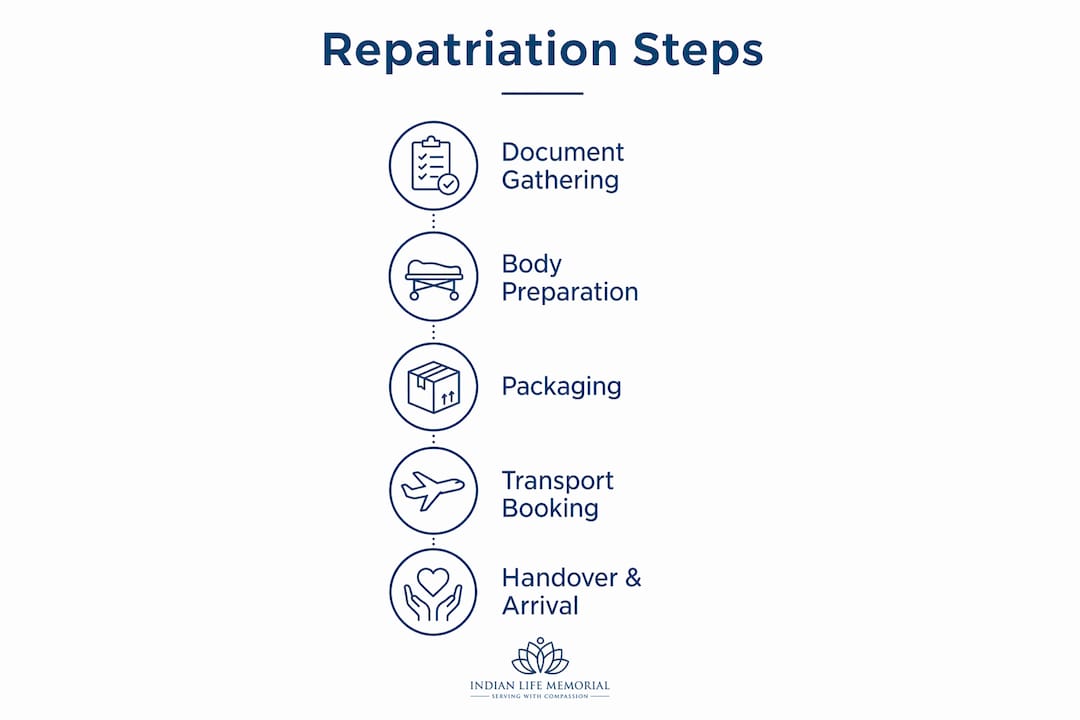
Funeral repatriation requires a licensed funeral home to manage documentation, body preparation, airline cargo booking, customs clearance, and formal handover to a receiving funeral director at the destination.
| Point | Details |
|---|---|
| Documentation is the first priority | Gather the death certificate, embalming certificate, sanitary certificate, and consular NOC before any transport is arranged. |
| Embalming and zinc coffins are standard | Most countries require hermetically sealed, zinc-lined coffins for air transport of human remains. |
| Families cannot book cargo directly | Funeral homes must hold known shipper status to place airline cargo bookings for human remains. |
| Handover is a formal inspection | The receiving funeral director inspects packaging against documentation before releasing remains for funeral proceedings. |
| Cremation abroad is a faster alternative | Repatriating ashes is simpler, faster, and less costly than full-body repatriation when faith and tradition permit. |
What I have learned from watching families navigate repatriation
The families who cope best with repatriation are the ones who ask for help immediately and trust the process once it is in motion. The ones who struggle are those who try to manage logistics themselves out of a sense of duty, or who delay engaging a funeral home because they are not sure where to start.
Repatriation is genuinely complex. The legal requirements across two or more jurisdictions, the airline cargo rules, the coroner protocols at the destination — none of this is designed to be navigated by a grieving family alone. That is not a criticism. It is simply the reality of international death administration.
What I find most reassuring to share is this: when a funeral home with real repatriation experience takes charge, the process moves. Documents get filed correctly the first time. Cargo gets booked on the right flight. The receiving funeral director is briefed and waiting. Your family's role becomes one of making meaningful decisions, not chasing paperwork.
The dignity of your loved one is maintained throughout every step. The sealed coffin, the certified documents, the formal handover — all of it exists to honor the person being brought home. Treat the coordination process with the same seriousness, and it will serve your family well.
— Admin
How Indianlifememorial supports families through repatriation
Indianlifememorial provides end-to-end repatriation support for families in Singapore, covering documentation, body preparation, airline cargo coordination, and reception arrangements at the destination.

The team is available 24 hours a day, seven days a week, and serves families of all faiths, including Hindu, Christian, and freethinker traditions. Pricing is transparent, starting at $1,888 with no hidden fees, so your family can focus on honoring your loved one rather than managing unexpected costs. For families who need full-service support from the first call to the final handover, the full-suite funeral services at Indianlifememorial cover every stage of the repatriation process with compassion and clarity. You can also review the available service packages to find the right level of support for your family's needs.
FAQ
What does a funeral home do during repatriation?
A funeral home manages the entire repatriation process, including securing legal release, preparing and packaging the body, booking airline cargo, clearing customs, and transferring custody to a receiving funeral director at the destination.
How long does funeral repatriation take?
The timeline varies by destination country and documentation complexity, but most repatriations take between five and fourteen days from the date of death. Incomplete paperwork is the most common cause of delays.
Can a family arrange repatriation without a funeral home?
Families cannot arrange airline cargo bookings directly. Airline cargo shipments of human remains require known shipper status, which only licensed funeral homes hold. A funeral home is legally required for this stage.
What documents are needed for repatriation?
The standard documents include a death certificate, embalming certificate, sanitary transport certificate, consular approval or No Objection Certificate, and a coroner's release from the jurisdiction where the death occurred.
Is cremation abroad cheaper than full-body repatriation?
Cremation abroad followed by repatriation of ashes is simpler, faster, and less costly than full-body repatriation. Families should discuss this option with their funeral director early if their faith and traditions permit it.