

Apply for a Coffin (Import) Permit from the National Environment Agency (NEA), or appoint a Singapore undertaker to apply on your behalf, and notify the Ministry of Foreign Affairs (MFA) or the nearest Singapore Overseas Mission so NEA Port Health can be alerted ahead of arrival at Changi. That single call sets everything else in motion.
Alongside the coffin or ashes, you will need:
- Foreign death certificate (with English translation if needed)
- Coffin export permit from the country of death
- Sealing certificate and embalming certificate, where applicable
- Airway bill for the shipment
- For ashes: a cremation certificate and a properly sealed container
Once your loved one is home, the death still needs to be reported to the Immigration & Checkpoints Authority (ICA) Registry of Births & Deaths. Indian Life Memorial handles this entire chain daily and can walk your family through each step without you having to decode government forms during your grief.
Key Takeaways
Repatriation to Singapore succeeds when families secure the NEA Coffin (Import) Permit early, notify MFA of flight details in advance, and register the death with ICA within days of arrival.
Table of Contents
- What Is the Singapore Repatriation Process Timeline?
- What Does Repatriation to Singapore Cost?
- What Happens After the Body or Ashes Clear Singapore Customs?
- Can Insurance or Financial Assistance Cover Repatriation Costs?
- How Indian Life Memorial Supports Families Through Repatriation
- Practical Reassurance: Who Handles What During Clearance
- Official Singapore Contacts and Pages to Check Now
- Frequently Asked Questions
What Is the Singapore Repatriation Process Timeline?
Repatriation to Singapore usually unfolds in four stages, and knowing them upfront helps you set realistic expectations with relatives waiting at home.
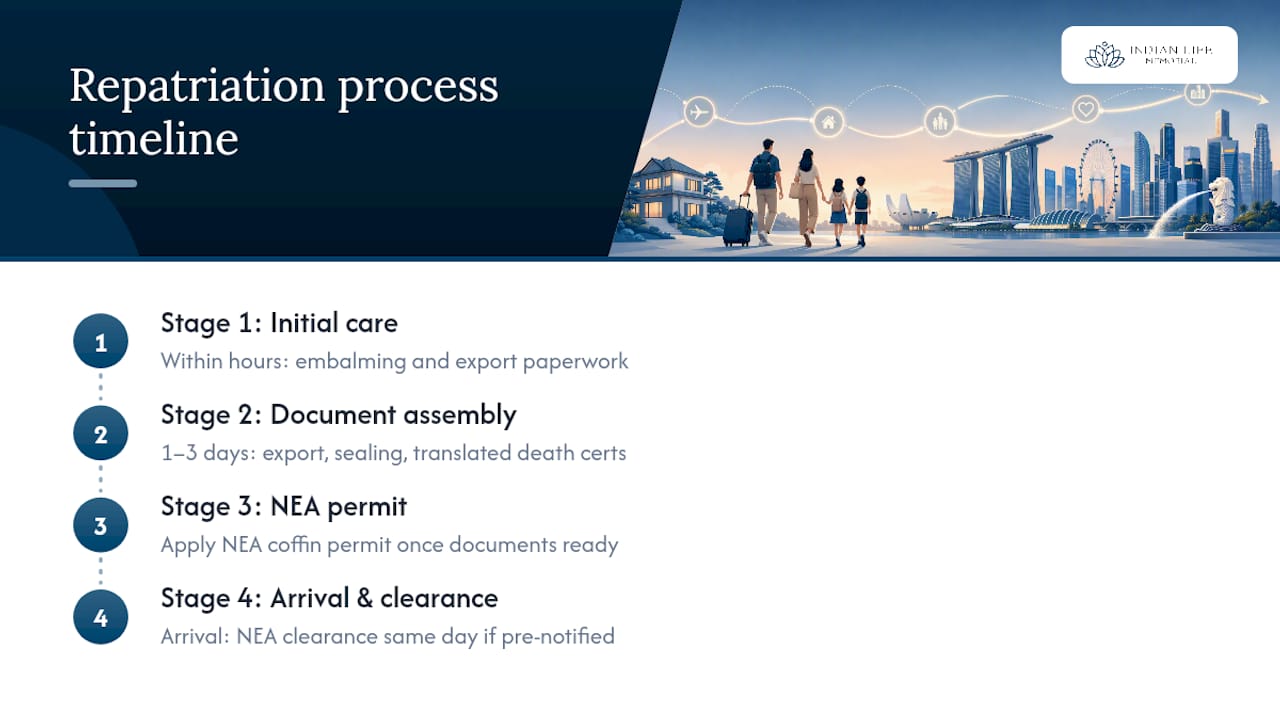
Stage one starts within hours of the death overseas. The family or a local funeral director in the country of death begins embalming and prepares export paperwork, while someone in Singapore contacts MFA or the overseas mission with flight details.
Stage two covers document assembly. This typically takes one to three days and includes the export permit, sealing certificate, and death certificate translation, all of which must travel with the remains.
Stage three is the NEA Coffin (Import) Permit application, submitted once documents are in hand. A Singapore-based undertaker often files this on the family's behalf, which speeds things up considerably since they know exactly what NEA expects.
Stage four is arrival and clearance. Early notice to NEA Port Health through MFA means clearance at Changi can happen the same day the flight lands, rather than being held up for inspection.
From the moment of death overseas to a completed cremation or burial in Singapore, the process duration varies significantly depending on the originating country's documentation speed and flight availability. Cases involving embalming delays or unfamiliar foreign bureaucracies stretch longer. This is precisely where having someone experienced coordinate on your side, rather than each step being handled by different unconnected parties, saves both time and heartbreak.
What Does Repatriation to Singapore Cost?
Costs vary by country of origin, but the components are consistent across nearly every case, and knowing them helps you budget without surprises.
Permit and administrative fees cover the NEA Coffin (Import) Permit and the accompanying Permit to Bury or Cremate, which are issued together. There is no Goods and Services Tax or separate Singapore Customs permit required to bring in human remains, bones, or ashes, so families are spared one layer of charges that many assume applies.
International transport is usually the largest line item. Airline cargo rates for a casket depend on weight, distance, and whether a specialized transport container is required to meet airline hazardous-materials rules.
Embalming and preparation costs are set by the funeral provider in the country of death, and prices differ widely depending on local regulation and whether hermetic sealing is mandated.
Local Singapore charges include the undertaker's coordination fee, mortuary transfer from Changi, and any re-coffining if the original casket exceeds Singapore's crematoria size limits.
Ashes transport is the most economical option by far. Since cremated remains can be hand-carried with a cremation certificate and a sealed container, families avoid cargo freight charges entirely, which is one reason many opt for cremation abroad when the death occurs far from Singapore.
Ask any funeral director you're considering for an itemized quote before committing, since bundled "repatriation packages" can obscure which of these five categories you're actually paying for.
What Happens After the Body or Ashes Clear Singapore Customs?
Clearing NEA Port Health at Changi is not the final regulatory step, and families are sometimes caught off guard by what still needs doing.
The most important follow-up is registering the death with ICA's Registry of Births & Deaths. This applies even though the death occurred overseas, and Singapore law requires it before certain estate and insurance matters can proceed. Processing typically takes about three working days after ICA verifies your documents, and you can submit through a dedicated FormSG portal rather than visiting in person.
Coffins also face physical constraints once they reach a Singapore crematorium or cemetery. Cremation chambers accept coffins up to certain maximum length and width dimensions. Burial allows slightly larger coffin sizes, with no specified height restriction. A coffin built overseas to different local standards can exceed these limits, and if it does, your undertaker will need to arrange re-coffining before the service, adding both time and cost.
One nuance worth knowing: importing a foreign national's remains for burial in Singapore is restricted, and NEA generally permits cremation only for non-citizens and non-permanent-residents; for more guidance on culturally appropriate services and procedures, families may consult Funeral Resources & Guidance. If your family situation involves a foreign spouse or relative, raise this with your undertaker early so it doesn't derail funeral planning at the last minute.
Can Insurance or Financial Assistance Cover Repatriation Costs?
Repatriation costs catch many families off guard, arriving at the worst possible moment financially. A few avenues can ease that burden, though none are guaranteed to cover everything.
Travel insurance policies purchased before the trip abroad often include a repatriation-of-remains benefit, sometimes capped at a set dollar amount. Check the policy documents or call the insurer directly, since this benefit is frequently bundled under "emergency medical evacuation" clauses that families overlook when reading the fine print.
Employer group insurance and credit card travel protections sometimes include similar clauses, particularly for corporate travel or platinum-tier cards. It's worth calling both your insurer and your employer's HR department before assuming you're covered.
What consular officers cannot do is pay for any part of the process. MFA and Singapore's overseas missions can advise, verify identity, and connect you with local undertaker lists, but the financial responsibility for transport, embalming, and permits sits with the family throughout.
Some funeral providers in Singapore, including Indian Life Memorial, offer transparent fixed-price packages so families know the total cost upfront rather than facing itemized surprises after the fact. Discussing payment structure honestly with your chosen provider before signing anything protects you from unexpected add-on fees during an already difficult week.
How Indian Life Memorial Supports Families Through Repatriation
When a loved one passes away overseas, the last thing your family should be doing is decoding permit applications between grief and jet lag. Indian Life Memorial coordinates the entire repatriation process on your behalf, available 24/7 from the moment you call.

Our team applies for the NEA Coffin (Import) Permit and the accompanying Permit to Bury or Cremate under your Letter of Authorisation, so you never have to personally navigate government counters while mourning. We liaise directly with MFA and the relevant Singapore Overseas Mission to make sure Port Health has advance notice, checking coffin dimensions against Singapore's crematoria and burial size limits before the casket even leaves its country of origin. That single check has saved families from costly last-minute re-coffining more than once.
From mortuary transfer at Changi to Vedic rites conducted by experienced priests, our packages start at $1,888 with no hidden fees, and every step is explained before you commit. If your family needs to bring a loved one home, call us now or visit our packages page to see transparent pricing and start the process today.
Practical Reassurance: Who Handles What During Clearance
You don't have to manage every agency yourself. MFA advises and connects you with undertakers but cannot pay costs. Your appointed undertaker applies for NEA permits under your Letter of Authorisation. NEA issues clearance; ICA registers the death once you're home, usually within three working days. Calling ahead with flight and casket details is often what makes Changi clearance smooth.
Official Singapore Contacts and Pages to Check Now
- NEA: permit requirements and document checklists for importing remains
- ICA: how to report an overseas death and register it after return
- MFA: consular guidance, undertaker lists, and a repatriation checklist for next-of-kin
- Singapore Customs: confirmation that remains and ashes need no GST or customs permit
Frequently Asked Questions
Do I need a lawyer to handle repatriation to Singapore? No. Most families work directly with a funeral undertaker who applies for the necessary NEA permits under a Letter of Authorisation, which covers the legal authority needed without requiring separate legal counsel.
Can I bring ashes into Singapore without a permit? Cremated remains do not require a Coffin (Import) Permit. You need the cremation certificate and a properly sealed container, and Singapore Customs confirms no GST or separate customs permit applies.
How long does the Singapore repatriation process usually take? Most cases take four days to two weeks from death overseas to a completed service in Singapore, depending on how quickly the country of death issues export documents and embalming certificates.
What if the deceased had a pacemaker? Pacemakers should be removed before transport due to public health and safety requirements tied to sealing and embalming rules under Singapore's Environmental Public Health Act.
Can a foreign national be buried in Singapore? Generally no. NEA restricts burial for non-citizens and non-permanent-residents, permitting cremation instead, so check this early if the deceased was not a Singapore citizen or PR.
Recommended
- Indian Life Memorial | Funeral Services Singapore | 24/7 Hindu, Christian, All Faiths
- Indian Life Memorial | Funeral Services Singapore | 24/7 Hindu, Christian, All Faiths
- Repatriation Cost Factors Checklist for Families
- Indian Life Memorial | Funeral Services Singapore | 24/7 Hindu, Christian, All Faiths