
Repatriating a loved one's remains internationally typically costs a substantial amount for standard commercial cargo transport, and can be significantly higher when air ambulance, autopsy requirements, or long-haul routing are involved. Your first two actions: secure the official death certificate from local authorities and contact the nearest U.S. embassy or consulate through usembassy.gov to obtain a mortuary release and consular assistance. These two steps unlock everything else on the checklist below.
Pro Tip: Most repatriation providers require a deposit of 50–100% upfront before they will begin preparation or book cargo. Confirm the deposit amount and refund policy in writing before signing anything.
The U.S. Department of State's consular offices can connect your family with vetted local funeral homes, explain transit permit requirements, and provide emergency contact lists. They do not typically pay costs directly, but their documentation support is indispensable. For families with foreign bank accounts involved in settling the estate, note that U.S. persons with aggregate foreign financial account balances above the FBAR filing threshold must file the appropriate reports as required by the Financial Crimes Enforcement Network. Indianlifememorial offers international repatriation services for families navigating this process, with faith-specific support and transparent pricing.
Table of Contents
- What factors affect repatriation costs? A complete checklist
- What do typical repatriation costs look like?
- Step-by-step timeline: what to do and when
- How to get accurate quotes and what to ask providers
- Insurance and financial assistance options
- Sample budget template you can use right now
- Key Takeaways
- What families often underestimate about repatriation planning
- Indianlifememorial's repatriation service: transparent support when it matters most
- Official sources and further reading
What factors affect repatriation costs? A complete checklist
Every quote your family receives will reflect a combination of the factors below. Understanding each one helps you distinguish required charges from optional add-ons and spot quotes that are missing key line items.
Distance and transport mode
The single largest cost driver is how the remains travel and how far. Commercial cargo on a scheduled airline is the most affordable option. A dedicated transfer on a charter flight costs significantly more. Air ambulance or medical repatriation, which involves a pressurized medical aircraft and clinical staff, is the most expensive mode by a wide margin. Academic research on international medical repatriation confirms that transport mode and medical complexity produce the widest cost variability of any factor in the process.
Paperwork and administrative fees
Documentation is where families are most often surprised. Each document carries its own fee, and some require notarization, apostille certification, or certified translation.
- Local death certificate (multiple certified copies)
- Consular mortuary certificate or "laissez-passer" for the remains
- Transit permits from each country the remains pass through
- Embalmer's certificate and preparation report
- Translation and notarization fees, billed per document or per page
- Expedited consular service fees when timelines are tight
For a detailed breakdown of international death registration requirements, families can review country-specific guidance before contacting the consulate.
Airline and cargo handling fees
- Cargo booking and freight charges, calculated by weight and volume
- Crate or container approval fees at origin airport
- Fuel surcharges and seasonal peak premiums (December and major holiday periods typically carry higher rates)
- Handling fees at both origin and destination airports
- Rerouting or rebooking fees if the cargo misses a cutoff
Local fees at the place of death
- Hospital or morgue holding fees, often charged per day from the time of death
- Refrigeration or cold storage daily rates if preparation is delayed
- Autopsy or medical examiner fees, which can add several thousand dollars and multiple days to the timeline
- Local transport from the hospital to the preparation facility
Body transport vs. returning ashes
Cremation at the place of death followed by courier return of the ashes is consistently the lower-cost option. Ashes can typically be shipped via international courier or carried as checked baggage, reducing carrier fees, container costs, and cargo handling charges substantially. The tradeoff is that cremation forecloses the option of a traditional open-casket service at the destination. For families following Hindu or other Vedic traditions, the choice between local cremation and repatriation of the body carries deep religious significance, and the decision should involve the family's priest or spiritual adviser.

Pro Tip: Gather all documents in the order they are needed: death certificate first, then embalmer's certificate, then consular mortuary permit, then transit permits. Submitting them out of sequence causes delays that add storage fees.
A cost analysis of repatriation cases found that evacuation and transport consistently account for the largest share of total costs, often exceeding preparation and documentation combined.
What do typical repatriation costs look like?
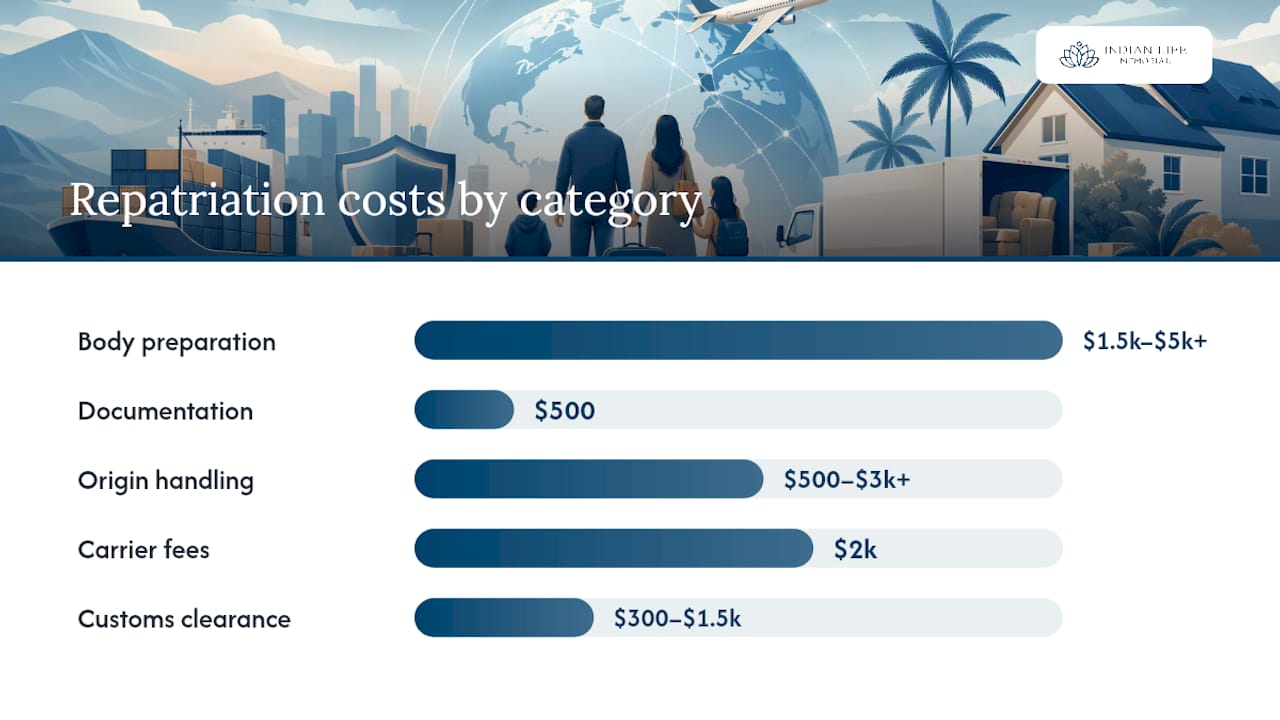
The table below reflects industry-observed ranges. Every case differs, and these figures are estimates to guide your budget, not firm quotes.
| Cost category | Lower-range estimate | Higher-range estimate |
|---|---|---|
| Body preparation (embalming, casket, air tray, sealing) | $1,500 | $5,000+ |
| Documentation (death certificates, permits, translations) | $500 | — |
| Origin handling (morgue/hospital, local transport) | $500 | $3,000+ |
| Carrier fees (cargo, crate, fuel/seasonal surcharges) | $2,000 | — |
| Customs clearance at destination | $300 | $1,500 |
| Estimated total (body repatriation) | $5,000 | $20,000+ |
Three scenarios to help you position your situation
Regional repatriation (neighboring country, commercial cargo): A family repatriating remains from Canada or Mexico to the U.S. via commercial cargo can often complete the process for $5,000–$10,000, depending on preparation requirements and documentation complexity. The main cost drivers are embalming, the hermetic container, and cargo fees.
Long-haul intercontinental (Asia, Europe, or South America): Flights from Singapore, India, or the United Kingdom add substantially to cargo costs and often require additional transit permits. Total costs in these cases commonly fall in the $10,000–$20,000 range, with documentation and handling fees representing a larger share of the total.
Air ambulance or medical repatriation: When a person dies during a medical emergency abroad and requires repatriation on a chartered medical aircraft, costs can reach $30,000–$50,000 or more. Academic research on international medical repatriation confirms that costs vary widely with medical complexity and transport mode, and that these cases are among the most expensive in the industry. Autopsy requirements, which can add days and thousands of dollars, compound the total further.
Returning ashes via international courier typically costs $500–$3,000 in total, making it the most affordable option for families whose faith traditions permit cremation abroad.
Step-by-step timeline: what to do and when
Immediate actions (0–48 hours)
- Obtain the official death certificate from local authorities or the hospital.
- Contact the nearest U.S. embassy or consulate (usembassy.gov) to register the death and request a consular mortuary certificate.
- Decide whether to repatriate the body or return ashes after cremation abroad.
- Identify who in the family holds legal authority to make arrangements (next-of-kin or designated representative).
- Contact a local licensed funeral home at the place of death to begin preparation and secure refrigeration.
- Request a provisional itemized quote from at least two providers.
- Notify your travel insurer and life insurer immediately, as most policies require prompt notification.
First week (days 3–7)
| Phase | Essential documents | Who to contact |
|---|---|---|
| Body preparation | Embalmer's certificate, preparation report | Local funeral home |
| Consular clearance | Consular mortuary permit, death certificate | U.S. consulate |
| Transit permits | Country-specific transit permits | Local funeral home or repatriation specialist |
| Cargo booking | Airline cargo confirmation, crate approval | Airline cargo division |
| Insurance claim | Policy documents, death certificate, receipts | Insurer claims department |
Begin the insurance claim process during this window. Insurers often require notification within a set number of days, and late notification can affect coverage.
Weeks 2–4
- Coordinate customs clearance at the U.S. destination airport with the receiving funeral home.
- Confirm the receiving funeral home's schedule and any local permits required in the destination state.
- Schedule final delivery and any local religious rites or ceremonies.
- Collect all receipts, invoices, and consular stamps for insurance reimbursement and tax records.
- If the estate includes foreign bank accounts, consult a cross-border tax adviser about FBAR filing obligations before closing those accounts.
Pro Tip: Photograph every document, receipt, and consular stamp as you receive it. A timestamped digital record speeds insurance claims and protects against lost paperwork.
For a detailed look at how funeral home coordination works across borders, families can review the step-by-step logistics before their first call.
How to get accurate quotes and what to ask providers
Getting comparable quotes requires asking every provider the same questions and requesting the same scope of work in writing. A quote that looks lower may simply be missing several line items.
What to request in writing
- A fully itemized quote listing every service, fee, and surcharge separately
- The carrier name, routing, and estimated delivery window
- Crate or container specifications and approval status with the airline
- The transit route and any countries the remains will pass through
- Refund and cancellation policy, including what happens if cargo is delayed
Specific questions to ask every provider
- Is embalming mandatory for this specific route and destination?
- Is a hermetically sealed container required, and is that cost included?
- Which airport terminals and cargo handlers will be used at origin and destination?
- Who is responsible for customs clearance on arrival, and is that fee included?
- What happens if the cargo misses the cutoff, and who bears the rebooking cost?
- Are translation, notarization, and apostille fees included or billed separately?
How to compare quotes fairly
Ensure every quote covers the same transport mode, the same document set, and the same storage period. Convert any fees quoted in foreign currency to USD at a disclosed exchange rate and date, and note that rate in your records. A quote in Singapore dollars or Indian rupees may look smaller until converted.
Pro Tip: Ask for an all-in final price and a payment schedule before signing. Confirm in writing which party is responsible for customs duties and airport handling fees at the U.S. destination.
Insurance and financial assistance options
Travel insurance
Travel insurance policies that include repatriation of remains coverage are the most direct source of reimbursement. Coverage limits vary widely depending on the policy. To file a claim successfully, you will typically need the death certificate, the embalmer's certificate, all invoices from the funeral home and carrier, and the consular mortuary permit. Read the exclusions carefully: some policies exclude deaths from pre-existing conditions or certain activities.
Life insurance
Life insurance proceeds can be used to pay repatriation costs, but the payout timeline may not align with the upfront deposit requirement. If the funeral home requires payment before the policy pays out, families may need to arrange a short-term loan or use personal funds and seek reimbursement later.
U.S. consular assistance
U.S. consulates do not typically pay repatriation costs directly. Their role is to provide documentation support, connect families with local licensed funeral homes, and in some cases facilitate emergency loans through the State Department's emergency financial assistance program. Contact the consulate early, as their local contacts and procedural knowledge can prevent costly mistakes.
Other options
- Employer assistance: Some employers, particularly those who sent the deceased abroad on assignment, carry group repatriation insurance or will advance costs.
- Partial cremation and ashes return: For families where faith permits, this is the most cost-effective path and can reduce total costs to $500–$3,000.
- Staged payments: Some funeral homes will accept a deposit and defer the balance until insurance pays. Confirm this arrangement in writing.
- ISS-USA guidance on repatriation program costs notes that direct expenses are allowable up to defined thresholds, and that cases exceeding those thresholds require additional documentation and review.
Pro Tip: Start your insurance claim and consular case simultaneously, on the same day if possible. Save every receipt and piece of correspondence in a dedicated folder, digital and physical.
Sample budget template you can use right now
Use this table to record quotes and track your actual costs. Fill in the "Your quote" column as you receive estimates.
| Budget line | Estimated range | Your quote |
|---|---|---|
| Embalming and body preparation | $800–— | |
| Casket or air tray and hermetic container | $700–— | |
| Documentation (death certificates, permits, translations) | $500–— | |
| Origin handling (hospital/morgue, local transport) | $500–$3,000 | |
| Customs clearance at U.S. destination | $300–$1,500 | |
| Destination funeral home reception and services | — | $4,000 |
| Contingency (10–20% of subtotal) | Variable | |
| Estimated total | $5,000–$20,000+ |
Worked example: long-haul repatriation from Singapore
A family repatriating remains from Singapore to the U.S. might see: preparation and container at $2,000, documentation at $1,500, origin handling at $1,200, carrier fees at $5,500, customs clearance at $800, and destination funeral home reception at $2,000. That totals approximately $13,000 before contingency. Adding a 15% contingency brings the working budget to roughly $15,000.
Numbered checklist: quotes to capture before committing
- Itemized quote from the local funeral home at the place of death
- Cargo quote from the airline or freight forwarder, including crate and handling
- Quote from the receiving funeral home in the U.S.
- Customs broker fee estimate at the U.S. destination airport
- Translation and notarization fee schedule from the document service
- Insurance policy limit and reimbursement timeline confirmation
Keep every receipt, invoice, and bank transfer record. For U.S. persons with foreign accounts involved in settling the estate, IRS guidance on FBAR recordkeeping requires that you document maximum account balances and retain full statements. Closing foreign accounts before verifying all payouts and statements is a common reporting error.
Key Takeaways
International body repatriation to the U.S. typically costs $5,000–$20,000 for standard commercial cargo, rising to much higher amounts for air ambulance cases, and the single most important first step is contacting the U.S. consulate and a local licensed funeral home simultaneously.
| Point | Details |
|---|---|
| Budget a realistic range | Standard body repatriation runs $5,000–$20,000; air ambulance cases are significantly higher. |
| Secure documents in order | Death certificate first, then embalmer's certificate, then consular permit, then transit permits. |
| Compare quotes on equal terms | Request fully itemized quotes covering the same transport mode, documents, and storage period. |
| Start insurance and consular contact immediately | Most policies require prompt notification; late filing can reduce or void coverage. |
| Indianlifememorial for managed repatriation | Indianlifememorial provides faith-specific, transparent international repatriation services from Singapore with 24/7 support. |
What families often underestimate about repatriation planning
The conventional wisdom is that repatriation is primarily a logistics problem. Book the cargo, file the papers, and the rest follows. In practice, the families who manage this process with the least financial stress are the ones who treat documentation as the critical path, not transport.
Every delay in the paperwork chain adds storage fees, risks missed cargo cutoffs, and can push a family into a more expensive transport option than they originally planned. The death certificate unlocks the embalmer's certificate. The embalmer's certificate unlocks the consular permit. The consular permit unlocks the transit permits. Miss one step or submit documents out of sequence, and the entire timeline shifts by days, sometimes weeks.
The other underestimated factor is the insurance claim. Families often focus entirely on arranging the repatriation and treat the insurance claim as something to handle later. Insurers have notification windows, and missing them is a costly mistake. The claim should begin on the same day as the funeral home call, not after the remains arrive home.
For families navigating Hindu or Indian funeral traditions, the decision between local cremation and body repatriation carries weight beyond cost. The Antyesti rites and the role of the Pandit in guiding the soul's transition are considerations that no budget template can fully capture. A trusted adviser who understands both the logistics and the sacred dimensions of this process is worth more than the cheapest quote.
Indianlifememorial's repatriation service: transparent support when it matters most
When your family needs managed, faith-aware repatriation from Singapore, Indianlifememorial offers a clear alternative to navigating every step alone. The service covers the full process: body preparation, documentation coordination, consular liaison, cargo booking, and receiving funeral home coordination, with transparent pricing and no hidden fees.

Indianlifememorial's international repatriation services are available 24/7, with faith-specific support for Hindu, Indian, and multi-faith families. The team coordinates directly with local authorities, airlines, and the receiving funeral home in the U.S., so your family is not managing multiple vendors across time zones during one of the most difficult periods imaginable. Pricing is transparent from the first conversation, and the team will walk you through what documents to have ready before the first call.
To get started, review the available service packages or call the team directly. Have the death certificate, passport of the deceased, and next-of-kin contact details ready. A deposit will be required to begin preparation and cargo booking, and the team will confirm the full payment schedule in writing before any work begins.
Official sources and further reading
These official sources provide verified guidance on repatriation procedures, documentation requirements, and financial reporting obligations for U.S. families.
- Academic article on costs of international medical repatriation
- Report of Foreign Bank and Financial Accounts (FBAR) — FinCEN
- Repatriation Reasonable and Allowable Expenses (ISS-USA presentation)
- How to Financially Prepare for Repatriation — FlashFi
- Moving back: A U.S. repatriation guide for returning U.S. expats
- US expats financial offboarding checklist — Gruv.ai
- Australian expat repatriation checklist — Runway Wealth
- Study: The costs of repatriation (seafarer case vignettes) — Health Economics research
- U.S. embassy and consular services — usembassy.gov
When in doubt about whether to call the embassy or the funeral home first, call the embassy. Consular officers can recommend vetted local funeral homes and prevent families from engaging providers who do not meet international transport standards.