
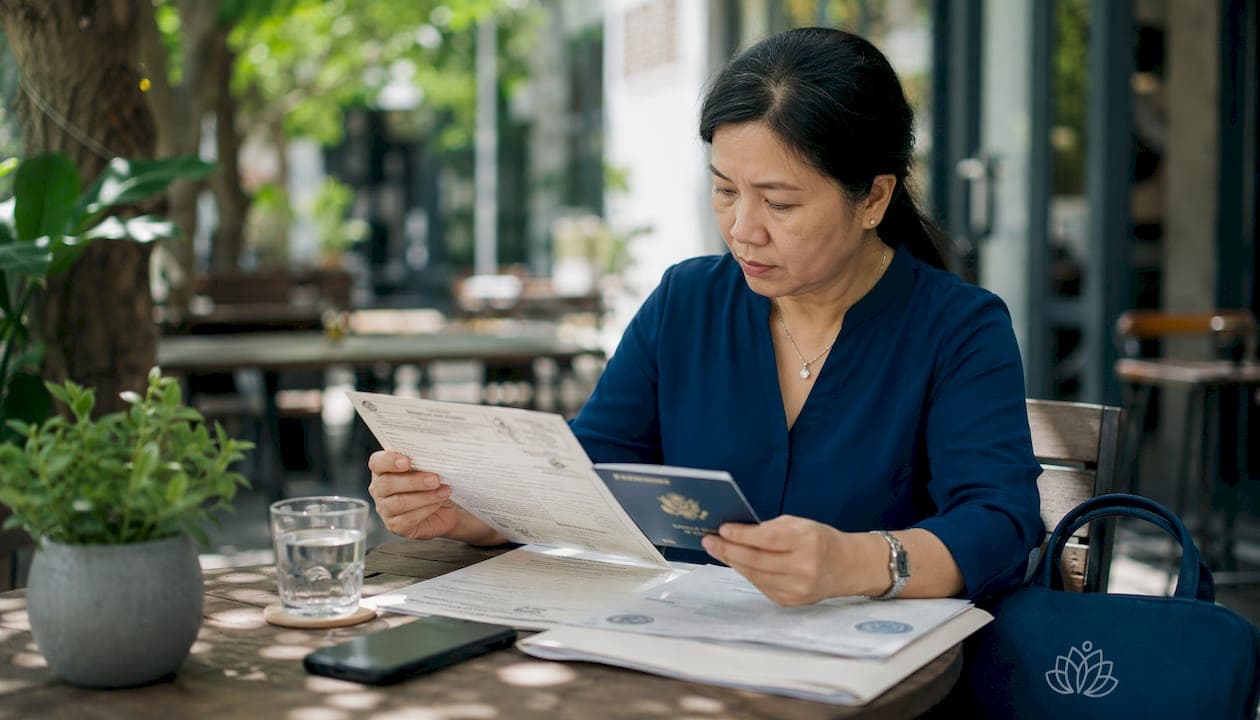
International death registration is the legal recording of a death in the country where it occurred, combined with the documentation required to give that record legal standing in another country. For U.S. families, the single most important first action is to obtain the local death certificate from the country where your loved one passed and then contact the nearest U.S. embassy or consulate.
Three authorities shape this process:
- U.S. Department of State issues the Consular Report of Death of a U.S. Citizen Abroad (CRODA) and the Consular Mortuary Certificate, both essential for U.S. estate and repatriation purposes.
- CRODA is the official U.S. consular document used to settle estate, insurance, and benefit matters in the U.S. The consulate will not issue it until you present the local death certificate first.
- World Health Organization (WHO) recognizes complete death registration, including cause of death, as foundational to public health planning. Registration standards vary considerably by country because no single international treaty compels every nation to follow a uniform process.
Table of Contents
- What to do in the first 24–72 hours after a death abroad
- Documents you will need for repatriation and U.S. legal use
- What the U.S. embassy or consulate can — and cannot — do
- Practical Singapore-specific steps for U.S. families
- Typical repatriation timeline and where fees arise
- How the process differs for non-U.S. citizens and dual nationals
- Common delays that slow registration or repatriation, and how to avoid them
- Key Takeaways
- What families say helped most
- How Indianlifememorial supports U.S. families through registration and repatriation
- Authoritative sources and further reading
What to do in the first 24–72 hours after a death abroad
Time matters. A clear sequence prevents document gaps that delay repatriation by days or weeks.
Within 24 hours:
- Contact local emergency services or the hospital and obtain the official pronouncement of death in writing.
- Call the nearest U.S. embassy or consulate to report the death and ask what documents they will need.
- If the death was sudden or unattended, request a police report immediately.
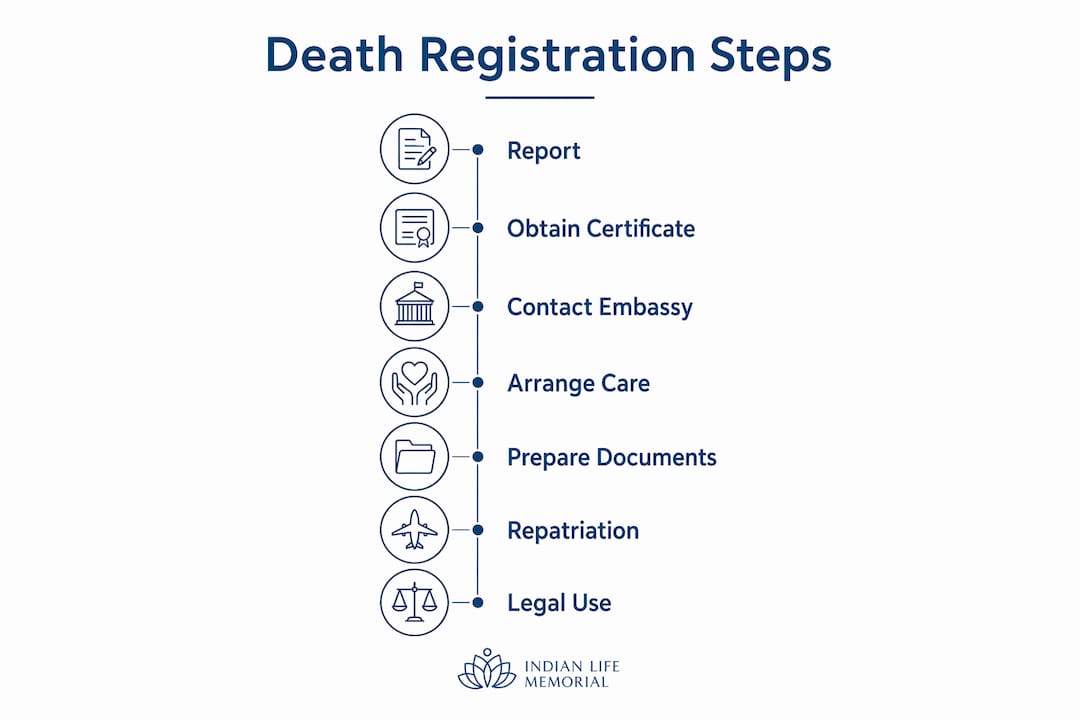
Within 48 hours: 4. Visit the local civil registry or hospital administration to begin the local death registration process. 5. Request at least five certified copies of the foreign death certificate while you are still in the country. Getting additional copies later is often harder and more expensive. 6. Contact a licensed local funeral director and confirm whether embalming is required for repatriation.
Within 72 hours: 7. Arrange temporary care for the remains with the local funeral home or mortuary. 8. Confirm the embalming standard required by your airline and U.S. customs. 9. Notify U.S. Social Security Administration and any relevant insurance carriers of the death. 10. Gather all identification documents for the deceased: passport, national ID, and travel documents.
For immediate guidance on what to do when someone dies in Singapore, Indianlifememorial's family resource covers local steps in plain language.
Documents you will need for repatriation and U.S. legal use
Every document below serves a distinct purpose. Missing even one can halt customs clearance or delay estate proceedings.
| Document | Purpose in U.S. processes | Issuing authority |
|---|---|---|
| Local death certificate (certified) | Primary legal proof of death; required before CRODA is issued | Local civil registry or hospital |
| Authenticated/apostilled death certificate | Accepted by U.S. courts, insurers, and banks | Local government authority or notary |
| CRODA | Settles U.S. estate, insurance, and federal benefit matters | U.S. embassy or consulate |
| Consular Mortuary Certificate | Certifies remains were prepared to applicable standards; required for customs and quarantine | U.S. embassy or consulate |
| Embalming affidavit or certificate | Confirms preparation method; required by airlines and U.S. customs | Licensed local funeral director |
| Passport/ID of deceased | Confirms identity for all consular and customs forms | N/A (pre-existing document) |
| Police or medical report | Required if death was sudden, unattended, or under investigation | Local police or hospital |
| Flight and transport permits | Authorizes international transport of remains | Local health authority or funeral director |
| Certified translations | Required for any non-English document used in U.S. proceedings | Accredited translator, notarized in-country |
Pro Tip: Have all translations notarized while you are still in the country. Tracking down a certified translator from the U.S. adds days and cost to an already difficult process.
For a detailed walkthrough of funeral registration paperwork in Singapore, Indianlifememorial's family guide covers each form step by step.
What the U.S. embassy or consulate can — and cannot — do
The consulate assists and supplements local documentation. It cannot replace a local death certificate, override local laws, or issue any consular document before the foreign death certificate is in hand.
What the consulate can do:
- Issue the CRODA after receiving the local death certificate. The CRODA is available as a paper document or as an e-CRODA with a digital signature, and it is the document U.S. banks, insurers, and probate courts recognize.
- Issue the Consular Mortuary Certificate, which certifies the casket contents and confirms that remains were prepared according to applicable standards. Airlines and U.S. customs require this for international transport.
- Authenticate documents, help communicate with local authorities, and advise on sending funds or arranging return of remains.
What the consulate cannot do:
- Issue or substitute for the local death certificate.
- Override local investigation requirements or release remains held by local authorities.
- Arrange or pay for repatriation.
The U.S. Department of State is the authoritative source for all consular procedures related to deaths abroad. Their guidance makes clear that embassies act as facilitators and document authenticators, not as decision-makers in local legal processes.
Pro Tip: Treat the consulate as your liaison and authentication resource. Bring the local death certificate to your first consular appointment. Without it, the process cannot move forward.
Practical Singapore-specific steps for U.S. families
In Singapore, you must register the death with the Singapore Registry of Births and Deaths, or through the hospital if the death occurred in a medical facility, before the U.S. embassy in Singapore will issue a CRODA.
- Contact the hospital's medical social worker or the police (for non-hospital deaths) immediately to begin the official process.
- A licensed funeral director in Singapore can register the death on your family's behalf and request certified copies of the local death certificate.
- Contact the U.S. Embassy in Singapore to report the death and schedule a consular appointment.
- Request certified copies and arrange certified translations of all Singapore-issued documents before leaving the country.
- Confirm whether the death requires a coroner's inquiry, which can extend the timeline significantly.
Indianlifememorial's Singapore death registration guide walks families through each local step, including who to contact and what to bring.
Pro Tip: For Hindu or Indian funerals, confirm Pandit availability, required ritual items, and whether the family's preference is cremation in Singapore or repatriation before making any arrangements. Timing the Antyesti rites correctly matters deeply, and a specialist can help align the sacred and the logistical.
Typical repatriation timeline and where fees arise
Repatriation to the U.S. from Singapore typically takes several days to two or more weeks, depending on documentation completeness, local investigation requirements, and flight routing.
Where fees commonly arise:
- Local funeral home services: preparation, embalming, casket or container, and storage.
- Consular fees: requesting a copy of an existing CRODA using Form DS-5542 costs $50 per record.
- Air freight and transport: costs vary by airline, weight, and routing.
- Customs clearance: handling fees at the U.S. port of entry.
- Translation and authentication: per-document fees for certified translations and apostille or notarization.
- Permits: local health authority and export permits for human remains.
Get written cost estimates from the local funeral director and any repatriation coordinator before committing to any service. Verbal estimates are not binding, and costs can escalate quickly without a written agreement.
Pro Tip: Ask the funeral director for a full itemized quote that includes document handling, embalming, storage, and transport packaging. Compare it against the repatriation coordination steps a Singapore specialist can manage on your behalf.
How the process differs for non-U.S. citizens and dual nationals
Non-U.S. nationals should contact their home-country consulate or embassy first. U.S. consular assistance is generally limited to U.S. citizens, so the process and documents differ.
- Identify the deceased's nationality. The home-country consulate handles consular documentation, repatriation authorization, and estate matters for their own nationals.
- Contact the home-country consulate in Singapore to report the death and ask which forms and authorizations are required for repatriation to the home country.
- Obtain the Singapore local death certificate regardless of nationality. This step is required by every consulate and every airline.
- For dual nationals: both countries may have a claim on documentation. Consult both consulates. Estate and benefit claims can be complicated when two countries' laws apply simultaneously.
- Check whether the deceased's home country requires additional repatriation permits beyond Singapore's export authorization.
For a detailed look at how foreign national deaths are handled in Singapore, Indianlifememorial's guide covers the procedural differences clearly.
Pro Tip: If the deceased held dual nationality, keep both passports accessible. Consulates often require both documents to confirm citizenship status before issuing any consular report.
Common delays that slow registration or repatriation, and how to avoid them
The most frequent bottlenecks are document-related, not logistical.
- Missing or non-certified death certificates: request certified copies immediately. Uncertified photocopies are rejected by consulates, airlines, and U.S. courts.
- Disputes over identity or cause of death: these trigger a coroner's inquiry in Singapore, which can extend the timeline by weeks.
- Translation delays: non-English documents must be translated and notarized before the consulate or U.S. authorities will accept them.
- Late apostille or authentication requests: some families discover this requirement only after returning to the U.S., forcing expensive overseas document retrieval.
- Airline packaging standards: airlines have specific requirements for the transport of human remains. Non-compliant packaging causes delays at the point of departure.
Prevention steps:
- Obtain at least five certified copies of the local death certificate before leaving Singapore.
- Confirm embalming and packaging standards with the airline before the remains are prepared.
- Keep a clear chain-of-custody folder with all funeral director paperwork, receipts, and permits.
Pro Tip: Engage a local repatriation coordinator or trusted funeral provider in Singapore as early as possible. They know the airline requirements, the authentication timelines, and the consulate's document checklist. That knowledge alone can save your family several days.
Key Takeaways
Register the death where it occurred, secure the certified local death certificate first, and contact the U.S. embassy in Singapore before any other consular step.
| Point | Details |
|---|---|
| Local certificate comes first | No consular document, including CRODA, can be issued without the local death certificate in hand. |
| Request multiple certified copies | Get at least five certified copies of the foreign death certificate while still in Singapore. |
| CRODA and mortuary certificate | The U.S. consulate issues both; CRODA supports U.S. estate matters, the mortuary certificate supports customs and airline clearance. |
| CRODA copy fee | Requesting an existing CRODA record via Form DS-5542 costs $50 per copy. |
| Indianlifememorial for Singapore cases | Indianlifememorial provides repatriation coordination, certified document support, and culturally specific funeral rites for families in Singapore. |
What families say helped most
The families who move through this process with the least additional grief are almost always the ones who assigned one person to manage all documents and communications from the start. One folder, one point of contact, one running list of what has been submitted and what is still outstanding. That single organizational decision prevents the most common source of delay: documents that were obtained but not authenticated, or authenticated but not translated, or translated but not notarized.
The other thing families consistently describe as a relief is having a local specialist in Singapore who already knows the consulate's checklist. You should not have to learn the Singapore Registry of Births and Deaths procedures, the U.S. Embassy's appointment process, and the airline's packaging standards simultaneously while grieving. A trusted local partner carries that knowledge so your family does not have to.
If you are looking for guidance on the emotional side of this process, what to do when someone dies offers a compassionate, practical resource for families navigating the immediate days after a loss.
How Indianlifememorial supports U.S. families through registration and repatriation
When a loved one passes in Singapore, U.S. families face two simultaneous demands: honoring sacred traditions with the care they deserve and managing a document-intensive legal process across two countries. Indianlifememorial handles both.
As a Singapore-based specialist available 24/7, Indianlifememorial coordinates the local death registration, certified document copies, translations, embalming to airline standards, and consulate liaison so your family does not have to manage each step alone. For Hindu and Indian families, qualified Pandits conduct authentic Vedic rites and Antyesti ceremonies with the reverence the Atman's passage deserves. For families of other faiths, the same transparent, fixed-price approach applies across all service options.
Packages start at $1,888 with no hidden fees. Explore service packages or call the team directly to begin arrangements today.
Authoritative sources and further reading
| Source | What it covers |
|---|---|
| U.S. Department of State — Deaths Abroad | CRODA, consular mortuary certificate, and step-by-step guidance for U.S. families |
| USA.gov — Death of a U.S. Citizen Abroad | Embassy services, authentication help, and return of remains |
| WHO — Civil Registration and Vital Statistics (CRVS) | Global importance of death registration and coverage data by country |
| Singapore Registry of Births and Deaths | Local death registration requirements and certified copy requests |
| Indianlifememorial — Singapore Death Registration Guide | Practical local steps, document checklists, and repatriation support for families in Singapore |
Keep a copy of every document submitted and received. Embassy and consulate procedures vary by mission, so confirm current requirements directly with the U.S. Embassy in Singapore before your appointment.