

When a loved one passes, "funeral registration" in the United States refers primarily to the legal filing of a death certificate with state or local vital records authorities. There is no formal public registration event. The process is managed largely by the funeral director, with your family providing personal information about the deceased and a medical certifier completing the cause-of-death section.
Here is what the process involves at a glance:
- The funeral director serves as the primary filer, coordinating all paperwork between your family, the medical certifier, and the state registrar.
- Your family acts as the informant, supplying accurate personal and demographic details about the deceased.
- A medical certifier (physician, medical examiner, or coroner) completes and signs the cause-of-death portion of the death certificate.
- State law sets the filing deadline. Florida Statute 382.008, for example, requires filing within a few days of death and before any disposition of the body.
- Authorization for final disposition (a burial or cremation permit) cannot be issued until the death certificate is complete and filed.
- Delays most often arise when a medical examiner investigation is required, which can hold up the entire process.
Pro Tip: Ask your funeral director on the first day of contact exactly which documents your state requires and what the filing deadline is. Knowing this early prevents last-minute surprises.
Table of Contents
- What are the legal requirements and key roles in death registration?
- How do funeral registration requirements vary by state?
- What families should know about obtaining certified death certificates
- What should you expect at each step of the funeral registration process?
- Indianlifememorial guides families through every step with care
- Key Takeaways
What are the legal requirements and key roles in death registration?
The death certificate is the foundational legal document in the funeral registration process. Every state requires one before any final disposition of the body can proceed. Understanding who is responsible for each section helps your family know what to prepare and what to expect.
| Party | Responsibility | Required Documents |
|---|---|---|
| Funeral Director | Prepares, coordinates, and files the death certificate | Personal data form, disposition permit application |
| Family / Informant | Provides personal and demographic data about the deceased | Government-issued ID, Social Security number, family records |
| Medical Certifier | Completes and signs the cause-of-death section | Medical records, autopsy report (if applicable) |
| State Registrar | Reviews, accepts, and registers the death certificate | Completed and signed death certificate |
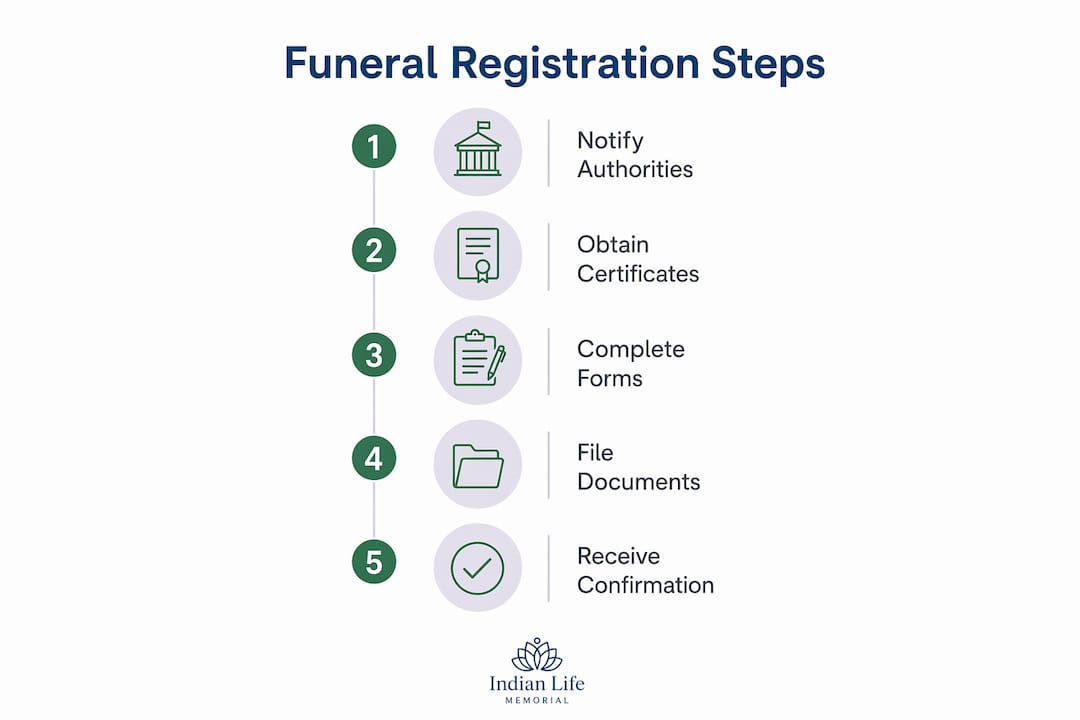
The funeral director's role goes well beyond arranging the service itself. Per the funeral director's responsibilities, this professional verifies personal information with the family, obtains the necessary signatures from medical certifiers, and files all required documents within the state-mandated timeframe. Families often underestimate how much administrative coordination this involves.

Electronic Death Registration Systems (EDRS) have made this process faster and more accurate in many states. These systems allow funeral directors, medical certifiers, and registrars to collaborate digitally, reducing the risk of errors and speeding up the issuance of certified copies.
Steps for completing and filing the death certificate:
- Funeral director meets with the family to collect personal information about the deceased.
- Funeral director prepares the personal data section of the death certificate.
- Medical certifier completes the cause-of-death section and signs the document.
- Funeral director reviews the completed certificate for accuracy.
- Certificate is submitted to the state or local registrar, electronically or in person.
- Registrar reviews and registers the document, then issues certified copies.
- Authorization for burial or cremation is granted once registration is confirmed.
How do funeral registration requirements vary by state?
State law governs nearly every aspect of the steps for registering a funeral, and the differences can be significant. What is standard procedure in one state may not apply in another.
Some states have specific filing deadlines, such as Florida's filing requirement, which is among the more detailed mandates in the country. Other states set their own deadlines, ranging from 24 hours to 10 days depending on jurisdiction and cause of death. Your funeral director will know the rules for your state, but your family should ask directly so there are no surprises.
Key differences families should verify for their state:
- Filing deadline: How many days after death must the certificate be filed?
- Authorization for disposition: Some states require a permit issued by the registrar; others require a form from a medical official; a few require no authorization unless the body crosses state lines.
- Electronic vs. paper filing: Many states now mandate EDRS, but some counties still use manual processes.
- Medical examiner jurisdiction: Unnatural, sudden, or unattended deaths trigger mandatory investigations that can delay registration by days or weeks.
- Out-of-state transport: Moving a body across state lines requires additional permits and compliance with both states' laws.
Families dealing with an unexpected death should ask the funeral director to communicate directly with the medical examiner's office. Proactive coordination often shortens the wait.
What families should know about obtaining certified death certificates
Certified copies of the death certificate are not just paperwork. They are the documents that unlock nearly every legal and financial process that follows a death.
You will need certified copies for insurance claims, probate court filings, closing bank accounts, transferring vehicle titles, notifying Social Security and pension administrators, and settling the estate. Each institution typically requires its own original certified copy. Requesting too few early on is one of the most common and avoidable sources of delay families face.
Pro Tip: Request multiple certified copies through your funeral home at the time of filing. Ordering additional copies later through the state vital records office takes longer and costs more per copy.
Actions your family should take after registration:
- Ask the funeral director how many certified copies are standard for your state and situation.
- Request additional copies if the estate is complex or involves multiple financial institutions.
- Keep a record of which institution received which copy.
- Follow up with the registrar's office if certified copies are delayed beyond the expected timeframe.
- Use certified copies promptly — some institutions have time-sensitive requirements for estate notifications.
If a medical examiner investigation is underway, the issuance of certified copies may be delayed until the cause of death is officially determined. Your funeral director can often provide a preliminary letter to institutions explaining the delay, which many will accept temporarily.
What should you expect at each step of the funeral registration process?
Walking through the process of funeral registration step by step helps your family know exactly what is coming and who handles each part. The last-minute funeral planning guide addresses many of these same pressures when time is short.
- Step 1 — Family meeting with the funeral director: You provide personal information about the deceased, including full legal name, date and place of birth, Social Security number, parents' names, and marital status. This becomes the informant section of the death certificate.
- Step 2 — Funeral director prepares the certificate: Using the information you provided, the director drafts the personal data section and coordinates with the medical certifier.
- Step 3 — Medical certifier completes cause of death: The attending physician, medical examiner, or coroner signs off on the cause-of-death section. This step can take hours or, in investigation cases, several days.
- Step 4 — Filing with the state registrar: The completed certificate is submitted, either through an EDRS or in person, within the state's required timeframe.
- Step 5 — Authorization for final disposition: Once the registrar accepts the certificate, a burial or cremation permit is issued. No disposition can legally proceed before this authorization.
- Step 6 — Certified copies issued: The registrar provides certified copies, which the funeral director typically delivers to your family.
- Step 7 — Funeral arrangements proceed: With authorization in hand, the funeral director can confirm burial, cremation, or other arrangements.
Common challenges at this stage include incomplete medical certifications, missing personal data from the family, and medical examiner holds. Each can be addressed through clear communication with your funeral director, who acts as the professional intermediary between your family and the legal system.
Indianlifememorial guides families through every step with care
Navigating funeral registration requirements while grieving is genuinely difficult. Indianlifememorial offers families a transparent, step-by-step approach to the entire funeral process, including the administrative and documentation responsibilities that most families have never encountered before.

Where the legal process can feel cold and procedural, Indianlifememorial brings compassion and clarity. The team handles coordination with the relevant authorities, guides families through the personal information they need to provide, and manages the documentation so your family can focus on honoring your loved one with the dignity they deserve. Services are available for Hindu, Christian, and all-faith families, with transparent pricing and no hidden fees.
To learn more about how Indianlifememorial supports families through the full process, visit the full-suite funeral services page or explore available funeral packages tailored to your family's needs and traditions.
Key Takeaways
Funeral registration in the United States is the legal process of filing a death certificate, managed by the funeral director with family input and medical certification required before any burial or cremation can proceed.
| Point | Details |
|---|---|
| Death certificate is the core document | No burial or cremation can proceed legally until the death certificate is filed and accepted by the state registrar. |
| Funeral director manages the process | The funeral director coordinates between your family, the medical certifier, and the registrar, handling all legal filings. |
| State deadlines vary | Some states require filing within a few days; other states set their own timelines that your funeral director will know. |
| Request multiple certified copies early | Order multiple certified copies at the time of filing to avoid delays with insurance, probate, and estate matters. |
| Indianlifememorial | Provides transparent, step-by-step funeral support for all faiths, including documentation guidance, with pricing from $1,888. |