

A funeral service order is a printed guide that outlines the sequence and elements of a funeral ceremony, helping guests follow and participate smoothly. Also called an order of service, this document serves as the official roadmap for the ceremony, ranging from a single folded sheet to a stapled booklet depending on the complexity of the service. For families planning a funeral, understanding this document removes one layer of uncertainty during an already difficult time. It tells every guest exactly what to expect at a funeral, when to stand, when to pray, and when to simply sit and remember.
What is a funeral service order and why does it matter?
A funeral service order is defined as a printed or digital document that guides attendees through each stage of a funeral ceremony in sequence. Beyond directing the ceremony's flow, the order of service reduces day-of stress and shifts focus from logistics to remembrance. Guests no longer need to wonder what comes next or feel anxious about missing a cue. That relief is not small. When grief is already heavy, a clear funeral service agenda lets families and friends stay present with their emotions rather than scanning the room for direction.
The document also serves as a lasting keepsake. Families often keep their copies for years, returning to them as a tangible memory of the person honored. Typical funeral services run 60–90 minutes, and a well-structured order of service holds that time together with dignity and purpose.

What are the essential components of a funeral service order?
Every funeral service order should contain certain core details. Without them, the document fails its primary purpose of guiding guests and honoring the deceased accurately.
Core identifying information:
- Full name of the deceased
- Date of birth and date of passing
- A photograph of the deceased
- Service date, time, and location
- Name of the officiant or presiding priest
Chronological order of service events:
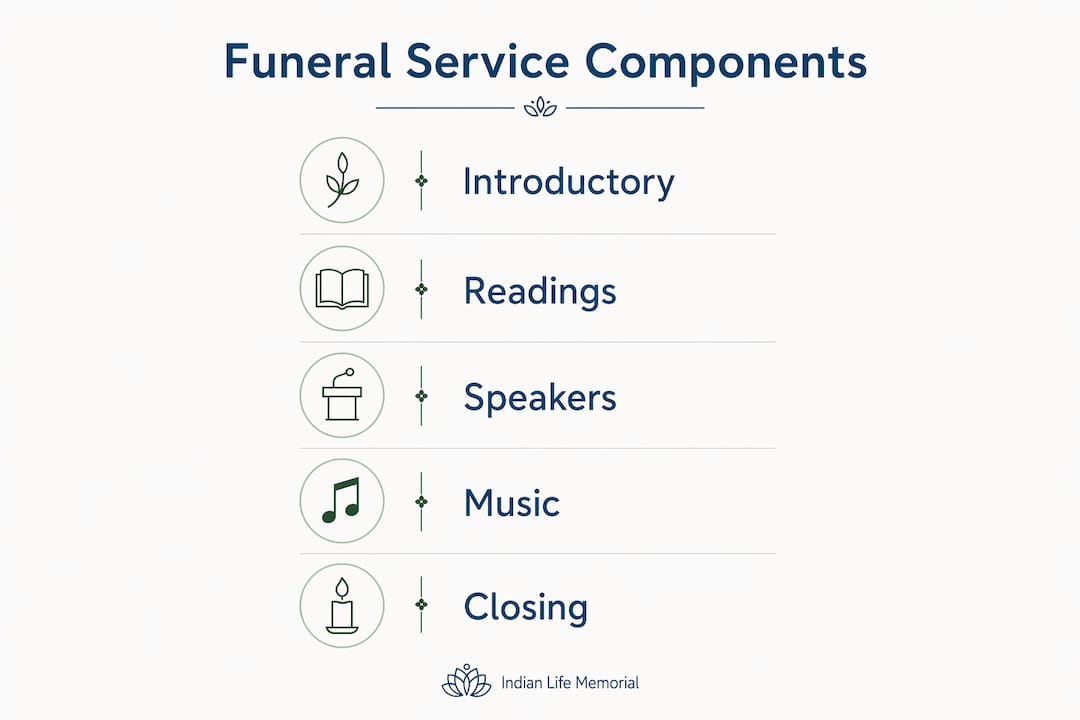
- Welcome or opening words by the officiant
- Opening prayer or moment of silence
- Scripture readings, poems, or reflections
- Musical tributes or congregational hymns
- Eulogy or life tribute by a family member or friend
- Additional readings or prayers
- Closing prayer or benediction
- Recessional
Essential components also include the names of speakers, musicians, and pallbearers. Families may add optional elements such as a thank-you note from the family, reception details, and information about charitable donations in the deceased's name. These additions transform the document from a simple schedule into a complete funeral service guide that guests will carry home with care.
How does a funeral service order differ from a funeral program?
The terms are often used interchangeably, but they describe documents with different primary purposes. Understanding the distinction helps families make better decisions about what to create.
| Feature | Order of Service | Funeral Program |
|---|---|---|
| Primary purpose | Guides ceremony sequence | Commemorates the deceased's life |
| Typical content | Event schedule, participant names | Biography, photos, personal tributes |
| Length | One folded sheet (4 panels) | Multi-page booklet |
| Tone | Functional and structured | Biographical and reflective |
| Common use | During the ceremony | Kept as a keepsake afterward |
Families increasingly merge these two formats into hybrid booklets that combine ceremony logistics with commemorative content. This hybrid approach is a growing trend in 2026, blending function and meaning into one document. The result is a booklet that guides guests through the service and then becomes a meaningful memorial to keep. Choosing between a strict order of service, a full funeral program, or a hybrid depends on the family's preferences, the complexity of the ceremony, and the time available for preparation.
What are best practices for creating a meaningful order of service?
There is no single standard format for a funeral service order. The document's tone should align with the funeral style, whether solemn and religious, secular and reflective, or a joyful celebration of life. That alignment is what makes the difference between a generic printed schedule and a tribute that truly honors the person.
Key best practices:
- Match the tone to the ceremony type. A Hindu funeral incorporating Vedic rites and Sanskrit prayers calls for a different register than a secular celebration of life.
- Add personal touches. A favorite quote, a short poem, or a brief reflection from the family gives the document warmth and individuality.
- Prioritize readability. Larger fonts and clean layouts improve guest comfort. Guests scan content quickly during a service, so dense text works against the document's purpose.
- Include full participation texts. Printing the full text of hymns, prayers, or responsive readings encourages congregational participation and deepens the ceremony's atmosphere, even for attendees who know the words by heart.
- Avoid overloading the document. Limit biographical text to what fits comfortably. A concise eulogy summary is more readable than a full transcript.
Pro Tip: Draft the order of service at least five days before the funeral. This gives time for family review, corrections, and printing without last-minute pressure.
Common pitfalls include misspelling the deceased's name or dates, listing participants who have not confirmed their role, and choosing a font size below 11 points. Each of these errors is avoidable with a single careful review by two family members before sending to print.
What are the practical steps for printing and distributing the order of service?
Printing decisions affect both cost and quality. Families have more options than they often realize.
- Format choices. A single sheet folded in half creates four panels, which suits a simple service. A stapled booklet works for longer ceremonies with biographical content and multiple readings.
- Printing options. Funeral homes offer in-house printing, but families are not required to purchase through them. Independent print shops and online services often provide greater creative control at lower cost. DIY design using tools like Canva or Microsoft Word is also a practical option for families with time and design confidence.
- Timing. Finalize all content at least 48 hours before the service. Allow 24 hours for professional printing and delivery.
- Quantity. Print slightly more copies than the expected guest count. Extra copies go to family members who could not attend and serve as keepsakes.
- Distribution. Assign a volunteer or funeral home staff member to hand programs to guests as they arrive. Place extras on a table near the entrance.
- Digital alternatives. Many families now include a QR code linking to a digital version or a livestream for guests who cannot attend in person. This is especially relevant for Singapore families with relatives abroad.
Choosing to print independently allows families to customize designs and save money, though it requires more coordination. Weigh that tradeoff honestly against the time and energy available during bereavement.
How do funeral service orders vary across cultures and religious traditions?
The structure of a funeral and its accompanying order of service changes significantly across faith traditions. A document designed for a Catholic Requiem Mass looks very different from one prepared for a Hindu Antyesti ceremony or a secular memorial.
Christian services typically include:
- Opening hymn and welcome
- Scripture readings from the Old and New Testaments
- Sermon or homily by the pastor or priest
- Congregational prayers and responses
- Closing hymn and benediction
Hindu and Indian funeral services follow the sacred Antyesti Samskaras, the last rites that guide the Atman toward its next transition. A Pandit leads the ceremony through Vedic prayers, fire rituals, and specific rites that vary by regional tradition. The order of service for a Hindu funeral reflects these stages clearly, helping family members who may be less familiar with the full sequence of rites to follow with reverence.
Secular or freethinker celebrations of life replace religious elements with personal tributes, music chosen by the deceased, and open sharing from friends and family. The tone is often warmer and less formal, and the order of service reflects that by using conversational language and personal photographs throughout.
Regardless of tradition, the funeral service order should reflect the tone and personality of the deceased while respecting the family's customs. Flexibility in format is not a compromise. It is a sign of genuine respect.
Key Takeaways
A funeral service order is both a practical ceremony guide and a lasting tribute, and its value depends entirely on how thoughtfully it is prepared.
| Point | Details |
|---|---|
| Core purpose | The order of service guides guests through each ceremony stage and reduces day-of anxiety. |
| Essential content | Include the deceased's full name, dates, photo, event sequence, and participant names. |
| Program vs. order of service | Hybrid booklets combining both formats are the most common choice for families today. |
| Design and readability | Use larger fonts, clean layouts, and full participation texts to improve the guest experience. |
| Printing flexibility | Families may print independently to save costs and gain creative control over the design. |
Why the order of service matters more than families expect
Having supported many families through the funeral planning process, I have watched the order of service do something quietly remarkable. When guests walk into a service and receive a printed program, their shoulders visibly relax. They know what is coming. That small document reduces anxiety in a room already heavy with grief, and that matters more than most families anticipate when they first sit down to plan.
The families who invest real care in their order of service, choosing a meaningful photograph, selecting a poem the deceased loved, printing it cleanly and legibly, create something guests carry home and keep. I have seen programs tucked into wallets and placed on refrigerators months after a service. That is not a logistics document. That is a tribute.
My honest advice: do not treat the order of service as a last-minute task. Treat it as one of the most personal things you will create during the planning process. The structure of a funeral can be managed by professionals, but the personal touches in the program come only from the people who knew and loved the deceased. Give that task the time and attention it deserves.
— Admin
How Indianlifememorial supports families with funeral service orders
Indianlifememorial works with families across Singapore to prepare funeral ceremonies that are both culturally faithful and personally meaningful. That includes helping families create orders of service that reflect their faith tradition, whether Hindu, Christian, freethinker, or another background.
The team at Indianlifememorial handles the details that families should not have to manage alone during bereavement. From coordinating experienced Pandits for Vedic rites to supporting the preparation of printed programs, the full-suite funeral services cover every stage of the ceremony. Packages start at $1,888 with transparent pricing and no hidden fees. Families can focus on honoring their loved one while Indianlifememorial manages the logistics with care and professionalism.
FAQ
What is included in a funeral service order?
A funeral service order includes the deceased's full name, birth and death dates, a photograph, the service schedule, and the names of participants such as speakers and musicians. Optional additions include thank-you notes, reception details, and charitable donation information.
How long should a funeral service order be?
Most orders of service fit on a single folded sheet for simple ceremonies or a short stapled booklet for longer services. The length should match the complexity of the ceremony, not exceed it.
What is the difference between an order of service and a funeral program?
An order of service focuses on the ceremony sequence, while a funeral program is more biographical and commemorative. Many families today combine both into a single hybrid booklet.
When should the funeral service order be finalized?
Finalize all content at least 48 hours before the service to allow time for printing and review. Aim for five days in advance to avoid last-minute errors.
Can families design and print their own order of service?
Families are not required to use a funeral home's printing services. Independent print shops and design tools offer more creative control, often at lower cost, though they require additional coordination from the family.