

A funeral director is a licensed professional who manages every aspect of a funeral service, from legal documentation to compassionate family support. Understanding what is a funeral director role helps your family make informed decisions during one of the most difficult times you will face. These professionals carry legal authority over the disposition of remains, coordinate logistics across multiple agencies, and serve as your primary guide through the entire process. Knowing what they do, and what they do not do, gives your family clarity and confidence when you need it most.
What is a funeral director's role in legal and operational duties?
Funeral directors hold legal authority over the disposition of remains. This means they are responsible for filing death certificates, securing burial or cremation permits, and coordinating with cemeteries, crematoriums, and government agencies. Without these steps completed correctly, a burial or cremation cannot legally proceed.
The operational scope of a funeral director is broad. They manage body transportation from the place of death to the funeral home, oversee preparation and embalming, and schedule all service logistics. They also run the business functions of the funeral home, including compliance with state and local regulations.
Many families are surprised by how much happens before the ceremony begins. A funeral director's duties include:
- Filing the official death certificate with the relevant government authority
- Obtaining permits for burial, cremation, or transport across state or national borders
- Coordinating with hospitals, hospices, or medical examiners for body release
- Arranging transportation of remains to the funeral home and final resting place
- Managing vendor relationships with florists, cemeteries, and officiants
- Maintaining compliance with health, safety, and licensing regulations
Pro Tip: Ask your funeral director for a written timeline of all legal steps they will complete on your behalf. This removes uncertainty and gives your family a clear picture of what happens and when.
The legal and logistical duties of a funeral director go far beyond what families see at the service. They project manage strict timelines, navigate regulatory requirements, and protect your family from costly errors.
How does a funeral director support families through planning?
A funeral director is the first professional your family meets after a death. That first conversation sets the tone for everything that follows. Their job is to translate your grief into a structured plan, one that honors your loved one while meeting every legal requirement.

Funeral professionals provide immediate body transportation, religious and ritual planning, venue booking, and coordination between families and regulatory bodies. This support turns chaotic grief moments into structured plans within days. For families observing specific traditions, such as Hindu Antyesti rites or Christian burial customs, this coordination is especially critical.
Here is how a funeral director typically guides families through the planning process:
- Initial consultation. The director meets with your family to understand your loved one's wishes, religious traditions, and budget. This is where priorities are set.
- Service design. The director coordinates all service elements, including venue, music, readings, officiants, and cultural or religious rites such as Vedic Samskaras or prayers.
- Documentation and permits. All legal paperwork is completed on your behalf, so your family does not have to manage government offices during grief.
- Day-of coordination. The director oversees every detail on the day of the service, from arrival of the hearse to the final committal.
- Post-service support. Many directors assist with notifying agencies, returning personal effects, and connecting families with grief counseling resources.
Pro Tip: Treat your funeral director as a partner, not just a vendor. Being transparent about your budget and cultural values early allows them to focus on what matters most to your family and shield you from unnecessary pressures.
Families who share their expectations openly receive better outcomes. The director can then allocate time and resources to the elements your family values most, whether that is a traditional procession, a specific priest, or a particular cremation timeline.
What is the difference between a funeral director, arranger, and planner?
These three titles are often used interchangeably, but they describe distinct responsibilities. Understanding the differences helps your family set the right expectations.
A licensed funeral director holds legal accountability for the disposition of remains and overall project management. A funeral arranger or coordinator typically focuses on the family experience and service details, often without a formal license. A funeral planner may work independently, outside of any funeral home, to advocate for a family's interests.
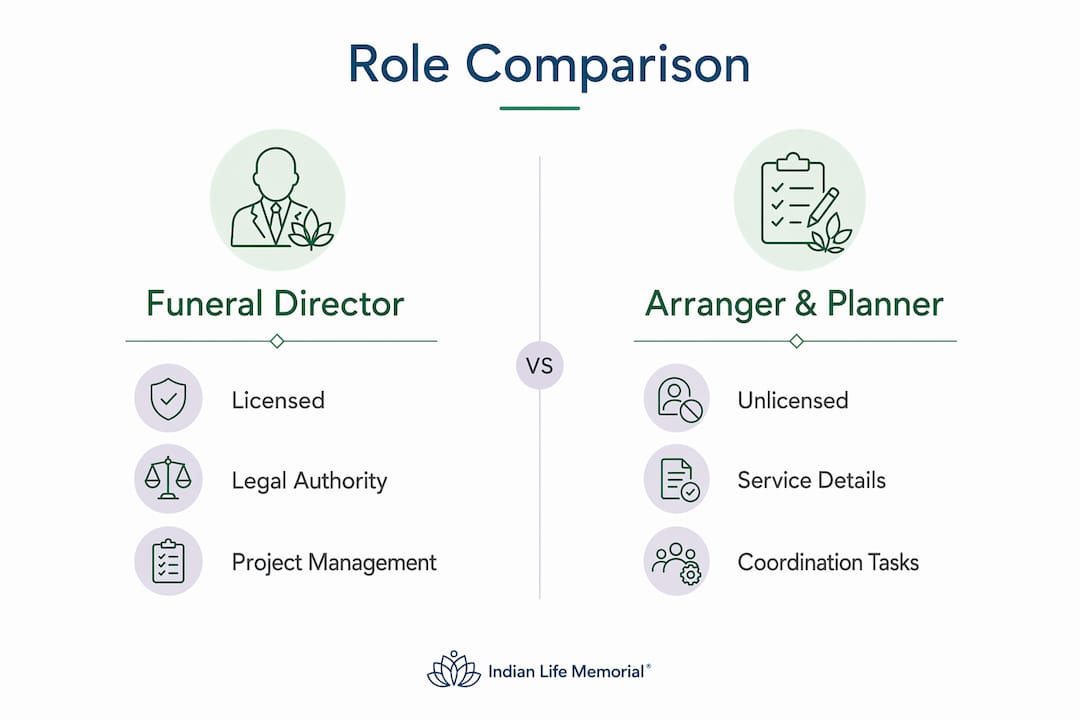
| Role | Licensed? | Primary focus | Legal authority |
|---|---|---|---|
| Funeral director | Yes | Legal compliance, full project management | Yes, over disposition of remains |
| Funeral arranger | Often no | Service details, family communication | No |
| Funeral planner | Varies | Independent advocacy, service coordination | No |
The size of the funeral home often determines how these roles overlap. In smaller operations, one person may serve all three functions. In larger firms, directors delegate front-end planning to arrangers while retaining legal oversight. Knowing which person holds legal responsibility helps your family direct the right questions to the right professional.
What qualifications does a funeral director need?
Becoming a funeral director requires formal education, supervised practice, and state licensure. The path is more structured than most families realize.
The standard qualifications include:
- Mortuary science degree. Most states require an associate's or bachelor's degree in funeral service or mortuary science from an accredited program.
- Apprenticeship. Candidates complete a supervised apprenticeship, typically one to three years, under a licensed director before sitting for board exams.
- State board examination. Passing a national or state licensing exam is required before practicing independently.
- Continuing education. Licensed directors complete ongoing training in ethics, grief counseling, legal updates, and cultural competency to maintain their license.
The balance between technical management and emotional support is what gives families real security during grief. A well-trained director acts as a translator of complex legal and cultural requirements, turning them into clear, manageable steps for your family. Qualifications directly affect the quality of that translation.
Cultural competency training is particularly valuable. A director who understands the significance of Atman in Hindu tradition, or the specific timing requirements of certain religious rites, can coordinate services with far greater accuracy and respect.
How do funeral directors handle complex or distant arrangements?
Not every funeral is straightforward. Deaths that occur far from home, family conflicts over arrangements, and preplanned contracts all create additional layers of complexity that a funeral director must manage.
For distant or complex arrangements, families can consider hiring an independent funeral planner or advocate. This professional works solely for the family, not the funeral home, and provides focused support beyond what funeral home staff can manage. They are especially useful when family members are spread across different countries or when there are disagreements about the type of service.
Key considerations for complex scenarios include:
- Contract portability. If your family has a prepaid funeral plan, verify that the contract can transfer to a different funeral home. This detail surprises many families and should be confirmed before signing.
- Cross-border logistics. International repatriation of remains requires additional permits, airline coordination, and sometimes consular involvement. A licensed director manages all of this.
- Family dynamics. When family members disagree on service choices, a skilled director acts as a neutral coordinator, keeping the focus on honoring the deceased.
- Preplanning benefits. Arranging services in advance with a licensed director locks in preferences and reduces the burden on your family at the time of death.
For families navigating urgent funeral arrangements, having a director who understands both legal timelines and cultural requirements is the single most important factor in a smooth process.
Key Takeaways
A funeral director is a licensed professional who combines legal authority, logistical management, and compassionate family guidance into a single, accountable role.
| Point | Details |
|---|---|
| Legal authority | Funeral directors hold legal responsibility for filing death certificates, permits, and disposition of remains. |
| Full project management | They coordinate transportation, vendors, venues, and compliance from death to final committal. |
| Family guidance | Directors serve as the first point of contact, translating grief into a structured, respectful plan. |
| Role distinctions | Funeral arrangers and planners support the process but do not carry the director's legal accountability. |
| Qualifications matter | Licensure, mortuary science education, and cultural competency training directly affect service quality. |
What families often miss about the funeral director's role
Working closely with families during some of their hardest days has taught me one consistent truth: most families arrive thinking a funeral director is primarily a ceremony organizer. They are not. The ceremony is the visible tip of a much larger operation.
The dual role as legal overseer and emotional translator is what makes this profession genuinely demanding. A director may spend the morning filing permits with a government office and the afternoon sitting with a grieving mother, helping her choose readings that reflect her son's life. Both tasks require full attention and completely different skills.
The misconception I see most often is that families feel they should not ask questions, as if the director has everything handled and questions would be an imposition. The opposite is true. Directors who work transparently with families, who share timelines, explain costs, and invite questions, produce better outcomes for everyone. Your family's clarity is part of the service.
My advice is direct: bring your budget, your cultural requirements, and your honest expectations to the very first meeting. If your family observes specific Hindu rites, ask whether the director has experience coordinating with a Pandit and managing Vedic timelines. If you are planning from abroad, ask specifically about diaspora funeral considerations. A director who welcomes these questions is a director worth trusting.
— Admin
Indianlifememorial: funeral director services for every faith
Indianlifememorial provides 24/7 funeral director services in Singapore, covering Hindu, Christian, freethinker, and multi-faith families with equal care and expertise.

Every family receives a dedicated coordinator who manages legal documentation, cultural rites, and service logistics from the first call through the final committal. Pricing starts at $1,888 with no hidden fees, so your family can focus on honoring your loved one rather than managing costs. Indianlifememorial's team includes experienced Pandits for Vedic Antyesti rites and coordinators trained in diverse faith traditions. Explore the full range of funeral services available or review service packages to find the right level of support for your family.
FAQ
What does a funeral director do on the day of the service?
A funeral director oversees every operational detail on the day of the service, including hearse arrival, coordination with officiants, and the final committal. They act as the on-site project manager so your family can be fully present.
Is a funeral director the same as a funeral coordinator?
A funeral director holds a state license and legal authority over the disposition of remains, while a funeral coordinator typically focuses on service planning and family communication without that legal accountability. In smaller funeral homes, one person may perform both functions.
How do I know if a funeral director is properly licensed?
You can verify a funeral director's license through your state or national licensing board. Licensed directors are required to display their credentials and comply with ongoing education requirements.
What should I ask a funeral director at the first meeting?
Ask about their experience with your specific cultural or religious traditions, their full fee structure, the timeline for legal documentation, and whether prepaid contracts are transferable. Clear answers to these questions indicate a trustworthy professional.
Can a funeral director handle arrangements from another country?
Yes. Licensed funeral directors manage cross-border logistics, including international repatriation permits, airline coordination, and consular documentation. Families arranging services from abroad should confirm these capabilities before engaging a director.