

A funeral program is a printed or digital document that guides guests through a service and preserves the memory of a loved one's life. Understanding how funeral programs are prepared helps your family create something that is both a practical guide for attendees and a lasting keepsake. The program typically contains the full name and dates of the deceased, the order of service, names of participants, and meaningful personal touches such as photos or poems. Getting this right requires gathering accurate information, choosing a clear layout, and following a disciplined timeline.
What essential information goes into a funeral program?
A funeral program serves two purposes at once. It tells guests what to expect during the service, and it honors the person who has passed. Every program should contain the following core elements:
- Full name of the deceased, including any preferred names or honorifics
- Birth and death dates, formatted clearly (for example, March 4, 1945 – january 12, 2026)
- Service details: date, time, venue, and the name of the officiant or Pandit
- Order of service: a numbered sequence of every element, from the opening prayer to the final blessing
- Participant names and roles: eulogists, musicians, pallbearers, and readers
- Photos: at least one clear, high-quality portrait
- Personal touches: a favorite poem, a short biography, a meaningful quote, or a prayer
- Reception information: location, time, and any instructions for guests
- Livestream link or QR code for remote attendees
That last item matters more than many families realize. Over 50% of NFDA-member funeral homes now offer livestreaming and include QR codes in programs. Including this detail ensures that family members who cannot attend in person still feel connected to the service.
Pro Tip: Start with the order of service before writing any other section. Once the sequence is confirmed, every other detail falls into place naturally around it.

The program is not an obituary. Keep biographical text brief and focused. Guests read programs quickly, so every line should earn its place on the page.
How are funeral programs prepared on a practical timeline?
The preparation of funeral programs follows a clear, time-sensitive workflow. Families who understand this timeline avoid last-minute panic and costly reprints.
- Days 5–6 before the service: Finalize the order of service and all content. Confirm participant names, spellings, and roles. Lock in the design.
- Days 3–4 before the service: Submit the final file to the printer. Confirm quantity, paper stock, and fold format.
- Days 1–2 before the service: Collect printed copies. Review every page carefully for errors in names, dates, and sequence.
- Day of the service: Assign one person to distribute programs at the entrance before guests arrive.
The recommended workflow is to finalize design 5–6 days before the service, send to print 3–4 days before, and collect copies 1–2 days prior for review. This buffer is not optional. It gives your family time to catch errors and request corrections before the service begins.
Funeral program preparation generally requires 2–3 days at minimum, with printing completed at least one day before the service. That is the absolute floor. Families who start earlier have more time to personalize and less stress overall.
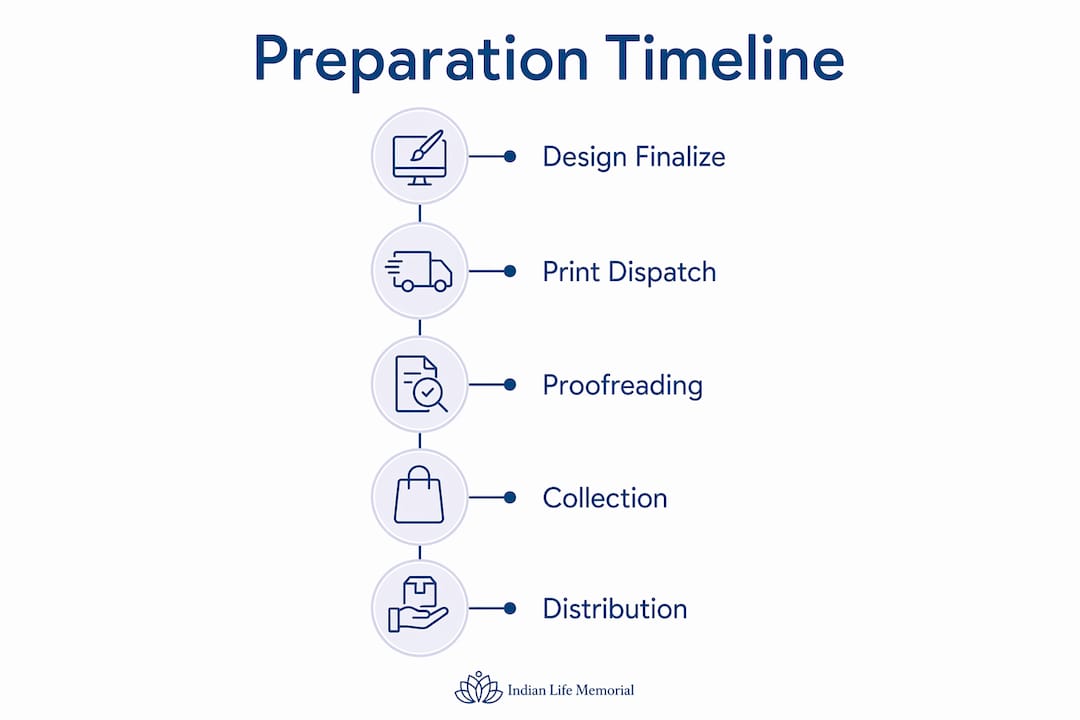
Proofreading is the step most families underestimate. Proofreading by at least two people, ideally including the officiant, is critical to avoid errors in names and dates. A misspelled name or wrong date on a funeral program causes real distress. Ask someone outside the immediate family to read the draft with fresh eyes.
How do you choose the right funeral program layout?
The funeral program layout determines how easy the program is to read and how much content it can hold. The most common formats are:
| Format | Best for | Typical size |
|---|---|---|
| Single bifold | Short services, simple content | Letter sheet folded in half |
| Trifold | Moderate content with photos | Letter sheet folded in thirds |
| Booklet | Long services, full hymn texts | Multiple pages, staple-bound |
| Single sheet | Very brief services | Half-letter or A5 |
Choose the format based on content length, not personal preference. A bifold works well for a 45-minute service with a short biography and four service elements. A booklet suits a longer Hindu Antyesti ceremony or a Christian service with full hymn lyrics and multiple readings.
Font size is non-negotiable for readability. Text should use a minimum 11–12pt font for body text in both print and digital versions. Older guests struggle with anything smaller. Use a clean, serif font such as Georgia or Times New Roman for body text, and a slightly larger sans-serif for headings.
Photo selection matters as much as font choice. Choose one strong, clear portrait for the cover. Avoid low-resolution images that print blurry. If the family wants additional photos inside, limit them to two or three and place them where they do not interrupt the order of service text.
Including full hymn or prayer texts is best practice if guests are expected to participate, but the program should prioritize readability over completeness. Do not assume guests know the words to a hymn or a Sanskrit prayer. Print the full text. If space is tight, use a booklet format rather than shrinking the font.
Pro Tip: Before sending to print, open the digital file on your phone. If the text is hard to read on a small screen, it will be even harder for older guests to read on paper. Adjust before printing.
Testing digital files on small screens ensures legibility for both printed and digital guests, improving overall accessibility. This single step catches font size problems, image quality issues, and layout breaks that desktop previews often miss.
What are the most common mistakes in funeral program preparation?
Most errors in funeral programs come from rushing the process or skipping structured steps. These mistakes are preventable.
- Starting design before locking the order of service. Changing the sequence after design often breaks formatting and forces a full redesign. Confirm the service order first, always.
- Skipping a template. Using a proven template and filling it section by section reduces cognitive load during stressful times. Funeral program templates give families a clear structure to follow without starting from a blank page.
- Relying on one proofreader. One person misses what two people catch. Assign at least two readers, including someone who knew the deceased well enough to spot name or date errors.
- Setting no deadline for final changes. Without a firm cutoff, family members keep requesting edits. Set a clear deadline for all changes, and hold to it.
- Forgetting to assign a distributor. Appoint someone to distribute programs before the service starts. Programs handed out after guests are seated create confusion and noise.
- Overloading the design. Too many fonts, decorative borders, and long text blocks make the program hard to read. Restraint is respectful.
- Treating the program like an obituary. The program guides guests through the service. Keep biographical text short. Direct readers to a separate memorial booklet or website for the full life story.
Pro Tip: Assign one family member as the "program coordinator" from day one. This person owns all deadlines, collects information from participants, and approves the final proof. Shared responsibility without a clear owner leads to missed details.
The most effective funeral programs are those that exactly match the service, starting with key moments and working backward to avoid filler content. Build the program around what actually happens, not what you hope will happen.
Key Takeaways
A well-prepared funeral program requires locking the order of service first, following a clear timeline, and proofreading with multiple readers before printing.
| Point | Details |
|---|---|
| Lock the order of service first | Confirm the service sequence before designing to prevent formatting rework and errors. |
| Follow a structured timeline | Finalize design 5–6 days out, submit to print 3–4 days out, and collect copies 1–2 days before. |
| Use a proven template | Funeral program templates reduce stress and give families a clear structure to fill section by section. |
| Proofread with multiple readers | At least two people, including the officiant, should review the draft to catch name and date errors. |
| Match format to content length | Choose bifold, trifold, or booklet based on how much content the service requires, not preference. |
What I have learned from watching families prepare funeral programs
After working with many bereaved families, one pattern stands out clearly. The families who start with the order of service, rather than the design, always produce better programs with less stress. It sounds obvious, but grief makes it easy to reach for something visual first. Choosing a background color or a decorative border feels manageable when everything else feels impossible. The problem is that design decisions made before the content is final almost always need to be redone.
The second thing I have seen consistently is that readability for older guests is underestimated. A beautiful, elegant font at 9pt is genuinely difficult for a 70-year-old to read in a dimly lit chapel. I always recommend families print one test copy and hand it to the oldest person they know. If that person reads it without squinting, the design works.
Digital and printed programs are not competing options. They complement each other. A printed program serves guests in the room. A digital version, shared via a QR code or a link, serves remote family members and becomes a permanent record. Families who prepare both versions honor more people with less additional effort than they expect.
My most practical advice on timing: treat the print deadline as the service deadline. If the service is on a Friday, the program should be in your hands by Wednesday. That buffer has saved families from real distress more times than I can count.
— Admin
How Indianlifememorial supports families with funeral programs
Preparing a funeral program while grieving is genuinely difficult. Indianlifememorial works directly with families to gather accurate information, coordinate design, and manage printing so that nothing falls through the cracks.
Indianlifememorial's full-suite funeral services include program preparation tailored to your faith tradition, whether Hindu, Christian, or another. The team coordinates with your family to confirm participant names, service sequence, and personal details, then produces a program that reflects your loved one's life with clarity and respect. For families who need support urgently, 24-hour availability means help is always within reach. Pricing starts at $1,888 with no hidden fees, so your family can focus entirely on honoring the person you have lost.
FAQ
What does a funeral program typically include?
A funeral program includes the deceased's full name and dates, the order of service, participant names and roles, photos, and personal elements such as poems or prayers. It may also include a QR code or livestream link for remote guests.
How long does it take to prepare a funeral program?
Funeral program preparation generally requires 2–3 days at minimum, with printing completed at least one day before the service. Starting 5–6 days before the service gives families time for corrections and reprints.
What is the best format for a funeral program?
The best format depends on content length. A bifold suits short services, a trifold works for moderate content, and a booklet is best for longer services with full hymn texts or multiple readings.
How do you personalize a funeral program?
Personalizing a funeral program means including a meaningful photo, a favorite poem or quote, a short biography, and any cultural or religious elements specific to the deceased's faith and traditions.
Who should proofread a funeral program before printing?
At least two people should proofread the program, ideally including the officiant or Pandit. A second reader outside the immediate family often catches name spellings and date errors that grieving family members overlook.