
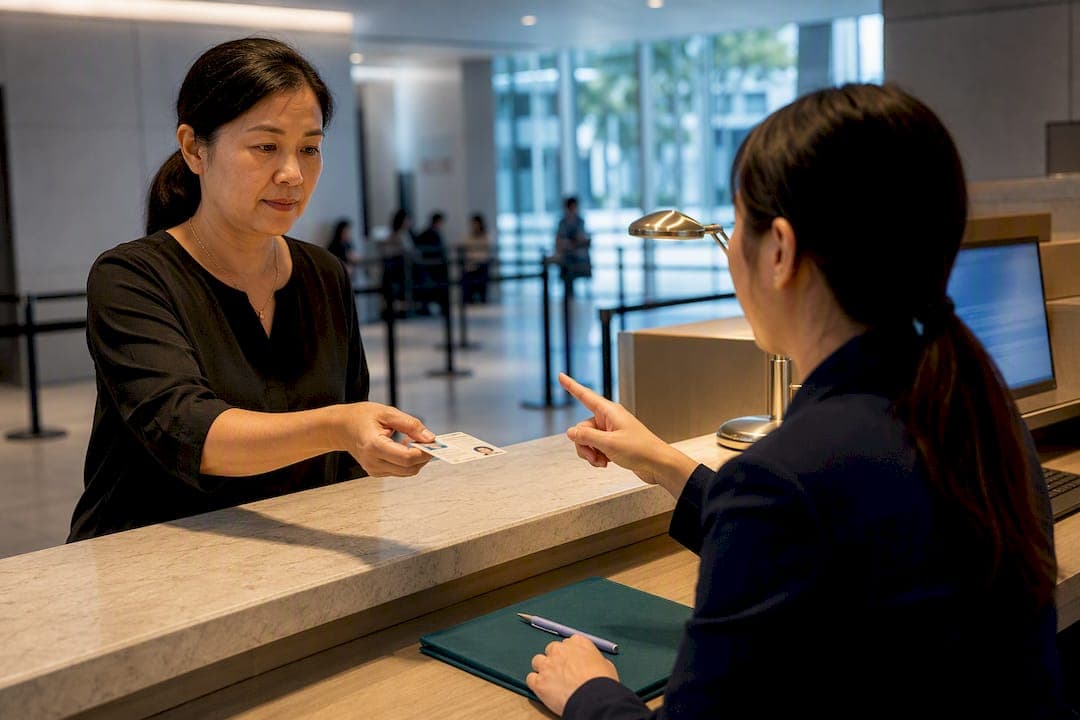
Yes. If your wake will be held at a Town Council–managed void deck, multipurpose hall, or pavilion, you need a Town Council venue permit before you set up anything. Visit your Town Council office in person with your NRIC and the digital death certificate, or ask your funeral director to handle this on your behalf. This permit is separate from the NEA burial or cremation permit.
TL;DR:
- The Town Council permit only covers the use of common spaces like void decks, halls, or pavilions, and separate permits are required for HDB parking, road closures, or other facilities.
- Applicants must bring ID, digital death certificates, contact details, proof of residency if needed, preferred dates, equipment needs, and payment methods to get the permit approved in a single visit.
- Processing of secondary permits for parking, road access, or traffic control can take longer than the venue permit, so early application is recommended.
- Funeral directors often handle permit submissions for families, but families may still need to personally sign or verify documents depending on the town council’s requirements.
- Fees vary, with some Town Councils waiving rental charges, but the permit process and fees for extra needs must be managed separately from the burial or cremation permits.
Table of Contents
- Quick Checklist: What to Bring for Your Town Council Funeral Permit Application
- Which Permits Cover What: Town Council, NEA, HDB, SLA, and Police
- How to Apply for a Town Council Permit in Person
- Venue Rules: Void Decks, Halls, Pavilions, and Parking Eligibility
- How Funeral Directors Handle the Permit Process
- Fees, Timelines, and Common Mistakes to Avoid
- How Indian Life Memorial Supports Families Through the Permit Process
- Skip the Paperwork Runaround With Full-Service Permit Handling
- Government Pages and Resources to Check Before You Apply
Quick Checklist: What to Bring for Your Town Council Funeral Permit Application
Grief leaves little room for paperwork, so knowing exactly what to carry to the Town Council office saves a wasted trip. Bring these items the first time, and you will likely walk out with an approved permit slip the same visit.
- NRIC of the applicant (usually the next-of-kin)
- Digital death certificate, or a hard copy if the digital version is not yet issued
- Contact numbers for the applicant and, if different, the family member overseeing the wake
- Proof of residency, if your Town Council restricts bookings to precinct residents
- Your preferred dates, times, and the specific venue area you want (void deck, hall, or pavilion)
- A rough list of equipment needs: standing fans, tentage, electricity points
- Payment method for any applicable rental or utility charges
Once you arrive, confirm the office's opening hours before you leave home. Most Town Council offices only process funeral permit applications during standard working hours, not after hours or on weekends.
Pro Tip: Call ahead to check if your specific block's void deck is already booked for another event. Town Councils don't take phone reservations, but a quick call can save you a wasted trip if the space is unavailable that week.

Which Permits Cover What: Town Council, NEA, HDB, SLA, and Police
Families often assume one permit covers everything. It doesn't. Five different Singapore authorities may be involved, and each governs a separate piece of the wake.
- Town Councils issue the venue permit for common property, including void decks, multipurpose halls, and pavilions.
- NEA issues the burial or cremation permit, which governs disposal of the deceased's remains, not where the wake is held.
- HDB handles temporary use of surface car parks for bereavement purposes, through the HDB Branch or the eFeedback portal under "Car Park" and "Use of Car Parks for Non-Parking Purpose." Some Town Councils also limit venue bookings to residents of that same precinct.
- SLA issues a Temporary Occupation Licence (TOL) if your wake setup spills onto public roads or walkways outside the HDB estate.
- Police manage road closures and traffic control permits, needed only if the wake requires blocking a road or redirecting traffic.
Treating the Town Council permit as a catch-all is the single most common mistake families make. It covers the void deck or hall. Nothing more.
How to Apply for a Town Council Permit in Person
Every HDB estate falls under a specific Town Council, and that Town Council's office is where the entire process starts. Check your town council's website or your HDB block's signage to confirm which one manages your estate, along with its office address and contact number.
- Present your documents. Bring NRIC and the digital death certificate to the counter.
- State your proposed dates and times. Wakes typically run for a defined number of days, so tell staff your intended start and end.
- Specify equipment needs. Mention fans, electricity points, or tentage upfront so charges are calculated correctly.
- Pay any applicable fees. Some Town Councils waive bereavement rental charges; ask directly.
- Receive written approval. Do not begin setup until you have a signed permit slip in hand.
If your wake needs adjacent parking, public road access, or traffic control, you'll need to file separately with HDB, SLA, or the police. Processing for these secondary permits can take longer than the Town Council slip itself, so start those applications as early as possible.
Pro Tip: If a funeral director is handling arrangements, ask exactly which documents they can submit without you present, and which steps still require your signature or ID in person. Some Town Councils require the applicant to appear personally, even when a director manages everything else.
Venue Rules: Void Decks, Halls, Pavilions, and Parking Eligibility
Not every resident can book every space, and not every space allows the same activities. Town Councils publish rules that vary by estate, but a few patterns repeat across most of them.
- Many Town Councils require the applicant or the deceased to have lived in that precinct, so confirm eligibility before planning around a specific void deck.
- Applications are typically accepted only a short window in advance, not months ahead.
- Fans and basic lighting are usually allowed; generators, open flames, and loud amplified music are often restricted or banned outright.
- Charges commonly include venue rental plus a per-point fee for electricity and water, though some Town Councils or Members of Parliament waive rental fees for bereaved families.
- Bookings are processed on a first-come-first-served basis. You cannot informally "hold" a void deck by word of mouth. Only a written approval secures the space.
Adjacent car park use is never automatically included. That requires its own HDB application.
How Funeral Directors Handle the Permit Process
Most funeral directors in Singapore routinely liaise with the Town Council, submit the required paperwork, and coordinate setup timing so families don't have to shuttle between offices during an already exhausting week. What they need from you is straightforward: a signed authorization, your NRIC, and reliable contact details for the next-of-kin.
Even with a director managing logistics, some Town Councils still require the family member's physical signature or ID verification at the counter. Confirm in writing, before the day arrives, exactly which steps your director will handle and which ones still need you present.
Fees, Timelines, and Common Mistakes to Avoid
Expect three broad fee categories: venue rental, electricity or water per connection point, and fan or equipment charges. Some Town Councils and MPs waive bereavement rental fees entirely, so it's worth asking rather than assuming you'll pay full price.
The Town Council venue permit and the NEA burial or cremation permit are entirely separate processes. NEA's e-Services portal handles the disposal side; your Town Council handles the space where the wake happens. Confusing the two is one of the most frequent causes of delayed setups.
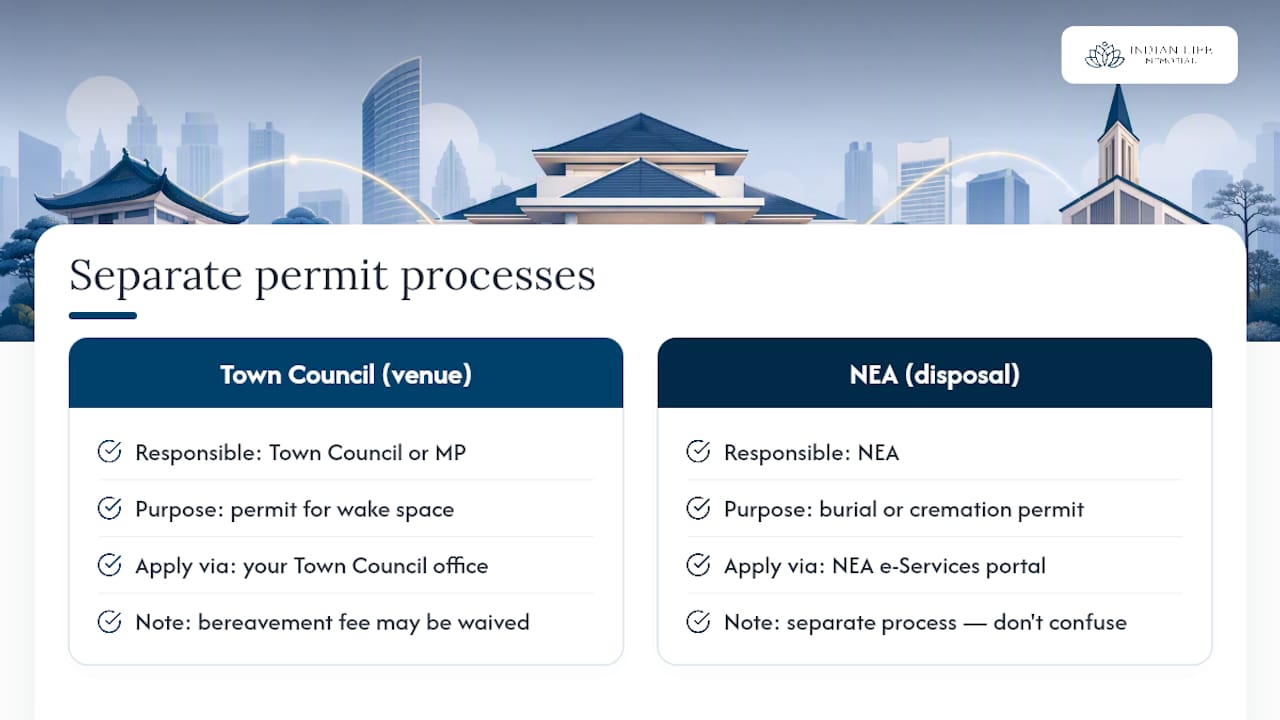
Other recurring mistakes: assuming the venue permit automatically covers the adjacent car park (it doesn't), starting setup before written approval arrives, and forgetting that SLA or police permits are needed if the wake spills onto public roads.
How Indian Life Memorial Supports Families Through the Permit Process
Coordinating Town Council paperwork while grieving is exactly where a full-suite funeral partner earns its place. Indian Life Memorial handles permit coordination, arranges Vedic rites with experienced priests, and keeps pricing transparent from the start, with packages beginning at $1,888 and no hidden fees. Support runs around the clock, so reach out the moment you need guidance.
Skip the Paperwork Runaround With Full-Service Permit Handling
Chasing down Town Council offices, HDB eFeedback forms, and NEA e-Services while arranging a wake is a lot to carry alone during a week that's already overwhelming in every other way. Indian Life Memorial is the alternative to piecing this together yourself: our team liaises directly with your Town Council, files the venue permit paperwork, and coordinates HDB or SLA approvals when your wake setup needs them, so your family can focus on the rites and the mourning instead of counter queues.

Pricing starts at $1,888 with no hidden fees, and every package can be arranged around Hindu, Christian, or other faith traditions depending on what your family needs. Explore our full-suite funeral services to see exactly what's included, or check our package pricing to compare options before you commit. Call our team now for immediate, 24/7 assistance with permits, logistics, and every step in between.
Government Pages and Resources to Check Before You Apply
For burial or cremation permit details, use NEA's e-Services portal directly. For venue rules specific to your estate, check your own Town Council's website, using pages like West Coast–Jurong West Town Council's common property guidelines as a reference point. HDB's eFeedback portal covers temporary parking requests, SLA handles Temporary Occupation Licences for public roads, and the Singapore Police Force manages road-closure permits. Families also planning the broader event may find this celebration of life planning guide useful for logistics beyond permits, and our Hindu funeral guide walks through culturally specific rites alongside these venue requirements.