
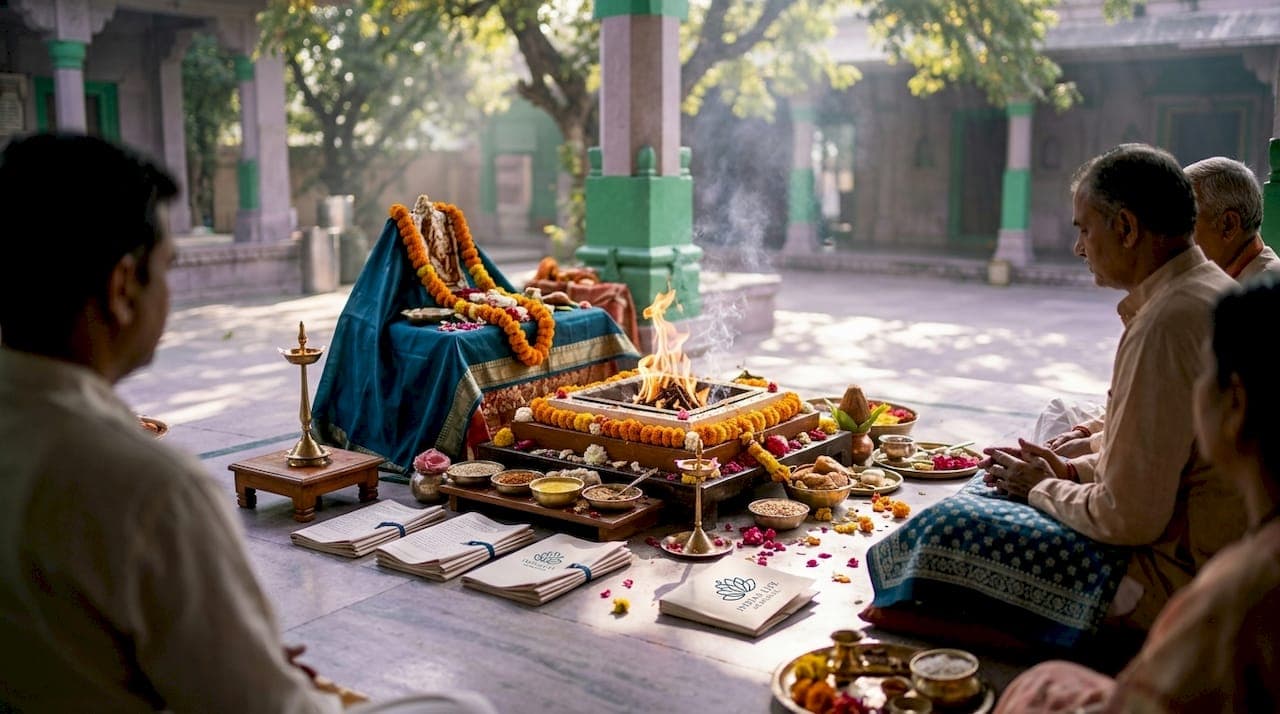
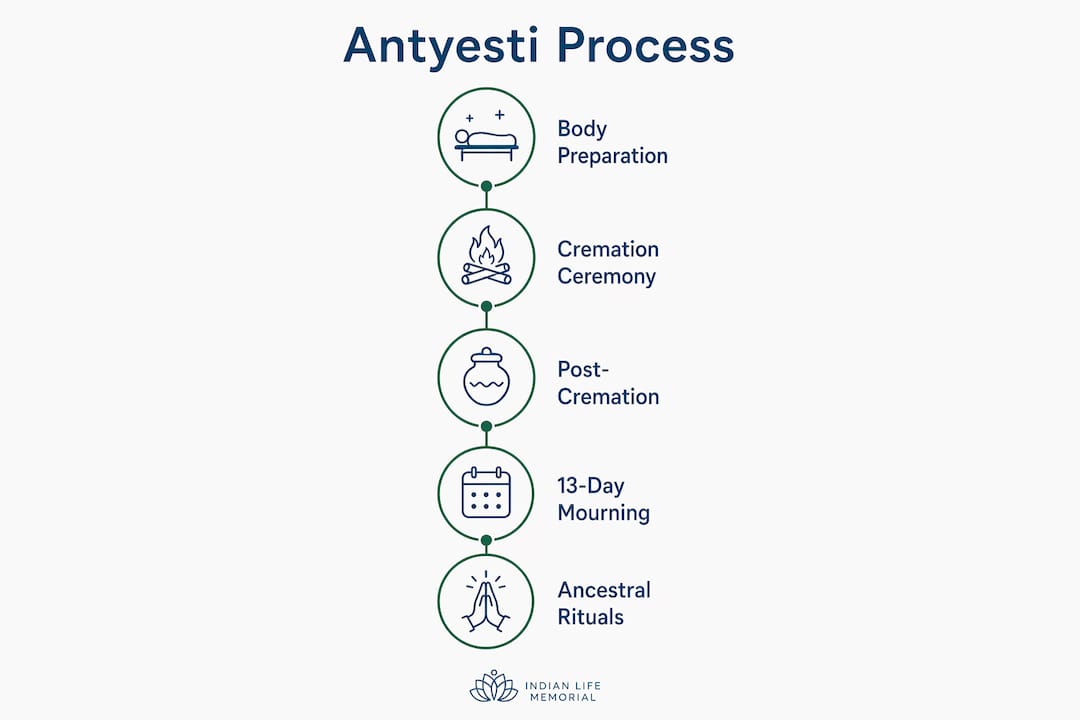
Hindu funeral rites, formally known as Antyesti, are sacred last rites designed to release the soul from the body and guide it toward the next life. These ceremonies form the final Samskara in a Hindu's spiritual journey and center primarily on cremation, prayer, and a structured mourning period. Understanding what are Hindu funeral rites matters deeply for families facing loss, as the rituals carry both spiritual weight and practical urgency. Practices vary across sects, regions, and diaspora communities, but the core purpose remains constant: to honor the departed and support the Atman's peaceful transition.
What are the core rituals involved in Hindu funeral rites?
Antyesti rites are expected to be completed quickly, often within a day of death. This urgency means families must organize logistics almost immediately, which is why understanding the sequence of rituals in advance is so valuable.
The core Hindu death rituals follow a clear, sacred order:
- Washing and purifying the body. The body is bathed with water, often mixed with Panchagavya (a mixture of five cow-derived substances), and dressed in clean white cloth. Female relatives typically perform this for women; male relatives for men.
- Applying sacred markings. A tilak of sandalwood paste or sacred ash is placed on the forehead. Tulsi leaves may be placed in the mouth, and sacred threads or garlands are arranged according to family tradition.
- Tying the toes together. The big toes are tied with a white thread, a practice that symbolizes the body's final rest and prevents the limbs from moving during transport.
- The funeral procession. The body is carried on a bier, traditionally by male family members, to the cremation ground. Mourners chant "Ram Naam Satya Hai" (the name of God is truth) during the procession.
- Circumambulation and final prayers. At the cremation site, the chief mourner, traditionally the eldest son, circumambulates the pyre while a Pandit recites Vedic mantras from texts such as the Rigveda and Garuda Purana.
- Lighting the funeral pyre. The eldest son or designated male relative lights the pyre. Fire holds deep significance in Hindu theology: it purifies the body and releases the soul, returning the five elements (earth, water, fire, air, and ether) to nature.
- Mukhagni. This is the act of placing fire at the mouth of the deceased, symbolizing the final offering of breath back to the divine.
Pro Tip: If you are organizing a Hindu funeral in a diaspora setting such as Singapore, confirm with your Pandit in advance which rituals can be adapted for a crematorium environment. The symbolic acts remain the same, but the physical setting may require adjustments.
Burial is practiced in some Hindu sects, particularly among certain Shaiva communities and for children or saints, but cremation remains the primary rite across the vast majority of Hindu traditions.
How do post-cremation rites and mourning practices unfold?
The funeral ceremony itself is only the beginning. What follows is a structured mourning period that supports both the soul's journey and the family's grief.
After cremation, the family returns the following day or within a few days to collect the ashes and bone fragments. This is called Asthi Sanchayan. The collected remains are then taken for Asthi Visarjan, the immersion of ashes in sacred flowing water. The Ganges River in Varanasi is the most revered site for this ritual, but diaspora families regularly perform Asthi Visarjan in local rivers, the sea, or other flowing water bodies.
The mourning period that follows typically spans 10 to 13 days, and it is far more than passive grieving. Key observances during this period include:
- Daily Shraddha rituals. Family members offer water (Tarpan) and food (Pind Daan) to honor the deceased and assist the soul's transition through the ancestral realm.
- Pind Daan. Balls of cooked rice or barley flour are offered as symbolic nourishment for the departed soul. This practice is performed on specific days within the mourning period.
- Dietary restrictions. The immediate family typically abstains from meat, alcohol, and certain foods. Cooking may be minimal, with neighbors and extended family providing meals.
- Social restrictions. Mourners traditionally avoid attending celebrations, temples, or auspicious events during this period. This separation honors the gravity of death and maintains ritual boundaries.
- The concluding ceremony. On the 13th day, a final Shraddha ceremony marks the formal end of the acute mourning period. The family may also perform Sapindi Karana, a rite that formally integrates the deceased into the community of ancestors.
The 13-day mourning period includes ancestor-focused practices that demand repeated observances rather than a single funeral event. This structure gives grief a sacred container, allowing families to process loss through ritual rather than silence.
What differences exist between Hindu sects and regions?
One of the most important things to understand about Hindu funeral customs is that variations by region, sect, and family tradition are the norm, not the exception. There is no single universal template.
The table below outlines key distinctions across major Hindu communities:
| Community | Cremation or burial | Key ritual distinctions |
|---|---|---|
| Shaiva (followers of Shiva) | Primarily cremation | Sacred ash applied to body; Shiva mantras recited; some sub-sects practice burial for saints |
| Vaishnava (followers of Vishnu) | Primarily cremation | Tulsi leaves and Vishnu mantras central; Ekadashi timing may influence ceremony scheduling |
| Smarta (eclectic tradition) | Cremation | Follows Vedic rites broadly; Pandit selects appropriate mantras based on family lineage |
| Tamil Hindu communities | Cremation, with some burial | Specific Tamil prayers and customs; community elders often play a coordinating role |
| Children and ascetics | Burial | Young children and renunciants are often buried rather than cremated across most sects |
Tamil Hindu funeral customs, for example, incorporate Tamil-language prayers alongside Sanskrit mantras, and the role of the community (particularly caste associations) in organizing the funeral is often more pronounced. The differences in Hindu Tamil funeral rites compared to North Indian practices are most visible in the music, the specific mantras recited, and the post-cremation food offerings prepared.
Funeral rites are also kept separate from temple worship across all sects. Scriptural texts including the Garuda Purana prohibit funeral ceremonies within temple premises, framing death rites as ancestral rather than deity-focused. This distinction shapes where and how ceremonies are conducted, regardless of sect.
For families in Singapore and other diaspora communities, the Hindu funeral Singapore guide from Indianlifememorial provides practical context on how these traditions adapt to local settings.
How is the body prepared and the procession organized?
Preparing the body for a Hindu funeral is a sacred act, not simply a logistical one. The steps below reflect the most widely observed practices, though your family's Pandit will guide specifics based on your tradition.
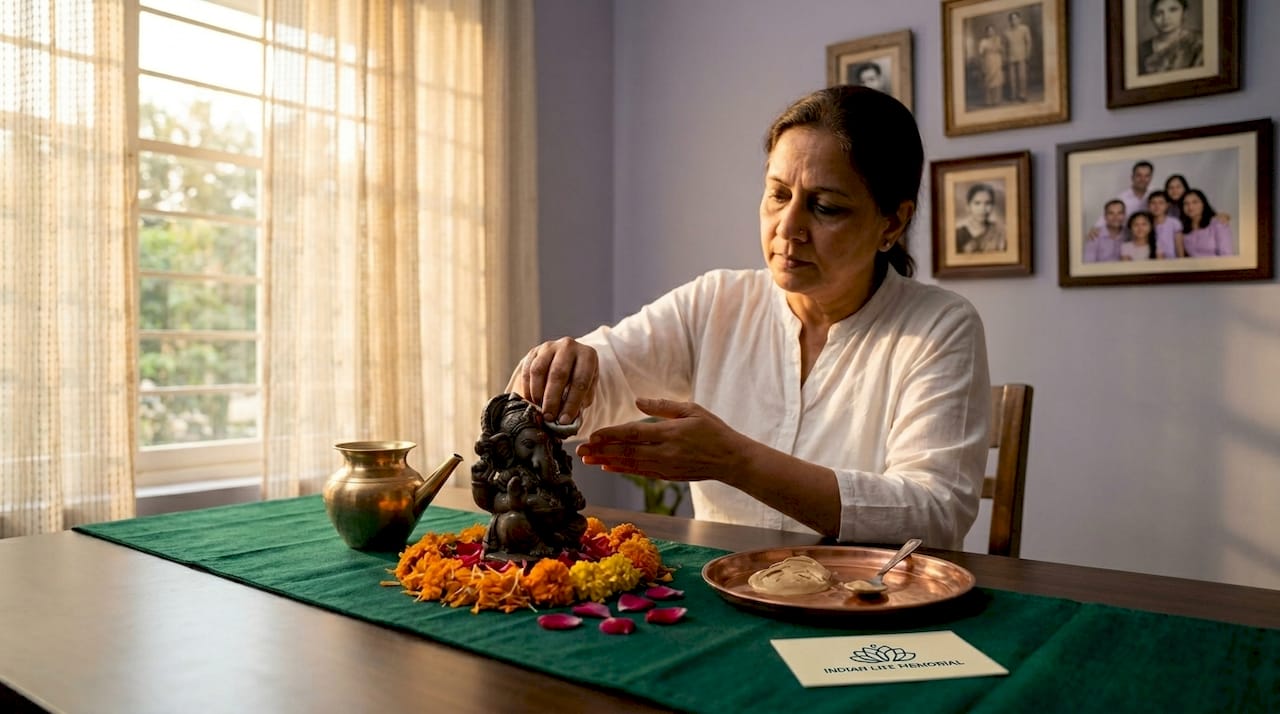
The body is first placed on the floor or a low platform, symbolizing a return to the earth. Family members wash it with clean water, sometimes with added turmeric or sandalwood. The body is then dressed: white for most adults, though some communities dress married women in red or the color of their wedding sari. Sacred items such as Tulsi garlands, flower offerings, and a lamp (Diya) are placed nearby.
The funeral procession itself carries deep symbolic meaning. The procession includes symbolic acts such as carrying water pots, circumambulating the body, and reciting mantras. Traditionally, the bier is carried on the shoulders of male relatives, with the head of the deceased facing south (the direction associated with Yama, the god of death). Mourners walk behind, chanting prayers.
In modern diaspora contexts, the procession may be adapted. A hearse replaces the traditional bier for transport, and the crematorium's procedures replace the open pyre. The chief mourner may press the cremation button as a symbolic equivalent of lighting the pyre. These adaptations are widely accepted, and many families balance religious observance with local legal and logistical requirements.
Pro Tip: Engage a Pandit and a funeral director who both understand Hindu rites before the day of the funeral. A coordinator who knows both the ritual sequence and the crematorium's procedures will prevent unnecessary delays and reduce stress on the family.
For diaspora families navigating these adaptations, understanding why Indian diaspora funeral needs differ can help your family make informed decisions without compromising the integrity of the rites.
Key takeaways
Hindu funeral rites (Antyesti) follow a defined sequence from body preparation through cremation and a 13-day mourning period, with meaningful variations across sects, regions, and diaspora communities.
| Point | Details |
|---|---|
| Antyesti must happen quickly | Rites are typically completed within one day of death, requiring immediate family coordination. |
| Cremation is the primary rite | Fire releases the soul and returns the body's elements to nature; burial applies in limited cases. |
| Mourning spans 10 to 13 days | Daily rituals including Shraddha, Pind Daan, and Tarpan structure the family's grief and honor the soul. |
| Sect and region shape the details | Tamil, Shaiva, Vaishnava, and Smarta communities each observe distinct customs within the shared Antyesti framework. |
| Diaspora families adapt with guidance | Crematorium settings and local regulations require adjustments; a knowledgeable Pandit and funeral director are both necessary. |
Why Hindu funeral rites deserve more than a checklist
Having supported many families through these moments, I find that the most common mistake is treating Antyesti as a checklist to complete under pressure rather than a living tradition to be understood. The urgency of completing rites within a day is real, but it should not collapse the meaning of what is being done.
What strikes me most is how the 13-day mourning structure actually serves the living as much as the departed. Grief without structure can feel formless and overwhelming. The daily rituals of Tarpan and Pind Daan give mourners a reason to gather, a task to perform, and a way to feel connected to the person they have lost. That is not superstition. That is sophisticated emotional architecture built over centuries.
The separation of funeral rites from temple worship, as scriptural sources emphasize, also reflects something profound: death is treated as its own sacred category, not folded into everyday devotion. This distinction deserves respect, not just compliance.
My honest observation is that families who take time to understand these rites before a death occurs are far better equipped to honor their loved ones with dignity. The rituals are not burdensome. They are a gift, if you understand what they are for.
— Admin
How Indianlifememorial supports your family through Hindu rites
Indianlifememorial specializes in Hindu and Indian funerals in Singapore, offering experienced Pandits, proper Vedic rites, and transparent pricing from $1,888 with no hidden fees.

Their full-suite funeral services cover every stage of the Antyesti process, from body preparation and procession coordination to post-cremation rites and mourning support. Families receive a clear, step-by-step process so they always know what to expect. Indianlifememorial's team is available around the clock, and their Hindu funeral packages are designed to honor your family's specific traditions, whether your roots are Tamil, North Indian, or from another regional community. You can focus on grieving and remembrance while they handle the sacred logistics with care.
FAQ
What does Antyesti mean in Hindu tradition?
Antyesti translates to "last rites" or "final auspicious ceremony" and refers to the complete set of Hindu funeral rituals, primarily centered on cremation. It is the final Samskara in a Hindu's life and is designed to release the soul and honor the body.
How long does the Hindu mourning period last?
The mourning period typically spans 10 to 13 days, with daily rituals including Shraddha, Pind Daan, and Tarpan. A concluding ceremony on the 13th day formally closes the acute mourning period.
Can Hindu funerals be performed at a temple?
No. Scriptural texts including the Garuda Purana prohibit funeral rites within temple premises, as death ceremonies are classified as ancestral rites rather than deity-focused worship. Ceremonies are held at home, a funeral parlor, or a cremation ground.
What are the main differences in Tamil Hindu funeral customs?
Tamil Hindu funerals incorporate Tamil-language prayers alongside Sanskrit mantras and often involve a stronger role for community elders and caste associations in organizing proceedings. The core Antyesti framework remains the same, but the music, specific prayers, and food offerings reflect Tamil cultural tradition.
Who lights the funeral pyre in a Hindu cremation?
The eldest son or closest designated male relative traditionally lights the funeral pyre, performing the act of Mukhagni. In diaspora crematorium settings, this is often adapted to pressing the cremation button as a symbolic equivalent of the same sacred act.
Recommended
- Indian Life Memorial | Funeral Services Singapore | 24/7 Hindu, Christian, All Faiths
- Indian Life Memorial | Funeral Services Singapore | 24/7 Hindu, Christian, All Faiths
- Indian Life Memorial | Funeral Services Singapore | 24/7 Hindu, Christian, All Faiths
- Indian Life Memorial | Funeral Services Singapore | 24/7 Hindu, Christian, All Faiths