
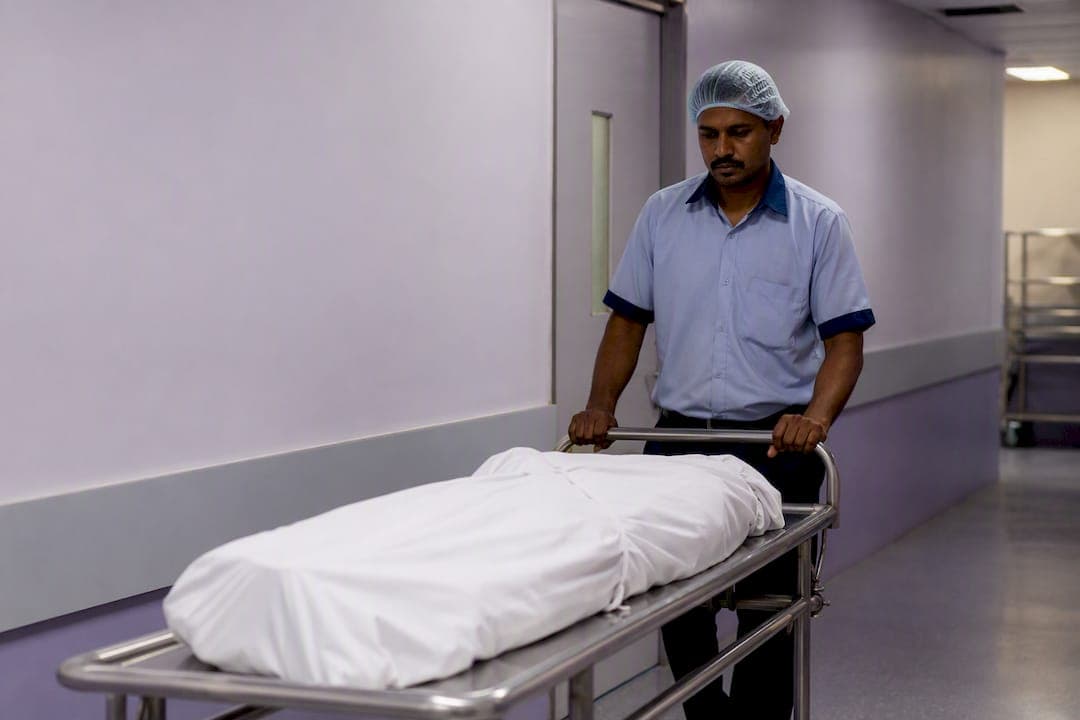
The next-of-kin closest in relationship to the deceased, in a set legal order, is the person who claims a body from a Singapore hospital, and the first action is simple: ask the attending doctor for the Certificate of Cause of Death (CCOD), or, if the doctor cannot certify it, request that hospital staff notify the police immediately.
Before you leave the ward, gather a few essentials:
- Your NRIC, passport, or FIN, plus the deceased's identification
- The hospital registration number (HRN) for the deceased's admission
- The CCOD or the digital death certificate number once issued
From there, your next moves are straightforward. Download the digital death certificate through MyLegacy once it is available, speak with the ward nurse or hospital administration desk about collection procedures, or, if the cause of death cannot be certified on the spot, wait for the police to make contact regarding Mortuary@HSA.
Key Takeaways
Claiming a body from a Singapore hospital depends on next-of-kin priority, a properly issued CCOD or digital death certificate, and, in coronial cases, cooperation with the assigned Investigation Officer.
| Point | Details |
|---|---|
| Know your priority order | Spouse, then adult children, then parents, then siblings can claim; others need documented authorization. |
| Get the CCOD or digital certificate | Download it via MyLegacy within 30 days to apply for NEA permits or authorize a funeral director. |
| Expect a different track for coronial cases | Police-referred deaths go to Mortuary@HSA, with an Investigation Officer guiding identification and timing. |
| MediSave can cover the final bill | The deceased's MediSave pays the last hospitalization bill in full, without standard withdrawal limits. |
| Engage a funeral director early | Indian Life Memorial can collect the body, file NEA permits, and manage culturally appropriate rites on fixed pricing. |
Official Pages and Resources Worth Bookmarking
A handful of official pages cover most of what you'll need to verify or file directly:
- NEA's "In a Hospital" guidance for permit and mortuary procedures.
- Mortuary@HSA's coroner page for what happens once a case is referred to the coroner.
- CPF Board's MediSave guidance for using a deceased member's account to pay hospital bills.
- MOH's MediShield Life claims page for how hospitals submit claims on the family's behalf.
- MyLegacy for downloading the digital death certificate itself.
Table of Contents
- Who Can Claim a Body From a Hospital in Singapore?
- What Are the Steps to Claim a Body at the Hospital?
- What Happens if the Coroner or Police Get Involved?
- How Do Hospital Bills, MediSave, and MCAF Affect Releasing the Body?
- How Does a Funeral Director Help Claim a Body?
- How Indian Life Memorial Supports Families Claiming a Body
- Frequently Asked Questions
Who Can Claim a Body From a Hospital in Singapore?
Singapore hospitals release a body to the next-of-kin in a defined order of priority, not to whoever arrives first at the ward. Understanding where you sit in that order tells you whether you can sign forms and collect the body yourself, or whether you need to authorize someone else to act.
- Spouse of the deceased, if living and contactable.
- Adult children, typically 21 years or older, when there is no spouse or the spouse is unavailable.
- Parents of the deceased, where there is no spouse or adult child.
- Siblings or other close relatives who can demonstrate a caregiving relationship or documented family tie.
Authorization can also pass through a Power of Attorney, or a Donee or Deputy appointed under the Mental Capacity Act, if that person had legal authority over the deceased's affairs before death. When the deceased is a foreign national or non-resident, the next-of-kin usually coordinates with the relevant embassy or high commission for repatriation paperwork, alongside the hospital and a funeral director experienced in handling foreign national deaths in Singapore.
What Are the Steps to Claim a Body at the Hospital?
Claiming a body follows a fairly predictable sequence once you know what to expect at each stage. Here is the order most families and funeral directors work through.
- Death certification. If the attending doctor can determine the cause of death, they issue the CCOD directly. If they cannot, hospital staff will call the police, and the case moves into coronial territory rather than standard discharge.
- Death registration. Registration is expected to happen promptly, generally understood as within 24 hours in most non-coronial cases, so the family can move on to funeral arrangements without delay.
- Digital death certificate download. Once a doctor certifies the death, the family receives a digital death certificate number and can download the certificate through MyLegacy within a limited time frame for download. This certificate becomes the key document for almost everything that follows.
- Body transfer, if applicable. In non-coronial cases, the body typically stays at the hospital mortuary pending collection. In coroner-referred cases, the body is moved to Mortuary@HSA, usually by police hearse.
- Document collection. Bring your ID, the CCOD or digital death certificate number, the hospital registration number, any relevant medication or medical records, and signed authorization forms such as the Medical Claims Authorisation Form (MCAF) where the hospital requires one.
- Permit application. With the digital certificate in hand, you or your funeral director can apply for NEA burial or cremation permits through the NEA e-Portal.
Pro Tip: Authorizing a funeral director to collect the body on your behalf, in writing, saves a second trip to the hospital and lets the paperwork move while your family attends to more pressing matters.
Most non-coronial claims resolve within a day or two once the CCOD is issued and the digital certificate downloads cleanly. Coronial cases run on a different, longer clock, which the next section covers. Funeral directors familiar with the mortuary transfer process in Singapore can usually tell you within a phone call which track your situation falls into.
What Happens if the Coroner or Police Get Involved?
Not every death allows for a straightforward CCOD. Hospitals refer a case to the police and coroner when the cause of death is unknown, appears unnatural, or follows an accident or a surgical complication that raises questions.
- The hospital sends the body to Mortuary@HSA in a police hearse rather than releasing it directly to family.
- Police typically notify the family the next day with instructions on when to attend Mortuary@HSA.
- An Investigation Officer (IO) is assigned to the case and becomes the family's main point of contact for identification and timing.
- Families are not necessarily required to view the body in the State Coroner's presence. The IO can complete identification after verifying identity, sparing relatives that particular ordeal.
- If the coroner orders an autopsy, expect further delay while the investigation runs its course, and stay in contact with the IO for updates.
Bringing along the deceased's medical records and current medications when police first make contact can help move the investigation along faster, since the coroner's office often needs that history to rule out or confirm a cause of death.
How Do Hospital Bills, MediSave, and MCAF Affect Releasing the Body?
Settling the hospital bill runs on a separate track from physically claiming the body, but families still need to understand it, since unresolved billing questions can complicate the paperwork stage. The deceased's own MediSave account can be used in full to pay the final hospital bill when death occurred during that hospitalization, without the standard MediSave withdrawal limits that would normally apply. If that balance falls short, MediSave from other authorized account holders can cover the gap, subject to the usual MediSave rules.
If the deceased never signed an MCAF, someone else can still sign it after death: a spouse, a parent, a child aged 21 or older, or an appointed Donee or Deputy. Hospitals will sometimes seek MOH approval to let a next-of-kin sign when no MCAF exists on file.
Most hospitals also submit MediShield Life claims and liaise with private insurers directly, which trims down the paperwork families must chase during an already difficult week. Bring these along for reimbursement or insurance claims:
- Hospital registration number (HRN)
- The finalized medical bill
- The healthcare payments and claims statement, which CPF Board can issue
How Does a Funeral Director Help Claim a Body?
A licensed funeral director does more than arrange the service. They handle the collection itself, working directly with hospital staff, the mortuary, and, where the case is coronial, the assigned Investigation Officer.
Indian Life Memorial takes on the NEA permit filing, coordinates embalming and transport, and manages repatriation paperwork when the deceased needs to travel abroad. Because pricing is fixed and disclosed upfront, and support runs 24/7, families benefit from transparent funeral costs so they are not left guessing about cost or availability at 2 a.m. Whether the family follows Hindu, Christian, or another faith tradition, the rites and logistics are handled with the appropriate cultural sensitivity.
Pro Tip: Call a funeral director before you have every document in hand. An authorized collection letter from the family, given early, lets the director start paperwork with the hospital or Mortuary@HSA while you're still gathering ID and bank details.
What Helps Families Most in Practice
Families who navigate this smoothly tend to keep a simple folder ready: photocopies of ID, CPF details, and insurance documents, plus a note on who in the family qualifies to sign an MCAF. Having the hospital registration number and digital death certificate number on hand shortens every permit and claim step that follows. It also helps to tell hospital or funeral staff early about any religious rites your family wants observed, so nothing gets rushed or missed later.
How Indian Life Memorial Supports Families Claiming a Body
Indian Life Memorial exists for exactly this moment, when a family needs someone who already knows the hospital's paperwork, the mortuary's procedures, and the NEA's permit system, so you don't have to learn it under pressure.
The team collects the body from the hospital or Mortuary@HSA on your authorization, files NEA cremation or burial permits, and arranges culturally appropriate rites for Hindu, Christian, or all-faith families. Pricing stays fixed and disclosed from the first conversation, support runs around the clock, and a simple signed authorization letter is usually enough to let the team start working on your behalf while you focus on your family. Explore the full-service funeral package to see exactly what is included, or contact Indian Life Memorial directly to arrange body collection and begin the funeral process today.
Frequently Asked Questions
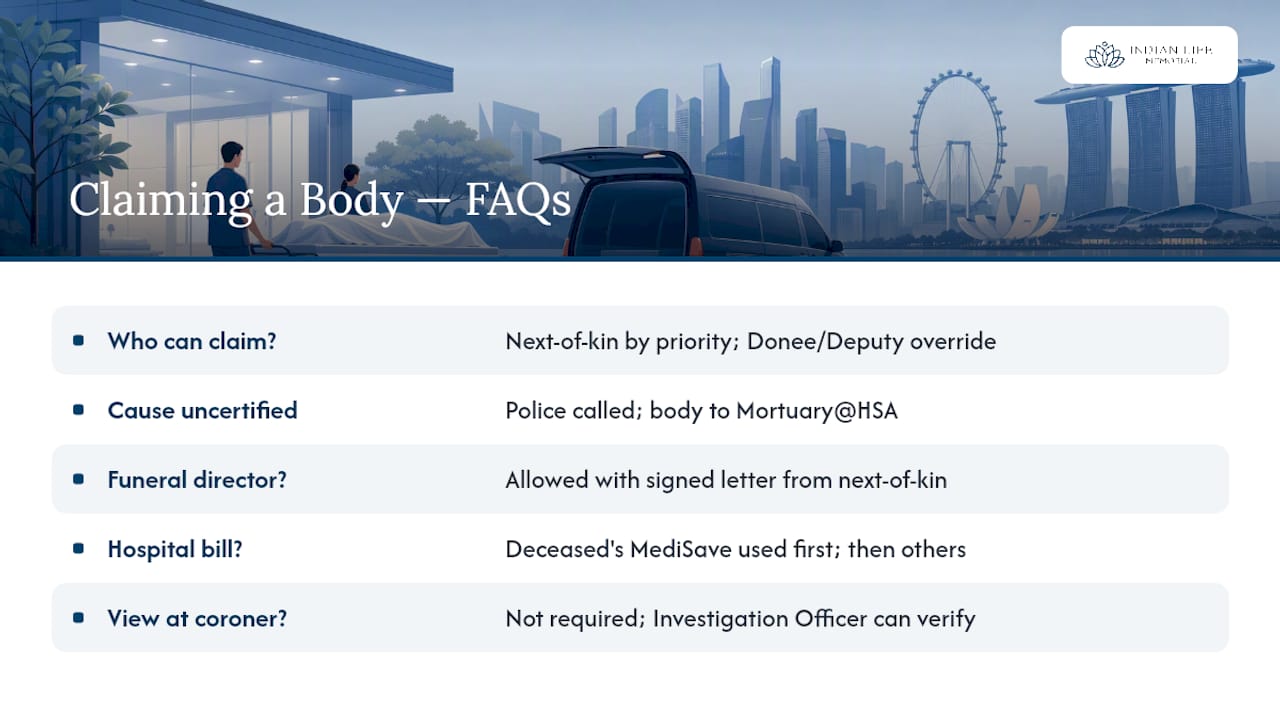
Who has the legal right to claim a body from a hospital in Singapore? The next-of-kin in order of priority, spouse first, then adult children, parents, and siblings, has the right to claim the body, unless a Power of Attorney or appointed Donee or Deputy holds that authority instead.
What happens if the doctor cannot certify the cause of death? The hospital calls the police, and the body is transferred to Mortuary@HSA by police hearse, with the family typically notified the following day about when to attend.
Can a funeral director collect the body instead of the family? Yes. With a signed authorization letter from the next-of-kin, a funeral director such as Indian Life Memorial can collect the body, file NEA permits, and manage mortuary coordination on the family's behalf.
How is the final hospital bill paid if MediSave doesn't cover it fully? The deceased's MediSave is used first without standard withdrawal limits, and any shortfall may be covered by other authorized MediSave accounts, MediShield Life payouts, or cash.
Do families have to view the body in front of the State Coroner? No. The assigned Investigation Officer can perform identification after verifying identity, so families are not required to view the body in the State Coroner's presence.
This article is general information, not a substitute for advice from a qualified lawyer. Consult a qualified legal professional about your own circumstances before acting on anything here.