
Direct cremation means cremating a body without embalming, a viewing, or a funeral service present, then returning the ashes to the family. It costs less than a full-service funeral because it removes chapel time, staff hours, and ceremonial add-ons from the bill. Nothing about it prevents a memorial. It simply separates the cremation itself from whatever remembrance the family chooses to hold afterward, on their own schedule.
TL;DR:
- The base cost of direct cremation typically starts at around $1,888 and covers transport, paperwork, the actual cremation, and the return of remains, but details vary by provider.
- Direct cremation excludes viewing, embalming, and ceremonial elements like chapel use or processions, which can be added separately if desired.
- The entire process involves initial authorization, body collection, paperwork processing, cremation with strict identification, and the return of ashes, with timing mainly affected by administrative steps.
- Choose a provider who clearly outlines their inclusions, verifies identity through chain-of-custody protocols, and provides a written timeline upfront to avoid surprises or delays.
- Families can separate the cremation from memorial rituals, planning honors like rites or ceremonies at their own convenience and budget, often with flexible scheduling.
Table of Contents
- What Does "Direct Cremation" Actually Mean?
- What a Direct Cremation Usually Includes
- What a Direct Cremation Usually Does Not Include
- How Does Direct Cremation Work, Step by Step?
- Why Direct Cremation Costs Less Than a Full-Service Funeral
- Direct Cremation vs. Traditional Cremation and Full-Service Funerals
- Weighing the Real Benefits and Drawbacks
- How to Decide if Direct Cremation Fits Your Family
- A Transparent Local Example of the Process in Practice
- What Actually Matters When You're Choosing This Path
- Get a Transparent, Same-Day Direct Cremation Arrangement
What Does "Direct Cremation" Actually Mean?
The Federal Trade Commission's consumer guidance on funeral options defines direct cremation plainly: cremation without embalming, without a viewing, and without a funeral service held with the body present. The remains go back to the family, and the overall price sits below what a full-service funeral typically costs. Dictionary definitions echo this almost word for word, describing it as a private or unattended cremation carried out without ceremony or family present at the time.
Funeral professionals often explain this through a simple framework: disposition versus memorialization. Disposition is the physical handling of remains, in this case cremation. Memorialization is the ceremony, ritual, or gathering that honors the person's life. Direct cremation handles disposition first and leaves memorialization entirely open. Some families hold a service two days later. Others wait two months, until relatives can travel or a preferred venue opens up.
You'll see the same service marketed under a few different names, all pointing to the same core meaning:
- Immediate cremation — emphasizes that it happens promptly after death, without waiting for a scheduled service
- Simple cremation — a plain-language label used by many providers to signal no add-ons
- Unattended cremation — highlights that no family members or officiants are present during the process itself
Whichever name a provider uses, the underlying definition stays consistent: cremation now, memorial later if and when the family wants one.
What a Direct Cremation Usually Includes
A standard direct cremation package covers the essentials of getting a loved one from place of death to returned ashes, without ceremonial extras. Most providers structure this into four core pieces:
- Transport and basic care of the body from the place of death to the crematorium
- Paperwork and permits, including the death certificate filing and cremation authorization forms, handled by the provider on the family's behalf
- The cremation itself, performed at a licensed crematory facility
- Return of the cremated remains, typically in a basic container or a simple urn included in the base price
Get every inclusion confirmed in writing before you sign anything. Ask specifically whether the quoted price covers the container, the death certificate copies, and any transport distance limits. Some providers cap free transport at a set number of miles or kilometers and charge extra beyond that, which is exactly the kind of detail that should never surprise a grieving family after the fact.
What a Direct Cremation Usually Does Not Include
Direct cremation strips out everything tied to ceremony and presentation, which is precisely how it keeps costs down. Understanding the exclusions matters just as much as understanding the inclusions, since assuming something is covered only to learn otherwise adds stress at the worst possible time.
Here's what typically falls outside the base package:
- Viewing or visitation with the body present is not part of the core service
- Embalming is usually not performed, since there's no viewing that requires it
- Chapel use, a procession, or ceremonial staff are not included in the base price
Families who want any of these elements can usually add them individually, or plan a separate memorial afterward. Common additions include a later scattering ceremony, a private gathering at home, or a columbarium placement for the urn.
How Does Direct Cremation Work, Step by Step?
Understanding the sequence removes most of the anxiety around direct cremation, since families usually aren't sure what happens between the phone call and receiving the ashes. Here's the typical flow:
- Initial contact and authorization. The family calls the provider, who explains the process and sends authorization forms. These forms confirm who has legal authority to approve the cremation, since not just any relative can sign off in most jurisdictions.
- Collection and identification. The provider transports the body to their facility or directly to the crematorium, verifying identity through documented checks at each handoff point.
- Paperwork processing. The death certificate gets filed, and the cremation permit is obtained. This administrative layer, not the cremation itself, is usually what determines how long the whole process takes.
- The cremation. The body is placed in the retort under strict identification protocols. Crematoriums follow chain-of-custody standards for unattended cremations that mirror the same respectful handling used in attended services. The mechanical process itself is relatively quick, but it's book ended by identification checks designed to guarantee the ashes returned are the right ashes.
- Return of ashes. Once the cremation and paperwork are complete, the provider returns the remains to the family, either for pickup or delivery, depending on the arrangement.
Timing depends far more on step three than on the cremation itself. Death certificate processing and permit issuance vary by jurisdiction, and that administrative queue is usually the real bottleneck, not the crematory's schedule.
Pro Tip: Ask your provider for a written timeline estimate at the point of authorization, not after. A provider who can name a realistic window upfront, rather than a vague "it depends," is one who has actually managed this paperwork before.
Why Direct Cremation Costs Less Than a Full-Service Funeral
Direct cremation costs less because it removes the line items tied to ceremony, not because it cuts corners on the cremation itself. Chapel rental, embalming, extended staff hours for a viewing, and ceremonial vehicles all add up in a traditional funeral, and none of them apply here.
Most direct cremation quotes break down into a small number of components:
- Basic services fee, covering the provider's administrative work and coordination
- Transport fee, for moving the body to the crematory
- Crematory fee, charged by the facility performing the cremation
- Container or urn cost, which ranges from a simple cardboard box to a decorative urn if the family upgrades
Cost snapshot: Industry cost breakdowns consistently show direct cremation landing well below the typical cost of a full-service funeral with viewing, embalming, and burial, largely because it removes the highest-cost ceremonial line items entirely.
When comparing quotes, ask each provider the same three questions: does this price include the death certificate copies, is there a mileage cap on transport, and is the container included or an upgrade? Providers who answer clearly and put it in writing are the ones worth trusting with something this personal.
Direct Cremation vs. Traditional Cremation and Full-Service Funerals
The difference between direct cremation and its alternatives comes down to what happens before the ashes are returned, not what happens to the remains themselves.
| Feature | Direct cremation | Traditional/full-service funeral |
|---|---|---|
| Family present during cremation | No | Sometimes, for witnessed cremation |
| Embalming | Usually not performed | Often included |
| Viewing or visitation | Not included | Standard part of the service |
| Chapel, procession, staff | Not included | Included |
| Relative cost | Lower | Higher |
| Memorial timing | Planned separately, anytime after | Built into the service itself |
A full-service funeral fits families who need the ceremony to happen immediately, want a viewing for closure, or are following cultural or religious traditions that call for specific rites before disposition. Direct cremation fits families who want to separate those decisions, either for cost reasons or because they'd rather plan a memorial without the time pressure of a body present. Either path leaves room for memorialization. Direct cremation just moves it to whenever the family is ready.
Weighing the Real Benefits and Drawbacks
Direct cremation's biggest advantage is flexibility paired with lower cost. Families aren't locked into a same-week ceremony, and the savings from skipping embalming and chapel fees can be meaningful, especially against the backdrop of a broader shift toward simpler, lower-cost farewells that researchers at the University of Bath and elsewhere have documented in recent years.
The tradeoff is the loss of an immediate, body-present ritual, which matters more in some cultural and religious contexts than others. Families following traditions that call for specific rites before cremation should confirm those rites can be arranged separately.
- Benefits: lower cost, scheduling flexibility, simplicity during an already difficult week
- Drawbacks: no immediate viewing, potential tension with cultural or religious expectations around timing
Pro Tip: If ritual matters to your family, ask whether a religious officiant can be present for a brief rite at the crematory before cremation, even without a full viewing. Many providers can arrange this separately from the base package.
Families who want both savings and ritual often split the difference: direct cremation now, a private memorial or keepsake ceremony, such as ash scattering, later.

How to Decide if Direct Cremation Fits Your Family
Choosing direct cremation comes down to matching the service to what your family actually needs, not just the lowest quoted price. A short set of questions and a few red flags will tell you most of what you need to know before signing anything.
Ask each provider these questions directly:
- What exactly is included in the base price, and what costs extra?
- How do you verify identity throughout collection, cremation, and return of ashes?
- What is the realistic turnaround time, and what typically causes delays?
- Will I receive a written agreement listing every inclusion before I pay anything?
- Can religious or cultural elements be added even if they're not part of the standard package?
Watch for these warning signs: pricing that stays vague until you've already committed, a provider who can't clearly explain their chain-of-custody process, or any reluctance to put the agreement in writing. A detailed cost breakdown upfront is a basic expectation, not a bonus. If ritual elements matter to you, ask about add-ons now rather than assuming you can arrange them later under time pressure.
A Transparent Local Example of the Process in Practice
Reading a definition is one thing. Seeing how a provider actually runs the process is another. Indianlifememorial structures its direct cremation service around the same disposition-then-memorial framework described above, built specifically for Hindu and Indian families who may still want specific Vedic elements honored even within a simpler service.
The process follows a consistent sequence:
- Initial contact, available 24/7, with clear explanation of what's included before any commitment is made
- Collection and paperwork, with authorization forms and permits handled by the team rather than left to a grieving family to chase down
- Cremation, carried out with the same identification and chain-of-custody protocols any respectful crematory follows
- Return of ashes, along with guidance on next steps if the family wants a later memorial or Vedic rite
Pricing is stated upfront with no hidden fees added after the fact. That transparency matters most in a category where vague quotes are common. Families can also arrange elements like an officiant-led rite separately from the core cremation, which keeps costs down without forcing a choice between affordability and tradition.
What Actually Matters When You're Choosing This Path
Most explainers on direct cremation stop at the definition and the price tag, which undersells the real decision families are making. The conventional advice treats direct cremation as purely a budget choice, a stripped-down version of a "real" funeral. That framing misses the point. Direct cremation isn't a lesser service. It's a sequencing choice: handle the cremation now, and design the memorial on your own terms, without a body present dictating the timeline.
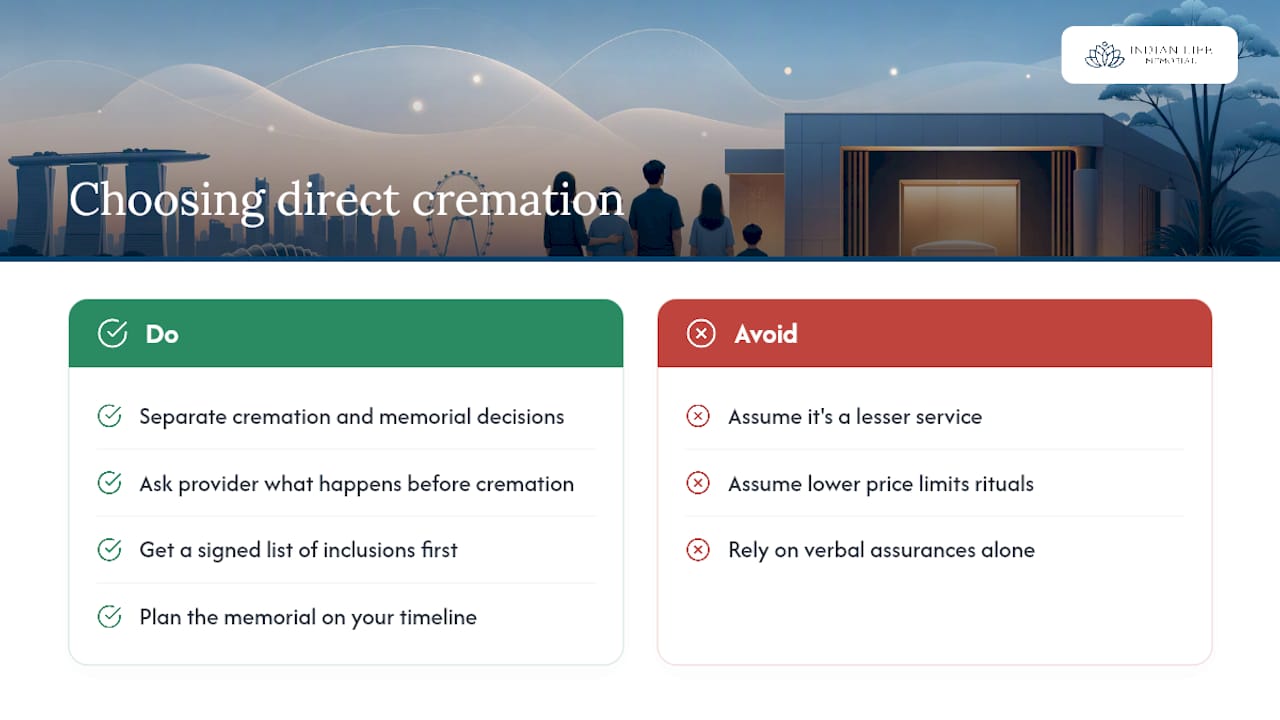
Where I'd push back hardest on common advice is the assumption that skipping the base viewing means skipping ritual entirely. It doesn't have to. The families who navigate this best treat direct cremation and memorialization as two separate decisions, not one bundled package. Ask your provider what happens before, not just after, and don't assume a lower price means fewer options for honoring tradition.
Prioritize the written agreement above everything else. Verbal reassurances about "including everything" mean nothing next to a signed list of inclusions. Get that first, then plan the memorial on whatever timeline actually works for your family.
— Admin
Get a Transparent, Same-Day Direct Cremation Arrangement
Indianlifememorial is built for exactly the scenario this article walks through: a family that wants a straightforward, honestly priced cremation without guessing at what's included. Instead of a quote that grows once you're already committed, pricing starts at $1,888 with every inclusion listed upfront, and support is available 24/7 for families arranging services on short notice.
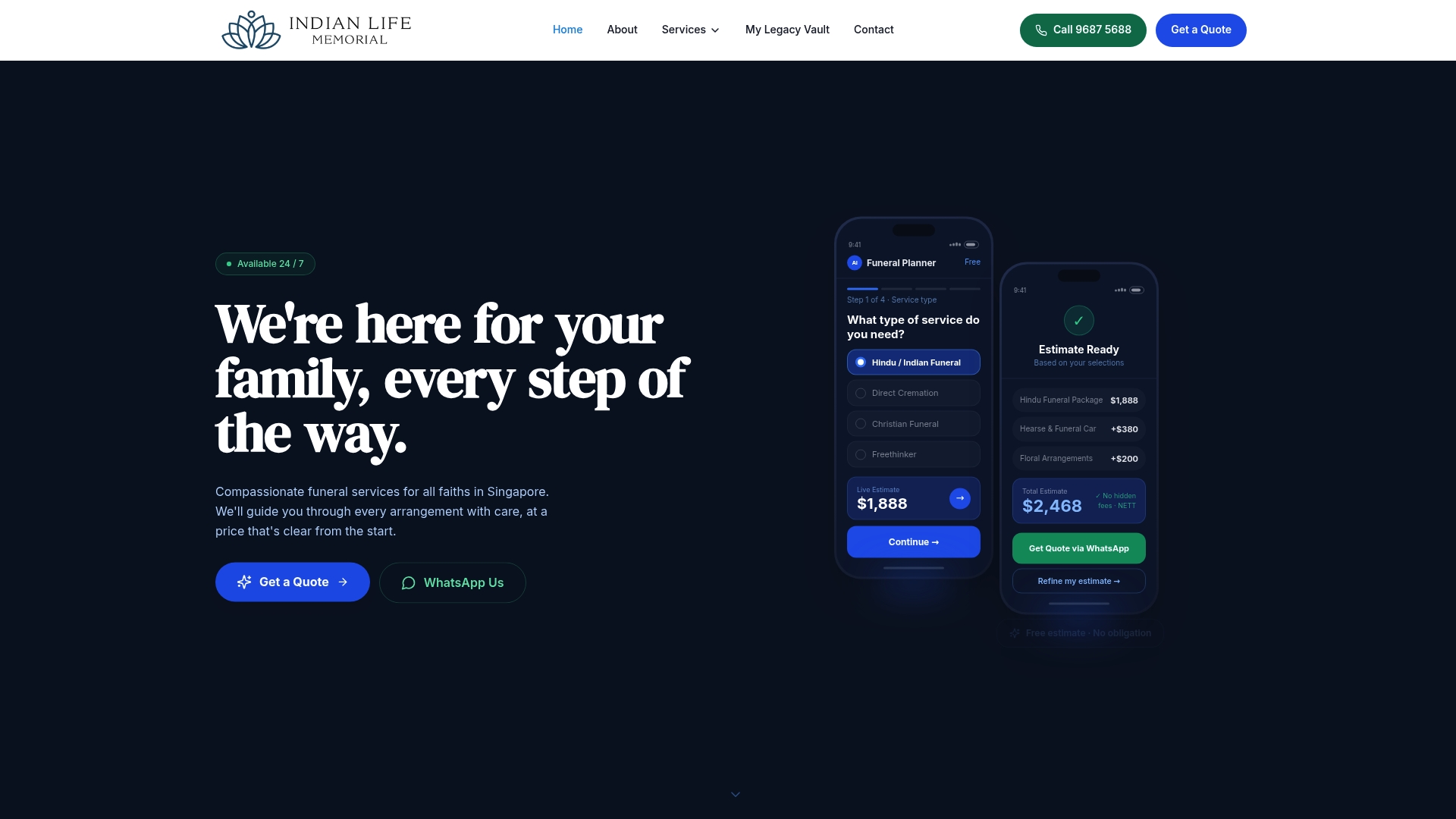
What sets this apart from a generic provider is the cultural fit built into the process. Every step, from paperwork to the cremation itself, is handled with Hindu and Indian rites in mind, and a qualified priest can be arranged separately if your family wants Vedic elements alongside the simpler service. You get the cost savings of direct cremation without having to choose between affordability and tradition.
If you're comparing options right now, start by reviewing the transparent pricing packages to see exactly what's included at each tier, then reach out for a same-day consultation to confirm availability for your family's timeline.