
A Lasting Power of Attorney (LPA) in Singapore lets you appoint one or more trusted people, called Donees, to make personal welfare and property decisions on your behalf if you ever lose mental capacity. The single most useful action you can take today is starting LPA Form 1 on the OPGO (Office of the Public Guardian Online) portal while you're still of sound mind, since capacity can decline suddenly through stroke, dementia, or accident.
Certification by a Certificate Issuer (CI) must happen in person in Singapore. No exceptions.
- Free for Singapore citizens applying for Form 1 from April 1, 2026
- A fee applies for permanent residents
- A fee applies for foreigners
- CI professional fees are separate and vary by provider
Key Takeaways
Making an LPA in Singapore requires acting while you have mental capacity, choosing Donees carefully, and completing in-person CI certification before the three-week registration wait begins.
| Point | Details |
|---|---|
| Act while capable | You can only make an LPA while you have mental capacity; there's no retroactive option once it's lost. |
| Form 1 covers most donors | Use LPA Form 1 via OPGO unless you need more than two Donees or customized powers, which require Form 2 and a lawyer. |
| CI certification is in person, no exceptions | A qualifying doctor, lawyer, or psychiatrist must verify capacity and voluntariness face to face in Singapore. |
| Fees are tiered | Form 1 is free for citizens from April 1, 2026, $30 for permanent residents, and $160 for foreigners, plus separate CI fees. |
| An LPA isn't a Will | Coordinate your LPA with a Will and an Advance Medical Directive for complete coverage before and after death. |
Table of Contents
- What Is a Lasting Power of Attorney in Singapore, and Who Qualifies?
- How to Make an LPA in Singapore: A Step-by-Step Process
- Who Can Certify Your LPA, and Why Does It Have to Be in Person?
- Costs, Waiting Time, and How to Revoke an LPA
- What an LPA Doesn't Cover: LPA vs. Will and Advance Medical Directive
- Why We Talk About LPAs During Pre-Planning Conversations
- What Happens if Your Donee Refuses or Can't Act?
- Can You Change the Donees on an Existing LPA?
- What Are a Donee's Legal Duties Once the LPA Is Registered?
- What Happens if a Donee Abuses Their Powers?
- Personal Welfare LPA vs. Property and Affairs LPA: What's the Real Difference?
- Official Sources and Hotlines Worth Bookmarking
- Why Most People Wait Too Long to Make an LPA
What Is a Lasting Power of Attorney in Singapore, and Who Qualifies?
An LPA covers two distinct territories: personal welfare and property & affairs. Personal welfare powers let your Donee decide where you live, who provides your daily care, and what medical treatment you receive if you can't communicate those wishes yourself. Property and affairs powers let your Donee operate your bank accounts, pay your bills, sell or manage property, and handle your CPF matters (within legal limits) while you're alive but incapacitated.
Eligibility is straightforward but firm:
- You must be at least 21 years old.
- You must have mental capacity at the time you make the LPA. This is not retroactive. Once capacity is lost, you cannot make one.
- You cannot be an undischarged bankrupt if you're granting property and affairs powers, though you can still grant personal welfare powers.
The alternative to planning ahead is stark. Without an LPA, your family has to petition the Family Justice Courts for a Deputyship order, a process that's slower, costlier, and emotionally harder than making an LPA proactively. Deputyship also puts a judge, not you, in charge of who gets appointed.
How to Make an LPA in Singapore: A Step-by-Step Process
Most donors only need LPA Form 1, the standardized form covering broad powers. You don't need a lawyer for Form 1 since it's designed to be completed independently through OPGO using Singpass. Here's how the lasting power of attorney process actually unfolds in practice.
- Choose your Donee(s) and, if you want, a Replacement Donee. Think about who you trust with major decisions and who would step in if your first choice becomes unavailable.
- Decide the powers you're granting and how Donees should act. You can require them to act jointly (all must agree) or jointly and severally (any one can act alone). This choice matters more than most people realize. Joint action protects against a single Donee overstepping but can freeze decisions if one Donee is unreachable during an emergency.
- Complete LPA Form 1 on OPGO. The portal walks you through donor details, Donee details, and the powers granted.
- Donees accept their appointment via Singpass. They'll receive an SMS or email notification prompting them to log in and confirm.
- Visit a Certificate Issuer in person. The CI verifies your capacity, confirms you're acting voluntarily, checks your identity, and witnesses your signature. This step cannot be done remotely under any circumstance.
- The CI submits the completed application through OPGO on your behalf.
- Monitor your OPGO dashboard for status updates and notifications during the waiting period.
Pro Tip: Book your Certificate Issuer appointment before you finish filling out the form on OPGO. CI slots, especially with practising lawyers, can book out weeks in advance, and there's no reason to let that become the bottleneck in an otherwise fast process.
If your situation is more complicated, say you want more than two Donees, more than one Replacement Donee, or highly customized instructions, you'll need LPA Form 2 instead, which requires drafting with a Singapore-qualified lawyer.
Who Can Certify Your LPA, and Why Does It Have to Be in Person?
The Certificate Issuer isn't a rubber stamp. Three professional categories qualify to serve as a CI: accredited medical practitioners, practising lawyers, and registered psychiatrists. Each brings a different lens to the same core job, confirming that you understand what you're signing and that nobody is pressuring you.
A CI's duties include:
- Verifying you have the mental capacity to understand the LPA's effect
- Confirming you're acting voluntarily, free of coercion or undue influence
- Checking your identity against official documents
- Witnessing your signature in person, physically present in Singapore
A CI cannot be one of your Donees or related to them. That conflict-of-interest rule exists for an obvious reason: the person confirming your consent shouldn't stand to gain from the powers you're granting.
Not every applicant can afford lawyer or psychiatrist fees on top of the application cost. Several not-for-profit organizations offer pro bono or means-tested certificate issuing services for eligible applicants, which matters because cost shouldn't be the reason someone delays protecting their family's future.
Costs, Waiting Time, and How to Revoke an LPA
Once the CI submits your application, there is a mandatory waiting period before registration. If no valid objections come in during that window, OPG registers the LPA, and the whole process from submission to registration typically completes shortly thereafter.
On cost: Form 1 becomes free for Singapore citizens from April 1, 2026, while permanent residents pay $30 and foreigners pay $160. CI fees sit outside that structure and vary depending on whether you use a doctor, lawyer, or psychiatrist.
Revoking an LPA requires a formal deed of revocation while you still have capacity. Once you revoke it, you should notify:
- The Office of the Public Guardian, so the register reflects the change
- Your named Donees, so they stop acting under the old authority
- Banks and financial institutions where the LPA was previously lodged
- Healthcare providers or hospitals that hold a copy on file
Skipping that notification step is a common mistake. An LPA sitting unused in a bank's records can create confusion later, even after it's formally revoked.
What an LPA Doesn't Cover: LPA vs. Will and Advance Medical Directive
An LPA only operates while you're alive and lacking capacity. It stops the moment you die, at which point a completely different set of documents takes over. This is the single most common point of confusion for families exploring their lasting power of attorney process.
- Will: Governs how your assets get distributed after death. An LPA has zero authority once you've passed.
- CPF nominations: Handled separately from both your LPA and your Will, through the CPF Board directly.
- Advance Medical Directive (AMD): Covers your end-of-life medical treatment preferences, specifically the decision to refuse extraordinary life-sustaining treatment if you're terminally ill and unconscious.
- LPA: Covers day-to-day welfare and financial decisions during a period of living incapacity, not after death and not specifically about end-of-life treatment refusal.
The smartest approach coordinates all three. An LPA without a Will still leaves your estate distribution to intestacy law. A Will without an LPA still leaves your family facing Deputyship if you become incapacitated first.
Why We Talk About LPAs During Pre-Planning Conversations
We've sat with enough families to know that the hardest conversations happen when there's no document to fall back on, just guesswork about what someone would have wanted. An LPA removes that guesswork while you can still speak for yourself.
That's why our pre-planning conversations at Indianlifememorial always touch on LPA status alongside funeral wishes. Readers who want the fuller picture, including how end-of-life medical preferences fit in, should also read our guide on the Advance Medical Directive.
What Happens if Your Donee Refuses or Can't Act?
A Donee isn't legally obligated to accept the role in the first place. During the acceptance step on OPGO, if your nominated Donee declines through Singpass, the application simply doesn't proceed for that person, and you'll need to either name someone else or move forward with your remaining Donees if you'd appointed more than one.

The more pressing scenario is a Donee who accepted the role but later becomes unwilling or unable to act, due to their own illness, relocation overseas, a breakdown in the relationship, or simple unavailability. This is exactly why naming a Replacement Donee at the outset matters so much. If your primary Donee can no longer act, whether because they've died, lost capacity themselves, or formally renounced the role, the Replacement Donee automatically steps into their place without requiring a fresh application.
If you didn't name a Replacement Donee and your sole Donee becomes unable to act, the LPA effectively stops functioning for the powers that Donee held. At that point, your family may need to apply to the Family Justice Courts, the same Deputyship route an LPA was meant to avoid. This is the scenario that catches families off guard most often: they assumed the LPA was a permanent safety net, not realizing its strength depends entirely on the Donee arrangement chosen at signing.
If you're still capable at the point a Donee becomes unavailable, the cleaner fix is making a new LPA with updated appointments rather than waiting for a crisis to force a court application.
Can You Change the Donees on an Existing LPA?
Singapore's LPA framework doesn't allow you to simply edit or amend a registered LPA the way you might update a form. Once an LPA is registered with OPG, the powers, Donees, and instructions on it are fixed as submitted.
If you want to change your Donees, whether adding someone, removing someone, or replacing one entirely, you have two paths, and the right one depends on your capacity and intentions:
- Revoke the existing LPA and make a new one. This requires a formal deed of revocation while you still have mental capacity, followed by a fresh LPA Form 1 (or Form 2, if your new arrangement needs customized powers) naming your updated Donees. You'll go through CI certification and the waiting period again as if starting fresh.
- Let the existing LPA lapse naturally if circumstances change, such as a named Donee passing away, and rely on your Replacement Donee provision if one exists.
There's no shortcut around re-certification. Even a minor Donee change, like swapping one adult child for another, triggers the full process again: choosing powers, CI verification, and the three-week waiting period. This is worth planning for. If you suspect your family circumstances might shift, such as a Donee planning to emigrate, it's often smarter to name a Replacement Donee upfront rather than assume you'll revoke and redo the LPA later when circumstances actually change.
What Are a Donee's Legal Duties Once the LPA Is Registered?
Accepting a Donee role isn't symbolic. Once registered, a Donee holds a legal position with binding obligations, and Singapore law expects those obligations to be taken seriously.
A Donee must:
- Act within the scope of granted powers. A Donee given personal welfare authority can't start managing property and affairs unless that power was also granted.
- Act in the donor's best interests, not their own convenience or financial benefit, at every decision point.
- Keep the donor's finances separate from their own, maintaining clear records if managing property and affairs powers.
- Consult the donor's wishes where known, even though the donor can no longer make the decision independently. A Donee's job is substituted judgment guided by what the donor would have wanted, not a blank check.
- Act jointly or jointly and severally as specified, respecting whatever arrangement the donor chose at the time of signing.
The Office of the Public Guardian retains oversight authority even after registration. If concerns arise about how a Donee is exercising their powers, whether raised by family members, financial institutions, or care providers, OPG can investigate. A Donee who ignores these duties isn't just breaching an informal trust. They're breaching a legally enforceable role, and that distinction shapes what happens next if something goes wrong.
What Happens if a Donee Abuses Their Powers?
Misuse of LPA authority carries real legal weight in Singapore, not just moral disapproval. Because a Donee's powers are granted under a formally registered legal instrument, abusing them, spending the donor's money for personal gain, making welfare decisions that clearly contradict the donor's known wishes, or acting outside the scope of granted authority, can trigger both civil and criminal consequences.
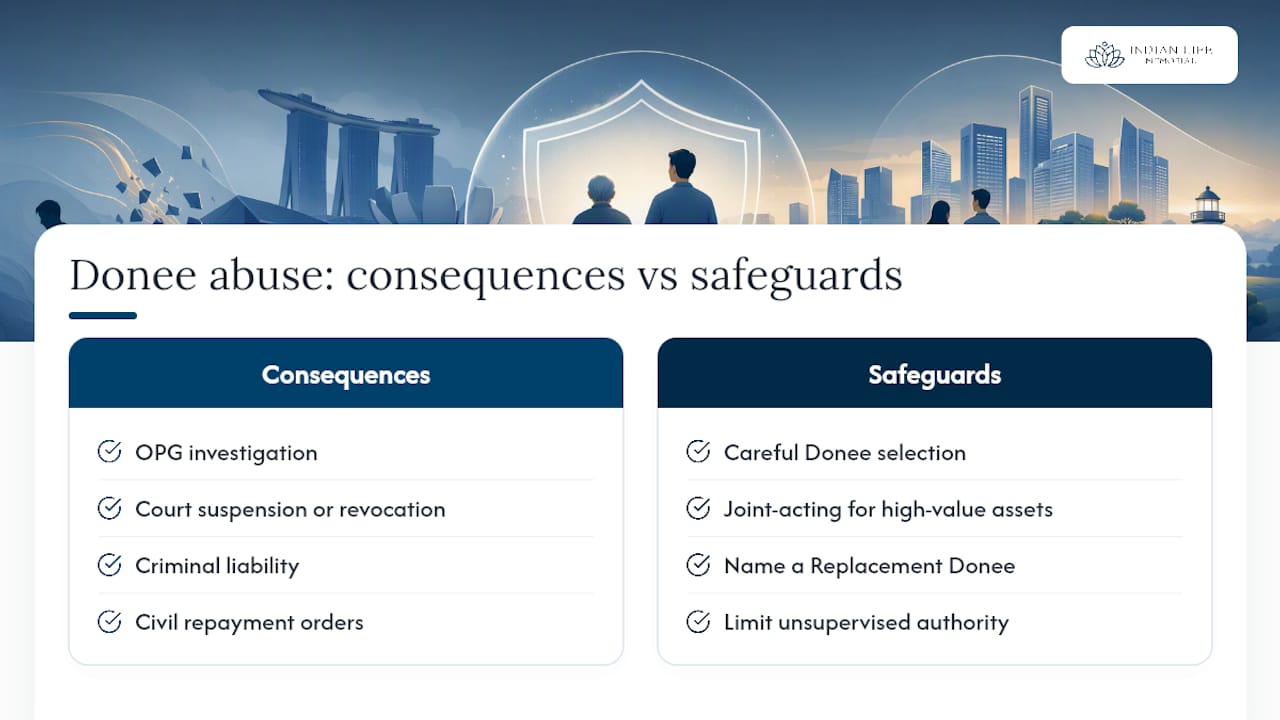
The Office of the Public Guardian has statutory power to investigate complaints about a Donee's conduct. Family members, healthcare providers, financial institutions, or other concerned parties can raise concerns directly with OPG. Where investigation confirms misuse, OPG can apply to the courts to suspend or revoke the Donee's authority, effectively removing their power to act on the donor's behalf going forward.
Beyond administrative removal, a Donee who commits financial abuse, such as siphoning funds from accounts they were only meant to manage on the donor's behalf, can face criminal liability under general provisions covering criminal breach of trust or cheating, depending on the specific conduct involved. Civil liability can also follow, with the Donee potentially required to repay misused funds to the donor's estate.
This is precisely why the safeguards built into the LPA system matter so much upfront: careful Donee selection, considering a joint-acting requirement for high-value property decisions, and naming a Replacement Donee who can also monitor conduct. An LPA granting broad, unsupervised authority to someone without a track record of trustworthiness is a risk multiplier, not a convenience.
Personal Welfare LPA vs. Property and Affairs LPA: What's the Real Difference?
Singapore's LPA framework treats personal welfare and property and affairs as genuinely separate categories of authority, and you can grant one, the other, or both to the same or different Donees.
A personal welfare LPA covers decisions about your daily care and wellbeing when you can't communicate them yourself: where you live (including whether you move into residential care), who provides your day-to-day support, and decisions about medical treatment you receive. It does not extend to end-of-life treatment refusal decisions, which fall under a separate Advance Medical Directive.
A property and affairs LPA covers your financial and material world: operating your bank accounts, paying recurring bills, managing or selling property, and handling CPF-related matters within legal limits. This is the category where the bankruptcy restriction applies. An undischarged bankrupt cannot grant property and affairs powers, though personal welfare powers remain available to them.
Many donors appoint the same Donee for both categories, often a spouse or adult child, on the theory that whoever handles welfare should also handle the money tied to that care. Others deliberately split the roles, naming one Donee for welfare and a different one (perhaps with financial expertise) for property and affairs. Neither approach is wrong. What matters is matching the choice to your family's actual dynamics, not defaulting to convention because it's the common pattern.
Official Sources and Hotlines Worth Bookmarking
Before you start, bookmark the official channels rather than relying on secondhand summaries:
- OPG and MSF's LPA pages — , plus the OPGO portal itself, for applying and checking accredited Certificate Issuer lists
- MyLegacy@LifeSG — and ServiceSG for broader end-of-life planning tools that complement your LPA
- ScamShield — and official government hotlines to verify any unsolicited calls or messages claiming to be from OPG, since LPA-related scams do circulate
For broader estate coordination once your LPA is in place, our guide on estate administration after death walks through what comes next, and a partner resource on comprehensive will writing is worth a look if you haven't drafted a Will yet.
Why Most People Wait Too Long to Make an LPA
The conventional advice treats an LPA like a retirement-planning item, something to handle in your sixties alongside estate documents. That framing misses the actual risk profile. Capacity loss from stroke or sudden illness doesn't wait for a life stage, and the families we've seen scramble hardest for a Deputyship order weren't elderly. They were adults in their forties and fifties caught by an unexpected medical event with no LPA in place.
What actually matters isn't the paperwork itself. It's the Donee conversation happening before a crisis forces it. Families skip that conversation because it feels premature, then face it under far worse conditions in a hospital corridor.
Prioritize naming a Replacement Donee from day one, even if it feels like an unnecessary extra step. It's the single safeguard most people skip, and it's the one that prevents a second court battle when your first Donee can't act. Coordinate the LPA with your Will and AMD together, not as separate future projects. When you're ready to think about the fuller arc of end-of-life planning, our full suite of funeral services exists for exactly that conversation.
— Admin
This article is general information, not a substitute for advice from a qualified lawyer. Consult a qualified legal professional about your own circumstances before acting on anything here.