
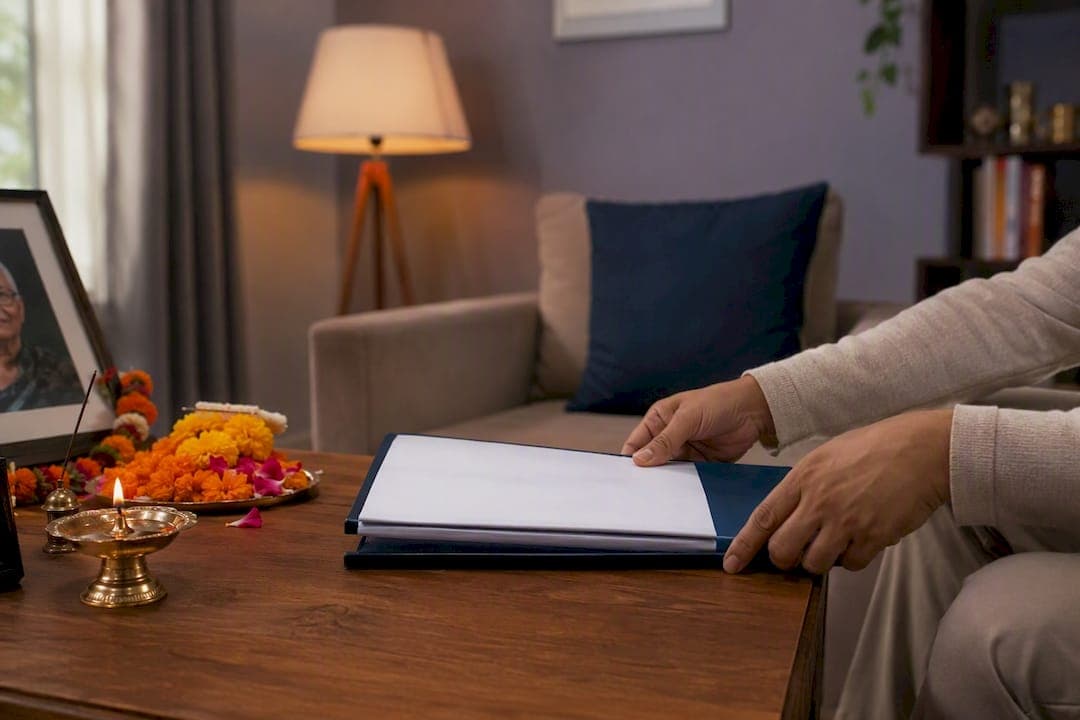
Start two things the same day: an insurer death claim and a CPF/Public Trustee Office (PTO) application for funeral reimbursement, if your loved one had CPF savings. Both routes exist to help your family recover funeral costs, and both need a certified true copy of the death certificate before anything else moves forward.
While you wait for the certificate, gather these items:
- Claimant's NRIC or passport
- Proof of relationship to the deceased (marriage or birth certificate)
- The deceased's CPF or insurance policy numbers, if known
- Itemized funeral invoices as they come in from your funeral provider
Contact the insurer's claims portal or your financial representative first, and start the PTO e-Services application in parallel. Register for PayNow linked to your NRIC now. It is the fastest, most traceable way to receive both CPF/PTO distributions and many insurer payouts. If the arrangements themselves feel like too much on top of the paperwork, Indian Life Memorial operates 24/7 and can manage both the funeral logistics and the document trail so your family isn't doing this alone.
Key Takeaways
Filing a Medifund death claim in Singapore succeeds when families start the insurer and CPF/PTO applications immediately and submit every required document in one complete packet.
| Point | Details |
|---|---|
| Act within the first 48 hours | Request the certified death certificate and start both the insurer claim and PTO application right away. |
| Know the S$150,000 threshold | Insurers can pay a Proper Claimant up to this amount without probate; above it, expect to need Letters of Administration. |
| Claim up to S$6,000 in funeral costs | PTO's Annex C route reimburses funeral expenses, with receipts compulsory for non-beneficiary claimants. |
| Expect a four-week PTO timeline | Distribution typically completes within four weeks once the full document packet is received. |
| Keep hospital-bill assistance separate | Community Care Endowment Fund and similar schemes are means-tested and filed apart from the funeral reimbursement claim. |
| Indian Life Memorial handles both sides | Fixed-price packages from $1,888 include itemized invoices mapped to insurer and PTO claim requirements. |
Table of Contents
- Step-by-Step Checklist to File Claims and Arrange the Funeral
- What Documents Do Insurers and PTO Actually Require?
- How Do You Claim Funeral Costs From CPF Through the Public Trustee Office?
- How Do You File a Death Claim With the Insurer Without Delays?
- Paying the Funeral Provider and Keeping the Right Receipts
- Does Your Family's Income Level Affect Death Claim Eligibility?
- Why Do Death Claims Get Rejected, and How Do You Prevent It?
- Who Can You Contact for Help With a Claim?
- What Happens if a Death Claim Is Denied?
- Coordinating a Medifund Claim With Other Government Support
- An Honest Take on What Actually Slows These Claims Down
- How Indian Life Memorial Supports Your Claim Process
- Frequently Asked Questions
Step-by-Step Checklist to File Claims and Arrange the Funeral
Grief doesn't wait for paperwork, but paperwork won't wait for grief either. Here's the order that keeps both moving without one blocking the other.
- Notify the attending doctor or hospital. Request the official death certificate, or the doctor's online certification if the death occurred in a medical facility.
- Report overseas deaths to ICA. If your loved one passed away outside Singapore, you'll need an ICA letter and a repatriation report before insurers or the PTO will process anything.
- Contact every insurer the deceased held a policy with. Download the death claim forms, and request the attending physician's statement if one is required for the payout.
- Start the PTO application for un-nominated CPF monies. Indicate the funeral reimbursement amount on the form and submit the Annex C supporting documents alongside it.
- Pay your funeral provider and request itemized receipts. Separate line items for priest services, hearse, venue rental, and embalming make later reimbursement claims far easier to process.
- Scan and save digital copies of everything. Insurers and the PTO both accept digital submissions, and a lost paper receipt can stall a claim for weeks.
Pro Tip: Photograph or scan every receipt the moment you receive it. Funeral arrangements move fast, and a misplaced hearse invoice can hold up a S$6,000 reimbursement for weeks.
If your family is also arranging traditional Hindu rites, What to do when someone dies in Singapore walks through the immediate 24 to 48 hours in more depth, including when to involve a priest.
What Documents Do Insurers and PTO Actually Require?
Every claim route wants a core packet: a certified true copy of the death certificate, the claimant's NRIC or passport, proof of relationship, and a signed claimant declaration form. Miss one of these and your file sits untouched.
Beyond that baseline, requirements branch depending on the case:
- Insurer extras: a doctor's or physician's statement, a police report or post-mortem summary if the death was accidental, and for deaths overseas, the ICA letter plus repatriation documents.
- Non-English documents: certified translations, sometimes notarized, especially common when a family member passed away outside Singapore.
- Large policy payouts: insurers may pay a Proper Claimant an amount up to a certain threshold without requiring a Grant of Probate or Letters of Administration. Above that threshold, most insurers require formal probate along with a schedule of assets.
Processing speed depends almost entirely on how complete your first submission is. The PTO generally distributes funds within a few weeks of receiving full documentation, but that clock only starts once every required paper is in. Insurers vary more, though electronic payment through PayNow tends to shave days off the wait compared with a mailed check.
If the estate involves a larger policy or property, Estate Administration After Death in Singapore covers the probate process in more detail than fits here.
How Do You Claim Funeral Costs From CPF Through the Public Trustee Office?
If the deceased had CPF savings and no nomination on file, the Public Trustee Office is where your family applies for both funeral reimbursement and distribution of the remaining balance. Eligibility splits into two lanes, and which one applies to you changes what you need to submit.
Beneficiaries named under the Intestate Succession Act or Muslim inheritance law can apply for reimbursement from the un-nominated CPF monies directly. Non-beneficiaries, such as a friend or distant relative who paid for the funeral, can still claim from estate monies, but the PTO holds them to a stricter standard: every receipt must be submitted, with no exceptions.
The application runs through PTO's online e-Services platform. You'll attach the Annex C list of supporting documents together with a completed Funeral Reimbursement Declaration Form.
| Claimant Type | Reimbursement Source | Receipts Required |
|---|---|---|
| Beneficiary | Un-nominated CPF monies | Recommended, not always compulsory |
| Non-beneficiary | Estate monies | Compulsory for every item claimed |
| Any claimant, overseas death | CPF monies via PTO | ICA letter and repatriation report added to Annex C packet |
Families can typically claim a capped amount toward funeral expenses under this route. Payment arrives either through PayNow linked to your NRIC or via direct credit, for which you'll need to provide bank proof upfront. One wrinkle worth knowing: if CPF Board hasn't yet forwarded the un-nominated monies to the PTO, your application can't proceed, and that handoff alone sometimes adds weeks before distribution even begins.
How Do You File a Death Claim With the Insurer Without Delays?
The paperwork insurers want is fairly standard across providers: a completed death claim form, certified death certificate, claimant NRIC or passport, and proof of relationship to the deceased. For overseas deaths, add the attending physician's statement to that list.
A few things separate a smooth payout from a stalled one:
- Check the payout amount against the S$150,000 threshold. Below it, insurers can often pay a Proper Claimant without probate. Above it, expect to produce a Grant of Probate or Letters of Administration.
- Submit through the right channel. Most insurers accept claims via their online portal, through a financial representative, or by post. Choose whichever gets a human confirmation fastest.
- Translate and certify anything not in English. Untranslated overseas documents are one of the most common reasons a file gets bounced back.
- Keep contact details current. Insurers flag outdated phone numbers and addresses as a leading cause of slow processing, so update these before you submit anything.
- Register for PayNow linked to your NRIC. It routes payment directly and skips the mailed-check delay entirely.
Paying the Funeral Provider and Keeping the Right Receipts
Ask your funeral provider for an itemized invoice, not a lump sum. Priest fees, hearse rental, embalming, venue costs, and repatriation charges each need to stand as separate line items, because insurers and the PTO map reimbursement rules to specific categories rather than a single total.

Keep both the original paper receipt and a digital scan of every payment. Non-beneficiary claimants in particular cannot skip this step. The PTO requires receipts for every dollar claimed from estate monies.
For Hindu and Indian rites, ask your priest for a written note or service letter confirming the ceremonies performed and their timing. It's a small document, but it can help explain unusual scheduling, such as ceremonies held across several days, if an insurer or the PTO ever asks for clarification.
Indian Life Memorial provides itemized invoices as standard, with fixed-price packages starting at $1,888 and 24/7 support for families who need paperwork handled alongside the funeral itself.
Does Your Family's Income Level Affect Death Claim Eligibility?
Insurer death claims and CPF/PTO funeral reimbursement is not means-tested. Eligibility rests on your relationship to the deceased and whether valid policy or CPF nomination documents exist, not on your household income or assets.
Where income and assets genuinely matter is on a separate track entirely: government financial assistance schemes for families struggling to cover outstanding hospital bills or care costs before or after a death. Those programs assess household income per capita and existing savings before approving support. If your family is also facing a large unpaid hospital bill from the deceased's final admission, that assistance runs through a different application than the funeral reimbursement claim, and it's worth applying for both rather than assuming one covers the other.
Don't let the presence of an income-tested scheme elsewhere confuse the CPF/PTO funeral reimbursement process. That claim is about documented relationship and receipts, not financial need. Families sometimes delay filing because they assume they'll be asked to prove hardship. They won't, as long as the Annex C paperwork is complete.
Why Do Death Claims Get Rejected, and How Do You Prevent It?
Most rejected claims share one root cause: an incomplete document packet, not a disputed eligibility. A missing certified translation, an unsigned declaration form, or a receipt left out of a non-beneficiary's submission are the most common culprits.
A few specific traps to watch for:
- Submitting a photocopy instead of a certified true copy of the death certificate. Insurers and the PTO both want the certified version, not a scan of a scan.
- Skipping the physician's statement on overseas deaths. This one gets missed constantly because families assume the death certificate alone is enough.
- Claiming above the S$150,000 threshold without probate documents. The insurer will simply hold the file until a Grant of Probate or Letters of Administration arrives.
- Non-beneficiaries omitting receipts. The PTO treats this as a hard requirement, not a suggestion.
- Outdated contact details on file. A returned confirmation email or unreachable phone number can quietly stall a claim for weeks without anyone flagging it to you.
The fix for nearly every rejection is the same: assemble the full Annex C packet, or the insurer's equivalent list, before you submit anything. A claim resubmitted after rejection almost always takes longer than one submitted complete the first time.
Who Can You Contact for Help With a Claim?
You don't have to work through this alone, and several channels exist specifically to help families untangle claim paperwork.
For CPF and PTO matters, the Public Trustee Office's e-Services portal is the primary application channel, and its guidance pages list every Annex C requirement in plain terms. For insurer claims, your first call should be the insurer's claims department or your assigned financial representative. Most major insurers in Singapore, including Manulife and Great Eastern, operate dedicated death claim portals with document checklists built in.
If your family is also navigating outstanding hospital bills or broader financial assistance, medical social workers at the hospital where the deceased was treated can point you toward the right scheme and help with the application itself. They're often the fastest route to sorting out which government support applies to your situation.
And for the funeral side of things, Indian Life Memorial's team is available 24/7 to answer questions about paperwork sequencing, even for families who haven't yet decided on a provider.
What Happens if a Death Claim Is Denied?
A denial isn't necessarily final. Insurers and the PTO both typically issue a written reason for rejection, and that reason tells you exactly what to fix.
Start by requesting the denial letter in writing if you haven't received one already. It should specify whether the issue was a missing document, an eligibility question, or a dispute over the claimant's relationship to the deceased. Most denials trace back to the first category, which means the fix is often as simple as resubmitting with the missing piece attached.
If the denial rests on a genuine dispute, such as competing claims from multiple potential beneficiaries, insurers generally offer an internal review process before the matter needs to go further. Ask specifically for the escalation or appeals contact within the claims department, since this isn't always listed on the standard forms.
For CPF/PTO applications, a rejected or incomplete submission typically comes back with a request for the specific missing item, rather than an outright denial. Treat that request as a checklist, and log every conversation with the office along with dates and staff names, since a paper trail helps enormously if the same document gets requested twice.
Coordinating a Medifund Claim With Other Government Support
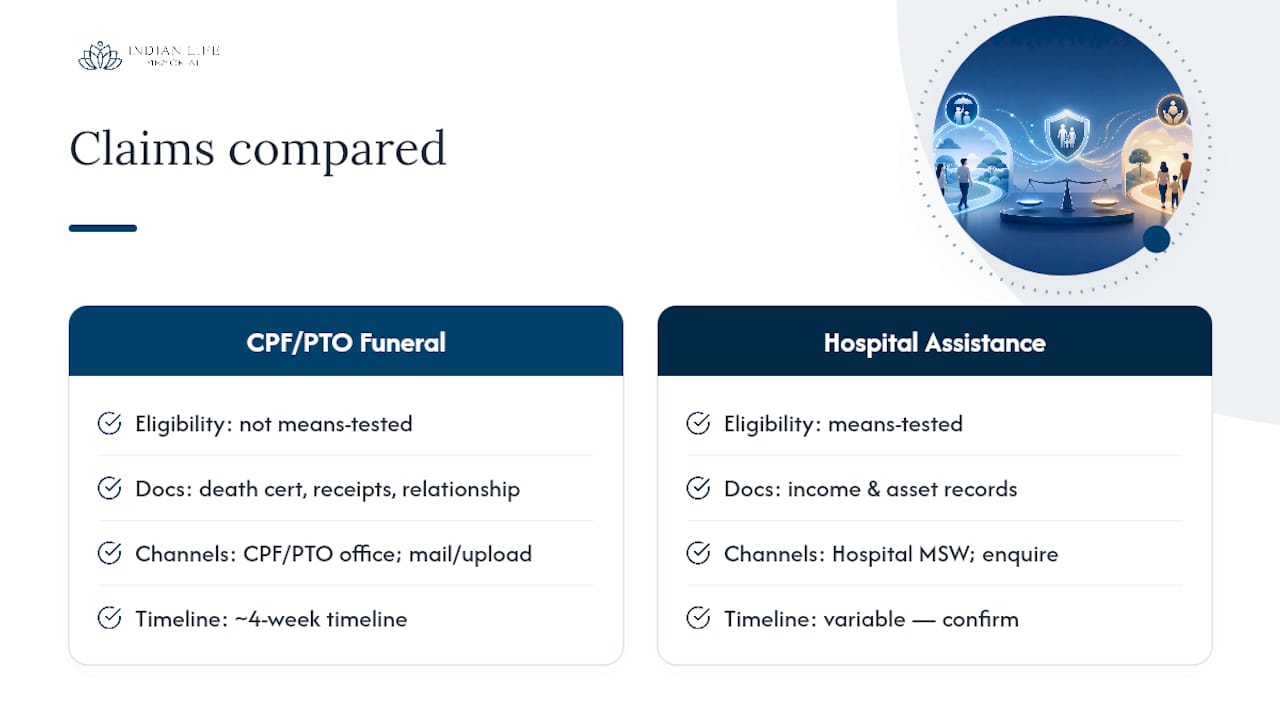
If your family is managing both funeral costs and unpaid hospital bills from the deceased's final illness, these run as two separate applications, and treating them that way from the start saves confusion later.
File the CPF/PTO funeral reimbursement first, since it has the clearer document path and the roughly four-week timeline once complete. In parallel, ask the hospital's medical social work department about financial assistance schemes for outstanding bills, including the Community Care Endowment Fund, which some hospitals administer for patients facing hardship before or after death.
Keep the two document sets distinct. The funeral reimbursement packet centers on Annex C items: death certificate, receipts, and relationship proof. The hospital bill assistance application will ask for income and asset information instead, since that scheme is means-tested. Submitting the wrong documents to the wrong office is a common source of delay, so confirm with each office which packet they actually need before mailing or uploading anything.
An Honest Take on What Actually Slows These Claims Down
Most guidance on this topic treats insurance and CPF claims as bureaucratic hurdles to survive. That framing misses the real pattern: claims stall almost entirely because of incomplete documentation, not because agencies are slow or difficult. The PTO's four-week distribution window and the insurer thresholds are genuinely reasonable once you understand them.
What conventional advice underplays is timing pressure from the funeral side. Families often file claims after arrangements are already paid for, scrambling to reconstruct receipts from memory. That's backward. The itemized invoice should be requested before the funeral, not after, so the receipt trail exists from day one.
Prioritize getting the death certificate and starting both claim applications within the first 48 hours. Everything else, including probate questions and hospital-bill assistance, can follow once those two engines are running. A provider who hands you organized paperwork alongside the funeral itself removes one entire category of stress most families don't see coming until they're already in it.
How Indian Life Memorial Supports Your Claim Process
Filing a death claim while planning a funeral shouldn't mean choosing between grief and paperwork. Indian Life Memorial is built around exactly that overlap: fixed-price packages starting at $1,888, itemized invoices ready for insurer and PTO submission, and 24/7 availability so your family isn't tracking down documents alone at midnight.
For families arranging Hindu or Indian rites specifically, this means qualified priests conducting proper Vedic ceremonies, paired with receipts already organized the way insurers and the Public Trustee Office expect them. You won't need to separately request an itemized breakdown after the fact. It comes standard, mapped to the categories PTO's Annex C and most insurer forms ask for.
Explore Hindu and Indian funeral services to see how ceremonies, transport, and paperwork support are packaged together, or check current funeral packages to get a straight answer on cost before you commit to anything. A call now gets you a provider who handles both the ceremony and the claims trail from the same conversation.
Frequently Asked Questions
Do I need probate to file an insurance death claim in Singapore? Not always. Insurers can pay a Proper Claimant up to S$150,000 without probate. Above that amount, most insurers require a Grant of Probate or Letters of Administration before releasing funds.
How much can my family claim for funeral expenses through CPF or PTO? Families can typically claim up to S$6,000 in funeral reimbursement through the Public Trustee Office, provided the Annex C documentation is complete.
How long does the medifund death claim process in Singapore take from start to finish? Once the PTO receives a complete document packet, distribution generally takes about four weeks. Insurer timelines vary, but PayNow payments tend to arrive faster than mailed checks.
What if the death happened overseas? You'll need an ICA letter and a repatriation report in addition to the standard death certificate and claimant documents. Certified translations are required for any non-English paperwork.
Can a non-beneficiary claim funeral cost reimbursement? Yes, from estate monies rather than un-nominated CPF savings, but the PTO requires receipts for every expense claimed, with no exceptions.
What should I do if my claim gets rejected? Request the written denial reason, since most rejections trace back to a missing document rather than an eligibility dispute. Resubmit with the specific missing item, and keep a log of every communication with the claims office.
This article is general information, not a substitute for advice from a qualified financial advisor. Consult a qualified financial professional about your own circumstances before acting on anything here.