

A funeral service contract is a legally binding agreement between a family and a funeral home that specifies the goods, services, and total costs to be provided, either at the time of death or arranged in advance. The industry recognizes two primary types: at-need and pre-need contracts, where at-need contracts are signed immediately after a death occurs, and pre-need contracts are arranged while a person is still living. Regulatory oversight governs both types, and understanding the funeral contract definition before signing protects your family from unexpected costs and emotional stress during an already difficult time.
What does a funeral service contract include?

A funeral service agreement covers three distinct categories of goods and services. Knowing which category each item falls into determines whether its price is guaranteed or subject to change.
Professional services form the foundation of every contract. These include:
- Body preparation (embalming, dressing, and casketing)
- Coordination of the funeral ceremony and logistics
- Use of the funeral home's facilities for viewing or services
- The basic non-declinable service fee, which covers overhead such as permit filing and administrative coordination
The basic services fee is mandatory and must appear clearly on the funeral home's General Price List (GPL). The GPL is a federally mandated disclosure document under the FTC Funeral Rule, and every funeral home in the United States must provide it upon request. Missing or reviewing this list carefully is the single most common mistake families make when comparing providers.
Merchandise is the second category. This includes caskets, urns, outer burial containers, and memorial items. Prices for merchandise are typically locked in under a guaranteed-price contract.
Third-party or cash advance items are the category most families overlook. These include:
- Cemetery fees and grave opening charges
- Death certificate copies
- Clergy or officiant fees
- Obituary publication costs
- Flowers and transportation beyond the funeral home's vehicles
Guaranteed-price contracts cover only the funeral home's own services and merchandise. Third-party items are almost always excluded, meaning your family could face additional charges even with a prepaid contract in place.
Pro Tip: Ask your funeral provider to separate guaranteed items from non-guaranteed cash advance items in writing before you sign. This one step prevents the most common source of surprise costs.
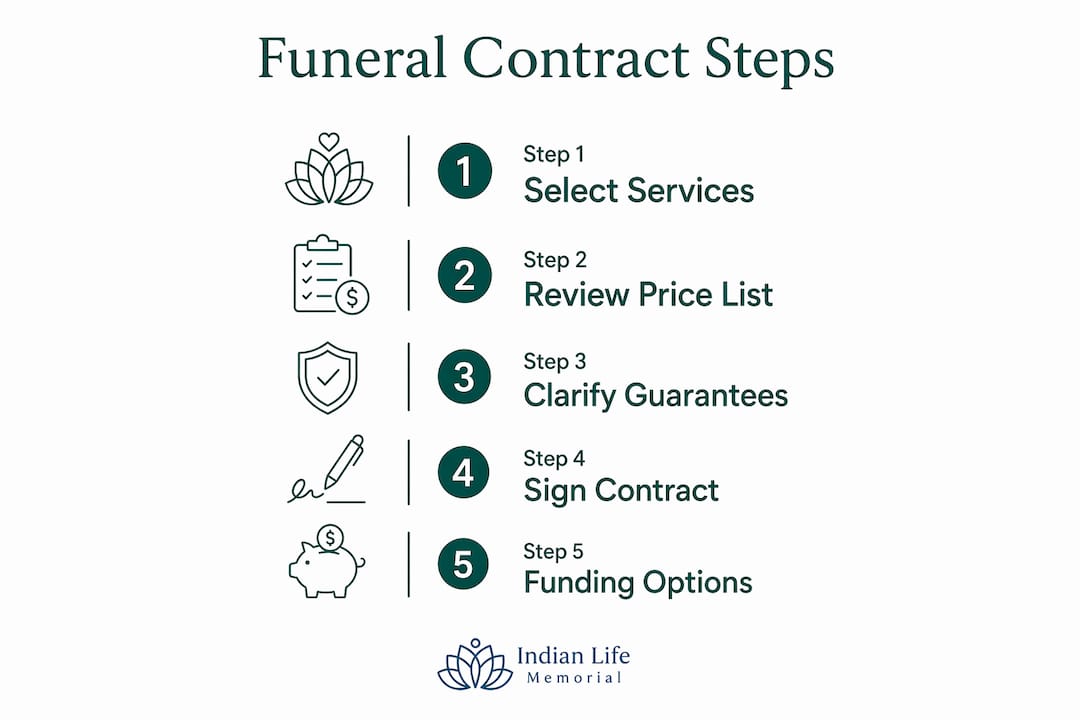
How are funeral contracts funded?
Pre-need funeral contracts require a funding vehicle to hold the money until the services are needed. The two primary methods are funeral trusts and pre-need insurance policies, and each carries different financial and legal consequences.
-
Funeral trusts are state-regulated accounts where your prepaid funds are held by a trustee until death. The funeral home cannot access the money until services are rendered. Trusts vary by state in terms of how much of the principal is protected, whether interest accrues to the estate or the funeral home, and what happens if you cancel.
-
Pre-need insurance policies function like life insurance. You pay premiums, and the death benefit is assigned directly to the funeral home. These policies are portable in some cases, meaning you can transfer coverage if you move to another state or change providers.
-
Tax and benefit implications differ significantly between the two methods. Funds held in an irrevocable funeral trust are often excluded from Medicaid and SSI asset calculations, which matters for families planning long-term care. Pre-need insurance policies may or may not receive the same treatment depending on state rules.
-
Cancellation terms are stricter with irrevocable contracts. Once you designate a contract as irrevocable, you generally cannot reclaim the funds or redirect them without legal intervention.
-
Portability is a real concern if you relocate. Pre-need insurance policies tend to offer more flexibility for transfers than funeral trusts, though both may carry fees.
Pro Tip: Consult an elder law attorney or financial advisor before signing any pre-need contract, especially if Medicaid eligibility is a consideration for your family.
What are the risks and limitations of funeral contracts?
Funeral service contracts carry real risks that families often discover too late. Reading every clause before signing is not optional. It is the only way to protect your family's interests.
The most significant risks include:
- Non-guaranteed cash advance items. As noted, cemetery fees, clergy costs, and obituary charges are typically excluded from price guarantees. These costs can rise substantially between the signing date and the date of death.
- Cancellation fees. Policies vary widely by state and provider. Some contracts allow full refunds within a cooling-off period, while others impose penalties of 10% or more of the contract value.
- Transferability restrictions. Moving to another city or country can make a pre-need contract difficult to use. Some contracts are non-transferable to other providers, leaving families with limited options.
- Irrevocable versus revocable contracts. An irrevocable contract cannot be canceled or modified without significant legal effort. Families sometimes sign irrevocable contracts for Medicaid purposes without fully understanding that they lose access to those funds permanently.
- The mandatory basic services fee. This charge appears in every contract and cannot be waived. Families who do not compare GPL documents across providers often pay more than necessary for this line item alone.
One distinction that carries major financial weight is the difference between pre-planning and pre-paying. Pre-planning documents your wishes with no financial obligation attached. Pre-paying creates a binding contract and transfers funds, which affects your legal and financial position immediately. You can pre-plan without pre-paying, and for many families, that is the wiser first step.
How does a funeral service contract benefit your family?
The practical benefits of a funeral service agreement are both financial and emotional. The median cost of a burial funeral is approximately $8,300 as of 2026. Locking in today's prices through a pre-need contract protects your estate against future cost increases for the services and merchandise covered under the guarantee.
The financial protection is real, but the emotional benefit may be even more significant. Pre-need contracts reduce the burden on grieving families by removing the pressure of making dozens of decisions under acute emotional distress. When arrangements are already documented and funded, your family can focus on honoring your memory rather than negotiating costs.
A funeral service contract is as much an act of love as it is a financial tool. When you document your wishes and fund them in advance, you give your family the gift of clarity at the moment they need it most. They do not have to guess what you would have wanted, and they do not have to argue over costs while grieving.
Faith-based considerations also belong in this conversation. Families observing Hindu rites, for example, require specific Vedic ceremonies such as Antyesti, the presence of a qualified Pandit, and adherence to Samskaras that govern the soul's transition. A contract that does not account for these requirements will not serve the family's actual needs. Specifying faith-based services in writing within the contract is the only way to guarantee they are honored.
A pre-need contract may not be the right choice if your financial situation is unstable, if you are likely to relocate internationally, or if you have not yet compared providers. In those cases, pre-planning your wishes without financial commitment is a sound intermediate step. You can always convert a pre-plan into a funded contract later.
Key Takeaways
A funeral service contract is a legally binding agreement that protects families financially and emotionally by locking in services, costs, and personal wishes before the time of need.
| Point | Details |
|---|---|
| Two contract types | At-need contracts are signed after death; pre-need contracts are arranged and funded in advance. |
| Guaranteed vs. non-guaranteed | Price guarantees cover funeral home services and merchandise only; third-party fees like cemetery charges are excluded. |
| Funding method matters | Funeral trusts and pre-need insurance policies differ in tax treatment, Medicaid impact, and portability. |
| Read cancellation terms | Irrevocable contracts cannot be easily canceled; transferability restrictions can limit your options if you relocate. |
| Pre-planning vs. pre-paying | Pre-planning documents wishes with no financial obligation; pre-paying creates a binding contract with immediate legal implications. |
What I have learned from reviewing funeral contracts closely
The single most common misunderstanding I encounter is the assumption that "prepaid" means "fully covered." It does not. Guaranteed pricing applies to the funeral home's own services and merchandise. The moment a third party is involved, such as a cemetery, a clergy member, or a government office issuing death certificates, the price guarantee ends. Families who discover this at the time of death face real financial stress on top of grief.
The second thing I have observed is that cancellation and transfer clauses receive almost no attention during the signing process. People focus on the service list and the total price. They rarely ask what happens if they move, change their mind, or need to switch providers. Those clauses can cost thousands of dollars if ignored.
My honest recommendation is this: separate the act of pre-planning from the act of pre-paying. Document your wishes in detail first. Share them with your family. Then, only after you have compared at least two or three providers and reviewed their GPL documents side by side, consider signing a funded contract. Reviewing funeral service fees across providers before committing is one of the most practical steps any family can take.
Clear communication with your funeral provider is not a courtesy. It is a contractual necessity. Ask every question in writing. Request written confirmation of which items are guaranteed and which are not. A provider who resists that level of transparency is telling you something important about how they operate.
— Admin
Indianlifememorial: transparent funeral planning for every faith
Families who understand funeral contracts are better prepared to choose a provider that matches their values, their faith, and their budget. Indianlifememorial serves families across Singapore with 24/7 availability, culturally sensitive care, and pricing that starts at $1,888 with no hidden fees.

Whether your family observes Hindu funeral traditions with full Vedic rites and an experienced Pandit, or requires a service aligned with another faith, Indianlifememorial provides a clear, step-by-step process so your family knows exactly what to expect at every stage. Transparent packages are available for review, and the team is available around the clock to answer questions before any commitment is made. Explore the full suite of funeral services to understand your options and begin planning with confidence.
FAQ
What is the funeral contract definition in simple terms?
A funeral service contract is a legally binding agreement between a family and a funeral home that specifies which services and goods will be provided, at what cost, and under what conditions. It can be signed at the time of death (at-need) or arranged in advance (pre-need).
What does a funeral contract include?
A funeral contract typically includes professional services such as body preparation and ceremony coordination, merchandise such as caskets or urns, and a list of third-party cash advance items like cemetery fees and death certificates. Only the funeral home's own services and merchandise are usually covered by a price guarantee.
What is the importance of funeral contracts for families?
Funeral contracts protect families from price increases, reduce decision-making pressure during grief, and ensure that a person's specific wishes, including faith-based requirements, are honored. Pre-need contracts also carry implications for Medicaid eligibility depending on how they are structured.
How do I choose a funeral service contract wisely?
Request the General Price List from every provider you consider, identify which items are guaranteed versus non-guaranteed, and review cancellation and transfer terms before signing. Consulting an elder law attorney is advisable if Medicaid planning is part of your financial situation.
Can a prepaid funeral contract be canceled?
Cancellation is possible in most cases, but the terms vary significantly by state and contract type. Irrevocable contracts impose the strictest restrictions, while revocable contracts may allow full or partial refunds within a specified period. Always confirm cancellation and transfer policies in writing before committing.