
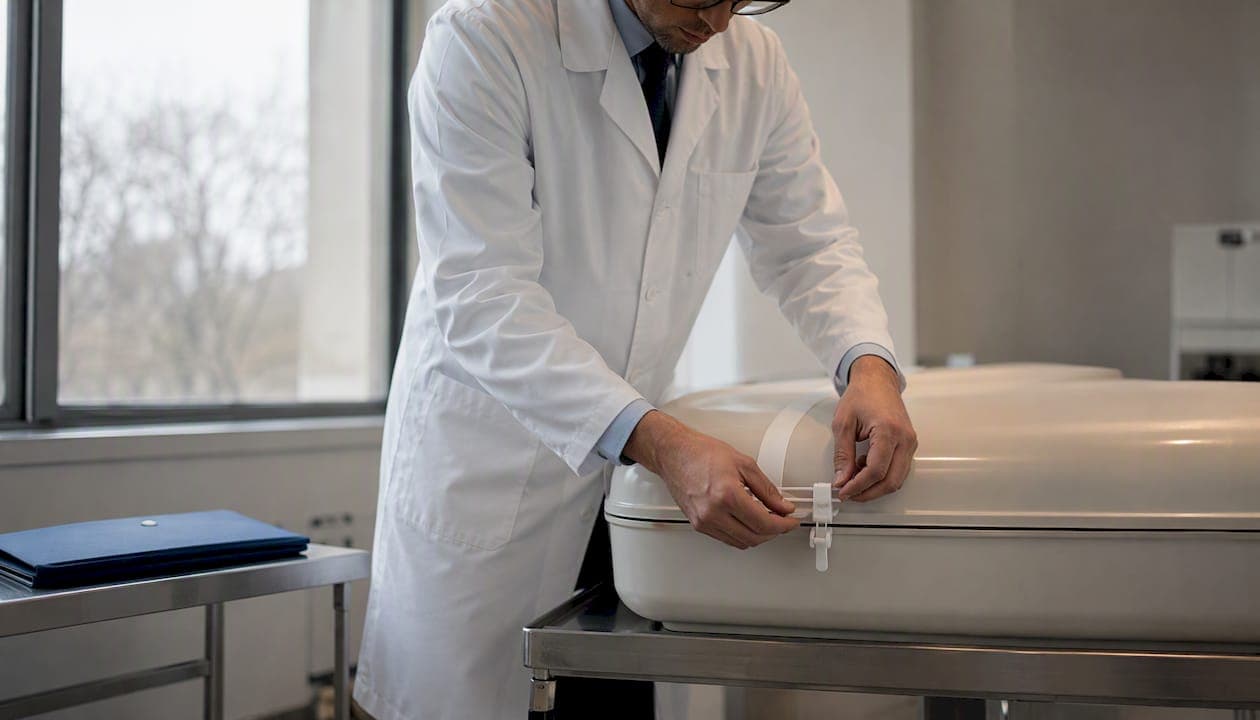
Repatriating a loved one internationally from the United States requires gathering these core documents first: a certified long-form death certificate, an embalming or non-contagious disease certificate, a consular mortuary certificate or transit permit, a copy of the deceased's passport, and any apostilles or certified translations the destination country requires. Once those are in hand, two actions unlock everything else: contact a licensed funeral home experienced in international transfers, and notify the destination country's U.S.-based consulate to request their specific mortuary checklist.
Core documents to collect immediately:
- Certified long-form death certificate (multiple certified copies)
- Embalming certificate or certificate of non-contagious disease
- Consular mortuary certificate or transit/transport permit
- Copy of the deceased's passport (and next-of-kin's ID)
- Coroner or medical examiner report (when applicable)
- Cremation certificate and urn documentation (for cremated remains)
- Certified translations of all documents (where required)
- Apostille or consular legalization of key documents
Your two immediate next steps:
- Call a funeral director licensed for international repatriation and authorize them to coordinate with the local coroner or medical examiner.
- Contact the destination country's consulate in the United States and request their published mortuary requirements or mortuary passport template.
Missing or mismatched documents are the most common cause of shipment delays. Starting both steps within the first 24 hours gives your family the best chance of a timely, dignified transfer.
Table of Contents
- What documents are required for international repatriation?
- Where do you get each required document in the United States?
- What do airlines and IATA require for transporting human remains?
- Step-by-step checklist from death to destination customs release
- How do special situations change the documentation?
- Which authoritative sources should you consult directly?
- Key Takeaways
- What families often underestimate about repatriation
- Indianlifememorial offers repatriation coordination when your family needs it most
- Official sources to consult when confirming destination requirements
What documents are required for international repatriation?
The table below covers every document your family may be asked to provide, who issues it, where to obtain it in the United States, and whether certified copies, apostilles, or translations are typically required.
| Document | Issuing Authority | Where to Obtain in the U.S. | Certified Copies Needed | Apostille / Translation Often Required |
|---|---|---|---|---|
| Long-form death certificate | State vital records office | State health department or county registrar | Yes (4–6 copies recommended) | Apostille often required; translation if destination language differs |
| Cause-of-death / coroner report | County coroner or medical examiner | County coroner's office | Yes | Sometimes required for consular review |
| Embalming certificate | Licensed funeral director | Funeral home | Yes | Translation often required |
| Certificate of non-contagious disease | Licensed funeral director or physician | Funeral home or attending physician | Yes | Translation often required |
| Consular mortuary certificate / mortuary passport | Destination country's consulate | Consulate in the U.S. | Yes | Issued in destination language; may require apostilled supporting docs |
| Transit / transport permit | State or local health authority | State health department | Yes | Varies by destination |
| Deceased's passport copy | Family | Family records | N/A (copy) | N/A |
| Next-of-kin ID and authorization | Family | Family records | Notarized copy often required | N/A |
| Autopsy report | Medical examiner | County medical examiner's office | Yes | Sometimes required |
| Cremation certificate | Cremation authority / funeral home | Funeral home or crematorium | Yes | Translation often required |
| Airway bill | Airline cargo | Airline cargo desk | N/A | N/A |
A few notes on each document:
Long-form death certificate. Request multiple certified copies from the state vital records office. The "long form" includes cause of death, which most consulates require. Processing time varies by state, but expedited service is usually available for an additional fee. Verify that the full legal name on the certificate matches the passport exactly.
Embalming or non-contagious disease certificate. Most destination countries require proof that the remains are safe to transport. If embalming is performed, the funeral director issues a signed certificate. If embalming is not performed (some religious traditions prohibit it), a physician or medical examiner may issue a certificate confirming the cause of death is non-contagious. Some countries, notably certain Muslim-majority nations, specifically require that remains not be embalmed, so confirm the destination's rules before preparation begins.
Consular mortuary certificate. This is the document most families underestimate. Each destination country's consulate issues its own version, sometimes called a mortuary passport or laissez-passer mortuaire. Italy, for example, requires apostilled long-form death certificates, an apostilled medical certificate stating cause of death, and certified translations before issuing this clearance. The consulate attaches or seals this certificate to the outside of the shipping container.
Transit permit. Required by the U.S. state of origin and sometimes by transit countries. Obtain it from the state health department. If the flight routes through a third country, check whether that country requires its own transit documentation.
Apostille and certified translations. An apostille is a standardized authentication recognized by countries that are party to the Hague Convention. If the destination country is not a Hague Convention member, full consular legalization (a more involved process) is required instead. Translations must be certified by a professional translator or a consulate-approved translation service, not a family member.
Pro Tip: Before submitting any document to the consulate, lay every document side by side and compare the deceased's full legal name, date of birth, and date of death. A single character difference between the death certificate and the passport is enough to trigger a rejection and add days to the process.
Documentation and consular or legalization fees commonly add several hundred dollars to the overall cost of repatriation, so budget for those early.
Where do you get each required document in the United States?
Knowing the right office to call saves hours. Here is a practical issuer map:
-
Certified death certificate: Contact the vital records office of the state where the death occurred. Most states offer expedited certified copies for an additional fee. You will need to provide proof of relationship (next-of-kin) and the deceased's full legal name, date of birth, and date of death. For international death registration purposes, the long-form version is almost always required.
-
Cause-of-death report / coroner report: Contact the county coroner or medical examiner's office in the jurisdiction where the death occurred. If an autopsy was ordered, the full autopsy report may take several weeks; request a preliminary cause-of-death letter in the interim so consular processing can begin.
-
Embalming certificate: Your licensed funeral director issues this after preparation. Confirm the certificate includes the funeral director's license number, the date of embalming, and the chemicals used, as some consulates require that level of detail.
-
Passport copy: Gather this from the deceased's personal documents. If the passport cannot be located, the U.S. Department of State's consular guidance recommends contacting the nearest U.S. Embassy or Consulate for a Consular Report of Death Abroad (CRDA) if the death occurred overseas, or the state vital records office if the death occurred domestically.
-
Consular mortuary certificate / transit permit: Contact the destination country's consulate or embassy in the United States. Most consulates publish a mortuary checklist or mortuary passport template on their website. Bring or courier all supporting documents (certified death certificate, embalming certificate, passport copy, and any apostilles) to the consulate. Processing times vary from one to five business days depending on the country.
-
Apostille: Obtain from the Secretary of State's office in the state where the document was issued. Most states offer expedited apostille services. The apostille authenticates the document for international use under the Hague Convention.
On authority to sign: The next-of-kin hierarchy matters. Most states recognize the following order: surviving spouse, adult children, parents, adult siblings. If authority is disputed or unclear, the funeral home may require a court order or a notarized affidavit of next-of-kin before releasing the remains. Resolve this early, as a contested authorization can halt the entire process.
What do airlines and IATA require for transporting human remains?
The International Air Transport Association (IATA) publishes handling guidelines that most major airlines follow when accepting human remains as air cargo. These guidelines cover container standards, sealing requirements, and documentation, and they carry real operational weight: airlines routinely defer to IATA guidance when deciding whether to accept a shipment.
IATA guidance is operationally decisive. Funeral directors and airlines routinely defer to IATA container and handling standards when approving cargo acceptance and routes. A compromised seal or a non-compliant container is grounds for refused shipment at the cargo desk, regardless of how complete the paperwork is.
Container and sealing standards. IATA guidelines generally require a sealed inner container (often a galvanized metal liner) inside the outer casket or shipping container. Some routes and airlines require a Ziegler case, a hermetically sealed zinc or metal container that prevents leakage. Pressure equalization devices may be required on certain long-haul routes. The consular mortuary certificate is typically attached to the outside of the container in a sealed envelope.
Airline-required documents at cargo acceptance:
| Document | Notes |
|---|---|
| Airway bill | Issued by the airline; identifies the shipment and route |
| Consular mortuary certificate | Attached to the outside of the container |
| Embalming certificate | Confirms remains are safe for air transport |
| Death certificate (certified copy) | Accompanies the shipment |
| Transit permit | Required by origin state and sometimes transit countries |
| Funeral home authorization letter | Confirms the shipping funeral home's identity and license |
Before booking any flight, verify these points with the airline's cargo desk:
- Whether the airline requires embalming or, conversely, prohibits it for religious reasons
- Whether a purifying device is required on the container for the specific route
- Whether the route transits a country that requires additional documentation
- The airline's specific container dimensions and weight limits
- Whether the airline has a dedicated human-remains cargo program or uses a general cargo process
For a fuller picture of how the cargo and shipment side works, the guide on overseas body shipment covers the handling steps in detail. Understanding customs clearance for international shipments also helps families anticipate what happens when remains arrive at the destination country.
Step-by-step checklist from death to destination customs release
Follow this sequence to keep the process moving and avoid the document gaps that cause delays.
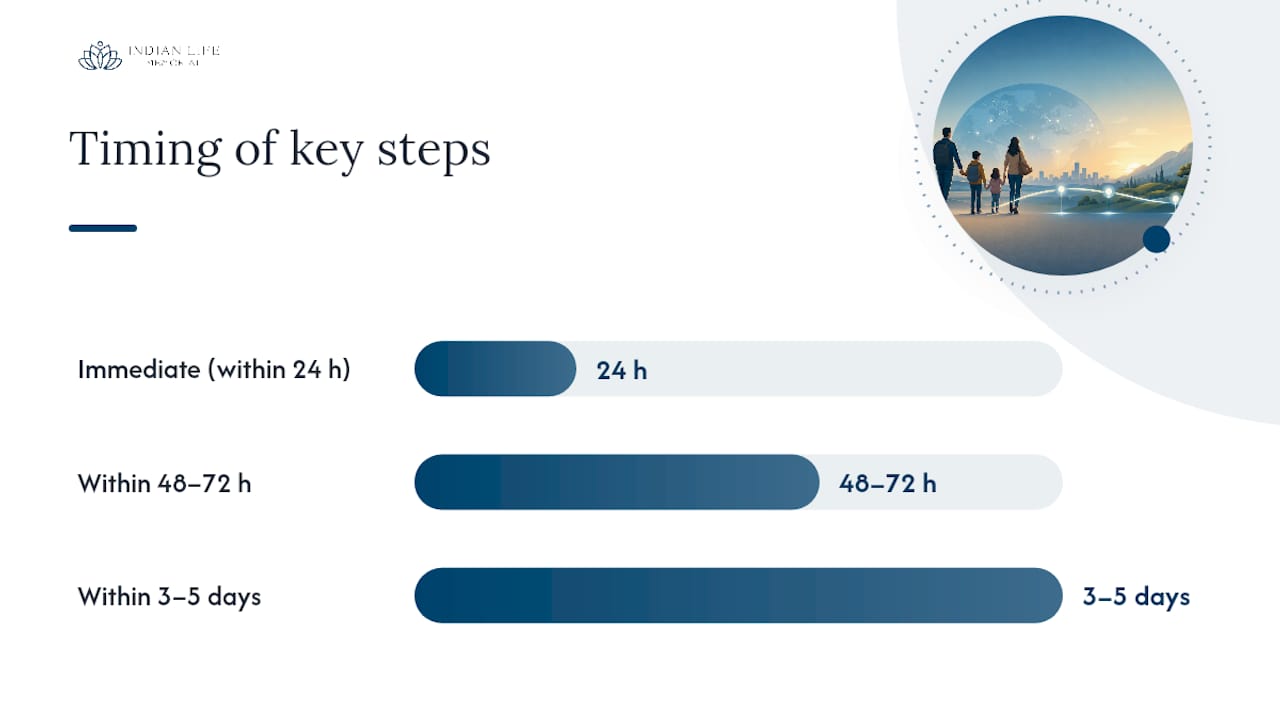
Immediate (within 24 hours):
- Notify the local funeral home and authorize them to take custody of the remains.
- Contact the county coroner or medical examiner to confirm whether an autopsy is required.
- Gather the deceased's passport, any identification documents, and proof of your relationship (next-of-kin).
- Contact the destination country's consulate in the United States and request their mortuary checklist or mortuary passport template.
Within 48–72 hours:
- Order certified long-form death certificates from the state vital records office. Request at least four to six certified copies.
- Confirm with the funeral director whether embalming is required or prohibited by the destination country, and proceed accordingly.
- Obtain the embalming certificate or certificate of non-contagious disease from the funeral director or attending physician.
- Confirm the receiving funeral home at the destination and share their contact details with the U.S. funeral home.
Within 3–5 days:
- Submit all required documents to the destination country's consulate: certified death certificate, embalming certificate, passport copy, and any apostilles or translations required.
- Apply for apostilles through the Secretary of State's office for any documents the consulate requires to be apostilled.
- Engage a certified translator for any documents that must be translated into the destination country's language.
- Obtain the transit permit from the state health department.
Pre-flight (once consular clearance is received):
- Confirm the airline cargo desk's specific container and documentation requirements.
- Verify that the consular mortuary certificate is sealed and attached to the outside of the container.
- Book the cargo shipment and obtain the airway bill.
- Share the flight details, airway bill number, and estimated arrival time with the receiving funeral home.
At destination:
- The receiving funeral home coordinates customs clearance and release of remains.
- Confirm that all original documents (or certified copies) travel with the shipment or are couriered separately as required by the destination country.
For a detailed look at funeral home coordination steps during international transfers, that guide covers the handoff procedures between U.S. and receiving funeral homes.
How do special situations change the documentation?
Infectious disease deaths and CDC requirements
When the cause of death involves a communicable or infectious disease, both the Centers for Disease Control and Prevention (CDC) and the World Health Organization (WHO) inform what additional health documentation is required. The CDC may impose restrictions on the transport of remains when the disease poses a public health risk. Some destination countries will only accept remains accompanied by specific health certificates confirming safe handling and containment. In rare cases involving highly contagious diseases, international transport may be temporarily prohibited.
If the cause of death involves any infectious disease, notify the funeral home immediately. They are required to follow CDC safe-handling protocols, and the embalming or preparation process may differ from standard procedures.
When infectious disease is involved, the CDC's guidance on safe handling of human remains takes precedence over standard repatriation procedures. Families should confirm with both the local health authority and the destination country's consulate whether additional health certificates, sealed container requirements, or quarantine protocols apply before any transport arrangements are made.
Autopsy or coroner holds
If the coroner or medical examiner orders an autopsy, the remains cannot be released until the investigation is complete. This can add days to several weeks to the timeline. Request a preliminary cause-of-death letter as soon as possible so consular processing can begin in parallel. The full autopsy report will be required by some consulates before issuing the mortuary certificate.
Cremated remains (cremains)
Repatriating cremains is generally simpler than transporting a full body, but documentation is still required. You will need a cremation certificate issued by the crematorium, a certified death certificate, and consular clearance from the destination country. Some countries have specific rules about urn materials and container types for air transport. Cremains are typically carried as checked baggage or hand luggage rather than cargo, but confirm the airline's policy and the destination country's customs rules before travel.
Apostille vs. consular legalization
If the destination country is a signatory to the Hague Apostille Convention, an apostille from the issuing state's Secretary of State office is sufficient to authenticate documents. If the destination country is not a Hague Convention member, full consular legalization is required, a more involved process that typically requires the document to be authenticated by the U.S. Department of State and then legalized by the destination country's embassy. Identify which process your destination requires on the first day, because starting the wrong process wastes time that cannot be recovered.
For destinations in Latin America, for example, regional guidance consistently highlights the need for apostilled death certificates, apostilled embalming certificates, and an international transfer permit, with the specific forms varying by country. Always confirm requirements directly with the receiving consulate.
Which authoritative sources should you consult directly?
No single checklist replaces the destination country's own published requirements. These are the primary sources to verify against:
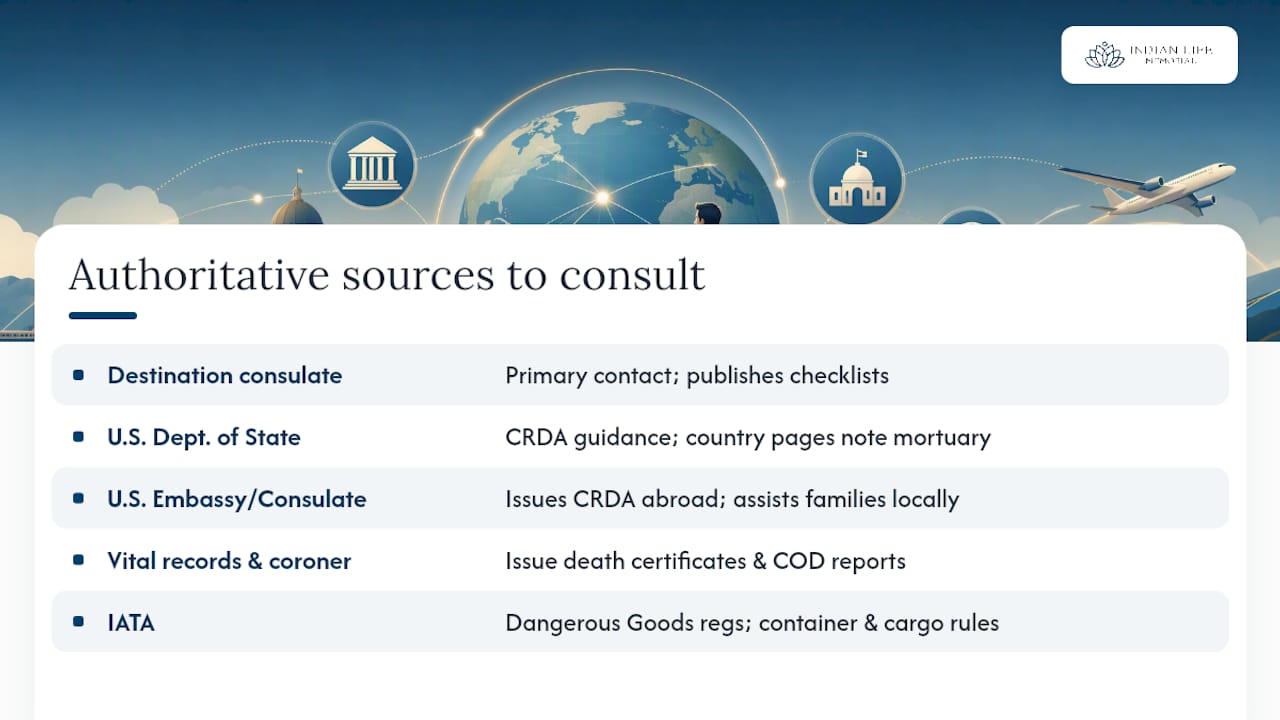
U.S. Department of State. The State Department's consular pages explain the Consular Report of Death Abroad (CRDA) process for Americans who die overseas, and they provide country-specific guidance on how U.S. consular officers assist families. For deaths occurring in the United States with repatriation abroad, the relevant authority is the destination country's consulate, but the State Department's country information pages often include useful notes on local mortuary requirements.
Centers for Disease Control and Prevention (CDC). The CDC publishes guidance on the safe handling and transport of human remains, particularly for infectious disease cases. Their materials define which diseases trigger additional documentation or transport restrictions.
IATA. The International Air Transport Association publishes the Dangerous Goods Regulations and handling guidance that airlines follow for human remains shipments. Funeral directors and airline cargo staff use IATA standards as the operational baseline for container compliance and cargo acceptance.
U.S. Embassy and Consulate network. For Americans who die abroad, the nearest U.S. Embassy or Consulate issues the Consular Report of Death Abroad and assists with local death registration. For repatriation from the United States to another country, contact that country's consulate in the United States.
State vital records offices and county coroner/medical examiner offices. These are the issuing authorities for death certificates and cause-of-death reports. Contact the office in the state and county where the death occurred.
Destination country's consulate in the United States. This is your most important contact for destination-specific requirements. Many consulates publish mortuary passport templates or document checklists on their websites. Treat that published checklist as the authoritative document list for your specific destination, and call the consulate directly if anything is unclear.
To verify whether your destination requires an apostille or full consular legalization, check the Hague Conference on Private International Law's official country list, then confirm with the consulate.
Key Takeaways
Repatriating a deceased person internationally requires a certified long-form death certificate, embalming or non-contagious disease certificate, consular mortuary certificate, passport copy, and destination-specific apostilles or translations, all gathered and submitted within the first 72 hours to avoid delays.
| Point | Details |
|---|---|
| Start with the death certificate | Order 4–6 certified long-form copies from the state vital records office within 48 hours. |
| Confirm embalming rules early | Some destinations require embalming; others prohibit it. Verify with the consulate before preparation begins. |
| Notify the consulate immediately | Contact the destination country's consulate in the U.S. on day one and request their mortuary checklist. |
| Apostille or legalize without delay | Identify whether your destination requires an apostille or full consular legalization on day one and start that process immediately. |
| Indianlifememorial repatriation support | Indianlifememorial coordinates document collection, consular filing, and airline logistics for families arranging international transfers. |
What families often underestimate about repatriation
The paperwork burden of international repatriation is real, and the families who navigate it most smoothly are almost always the ones who chose a funeral director with direct experience in international transfers, not just domestic ones. The difference is not just familiarity with the forms. An experienced director knows which consulates are slow, which airlines have strict container requirements, and which documents need to be apostilled before the consulate will even open the file.
The single most overlooked verification step is name matching. Families assume that because they have all the right documents, the process will move. What actually stalls shipments is a middle name abbreviated on one document and spelled out on another, or a hyphenated surname that appears differently on the death certificate versus the passport. Check every document against the passport before submitting anything to the consulate.
One more thing worth saying plainly: do not wait for the autopsy report to start consular processing. Request a preliminary cause-of-death letter from the medical examiner's office and use that to begin the consulate application. Most consulates will accept the preliminary letter to open the file and will request the full report before issuing final clearance. Starting in parallel rather than sequentially can save a week or more.
Indianlifememorial offers repatriation coordination when your family needs it most
When a loved one passes and the family is managing grief across time zones and borders, the document coordination alone can feel like a second full-time responsibility. Indianlifememorial provides hands-on repatriation support that takes that burden off your family's shoulders, covering document collection, consular filing, airline logistics, and coordination with the receiving funeral home at the destination.

The team is available 24/7 and works with families to handle the consular paperwork, apostille procurement, certified translations, and airline cargo arrangements that make up the repatriation process. Many of the documents required for international repatriation still need to be obtained locally in the United States (from state vital records offices, the coroner, or the consulate), and Indianlifememorial's coordinators will guide your family through exactly which offices to contact and what to request at each step.
For families who want transparent, fixed-price support without hidden fees, view the available repatriation and funeral packages or reach out directly through the repatriation services page to speak with a coordinator today.
Official sources to consult when confirming destination requirements
Use these authoritative sources to verify the specific requirements for your destination country before submitting any documents:
-
U.S. Department of State (travel.state.gov): — Look for the "Death of a U.S. Citizen Abroad" section for consular guidance and the Consular Report of Death Abroad process. For repatriation from the U.S. to another country, use the State Department's country information pages for general notes, then go directly to the destination consulate.
-
IATA (iata.org): — Review the IATA Dangerous Goods Regulations and the specific handling guidance for human remains to confirm container standards, sealing requirements, and documentation that airlines will check at cargo acceptance.