
A licensed funeral director coordinates every stage of international body transport, and remains travel as prioritized air cargo, not as accompanied baggage. The standard timeline is 1–3 weeks when paperwork is complete. Two requirements are non-negotiable: a hermetically sealed inner container (commonly zinc-lined) placed inside a wooden outer shipping casket, and a consular transit permit called a laissez-passer. For Hindu and Indian families in Singapore arranging repatriation to the United States, Indianlifememorial serves as a single point of contact, managing Vedic rites, consular coordination, and airline logistics so your family can focus on honoring your loved one.
Table of Contents
- What are the first steps your family should take?
- What documents does overseas repatriation require?
- What container and airline rules apply to air transport?
- How long does the process take, and what causes delays?
- What does repatriation typically cost?
- What does the funeral director handle, and what does the consulate do?
- How are Hindu and Indian rites honored during overseas shipment?
- What happens when the remains arrive in the United States?
- Key Takeaways
- Why an experienced repatriation team makes all the difference
- Indianlifememorial is ready to guide your family through every step
- Authoritative resources to verify requirements
What are the first steps your family should take?
The first 72 hours after a death abroad are the most time-sensitive. Here is the sequence to follow:
- Obtain the official pronouncement of death from the attending physician or hospital.
- Register the death locally with Singapore's Registry of Births and Deaths to receive the official death certificate. Request at least five certified copies.
- Contact a Singapore funeral director experienced in U.S.-bound repatriation. Indianlifememorial is available 24/7 for exactly this situation.
- Notify the nearest U.S. Embassy or Consulate in Singapore. They will guide you on the laissez-passer and any additional transit permits required.
- Secure the deceased's passport or a certified copy of the biographical page.
- Request an embalming certificate and a certificate of non-contagious disease from the funeral home performing preparation.
- Contact the receiving U.S. funeral home to confirm arrival logistics, local permits, and disposition plans.
- Assign one family point person to collect, scan, and transmit all documents to the consulate and receiving funeral home. This single step prevents the most common delays.
For a broader overview of what to do immediately after a death in Singapore, the urgent arrangement guide from Indianlifememorial walks families through each task in plain language.
Pro Tip: Request certified copies of the death certificate in both English and the local official language. U.S. customs and the receiving funeral home will need originals, not photocopies.
What documents does overseas repatriation require?
The full documentation packet must be assembled before the casket is sealed. Missing even one item can halt shipment at the airline cargo desk or at U.S. customs.
| Document | Issuer | Typical Processing Time | Translation / Apostille Note |
|---|---|---|---|
| Official death certificate | Singapore Registry of Births and Deaths | 1–3 business days | Certified English translation required if issued in another language |
| Laissez-passer / transit permit | U.S. Embassy or Consulate, Singapore | 2–5 business days | No apostille needed; consular seal is sufficient |
| Embalmer's affidavit / certificate of non-contagious disease | Licensed embalmer or funeral home | Same day as preparation | May require notarization |
| Deceased's passport (copy) | Family / estate | Immediate | Certified copy accepted |
| Airline / customs transit forms | Funeral director / airline cargo agent | 1–2 business days | Completed in English |
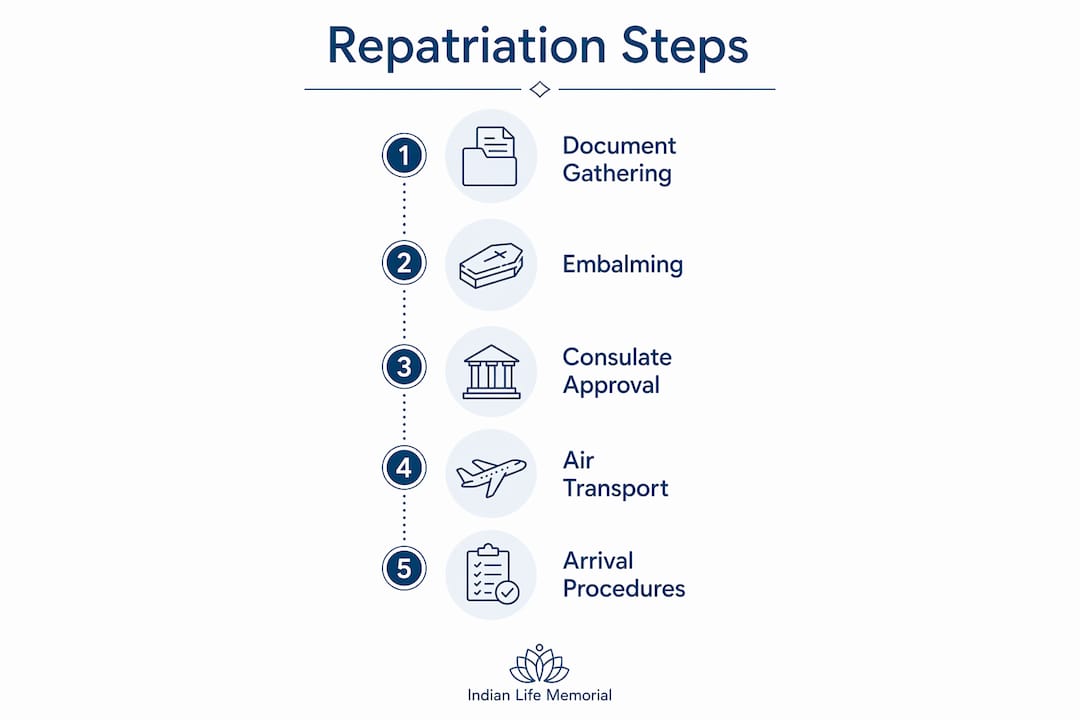
Common mistakes that delay shipments include name discrepancies between the death certificate and the passport, missing original-certified copies (photocopies are not accepted), and late consular sealing of the coffin. Translations must be performed by a certified translator; Singapore-based legal translation services can usually turn documents around within 24–48 hours.
Pro Tip: Cross-check every name spelling across all documents before submitting to the consulate. A single character difference between the death certificate and the passport can trigger a formal correction process that adds days to the timeline.
What container and airline rules apply to air transport?
Air transport of human remains follows strict public-health and aviation standards. The physical requirements are specific and not negotiable with airlines.
- Hermetic inner container: Remains must be placed in an airtight, hermetically sealed container, commonly zinc-lined, to prevent leakage and meet public-health standards.
- Wooden outer shipping casket: The sealed inner container is placed inside a protective wooden outer shell that meets airline cargo specifications.
- Cargo manifest, not passenger manifest: Remains travel as specialized air cargo. Families should not expect to travel on the same aircraft as their loved one's remains.
- Known-shipper registration: Funeral homes must be registered as a "known shipper" with each airline they use. This registration may involve an application, inspection, and fees, and is essential for airline acceptance.
- Seal inspection at cargo acceptance: Airline cargo staff inspect the integrity of seals before accepting the shipment. Any breach requires re-sealing by the funeral home.
Important: If cremation is planned at the U.S. destination, the zinc lining must be removed before cremation can proceed. This requires specialist removal and, in some jurisdictions, coroner permission. Confirm this with your receiving funeral home before the casket is sealed in Singapore.
The hermetic seal also affects open-casket viewing. Cosmetic embalming standards vary, and preparation performed overseas may meet public-health requirements without meeting the aesthetic standards expected for a traditional viewing in the United States. Discuss viewing plans with both the sending and receiving funeral homes before sealing.
How long does the process take, and what causes delays?

| Step | Typical Time Range |
|---|---|
| Death registration and document gathering | 1–3 business days |
| Embalming and preparation | 1–2 days |
| Consular processing (laissez-passer) | 2–5 business days |
| Airline booking and cargo scheduling | 1–3 days |
| Flight transit (Singapore to U.S.) | 1–2 days |
| U.S. customs clearance and release | 1–2 business days |
When all paperwork is in order, the full overseas repatriation process typically takes 1–3 weeks. Suspicious-cause deaths that require a coroner's investigation, missing or mismatched documents, or transit-country inspections can push timelines into weeks or months with no fixed end date.
Delay-mitigation steps your funeral director should take:
- Choose direct routing to the U.S. whenever possible. Routing through a third country can trigger that country's own transit rules, adding inspections and documentation requirements.
- Pre-check the full document packet with the receiving U.S. funeral home before submitting to the consulate.
- Use urgent consular contact procedures for time-sensitive cases; most consulates have an emergency line for death-abroad situations.
What does repatriation typically cost?
International repatriation costs typically range from $4,000 to $15,000, with complex cases exceeding $20,000. Major cost drivers include:
- Embalming and preparation: Approximately $500–$1,200
- Hermetic container or zinc coffin: Approximately $500–$3,000
- Funeral home coordination fees (sending and receiving): Approximately $1,000–$4,000
- Airline cargo charges: Variable by route and weight
- Consular and documentation fees: Variable by jurisdiction
- Translation and apostille charges: Typically a few hundred dollars
Payment norms in this industry are firm. Most funeral homes require full payment or a strong financial guarantee before any work begins, because international shipments carry high, non-refundable costs. Ask for an itemized invoice that separates one-time fees from professional coordination fees, and confirm the payment schedule in writing before signing any agreement. Transparent repatriation packages from Indianlifememorial are structured to give families a clear picture of costs from the first conversation.
Pro Tip: Request a written quote that lists the container cost, airline cargo estimate, consular fees, and coordination fees as separate line items. Bundled quotes make it impossible to compare providers or identify where costs can be managed.
What does the funeral director handle, and what does the consulate do?
A licensed funeral director functions as the project manager across multiple jurisdictions. Without this coordination, incomplete documentation causes terminal delays.
Sending funeral director's responsibilities:
- Procures and prepares the hermetic inner container and outer shipping casket
- Arranges embalming and cosmetic preparation
- Assembles the full document packet and submits to the consulate
- Holds known-shipper status with the airline and books cargo space
- Notifies the receiving U.S. funeral home with the air waybill and estimated arrival
Consulate's responsibilities:
- Issues the laissez-passer / transit permit
- Verifies the identity of the deceased
- May witness the sealing of the coffin in some jurisdictions
- Provides official letters used by airlines and U.S. customs
When hiring a funeral director, ask these questions directly: How many U.S.-bound shipments have you completed in the past year? Can you provide a sample itinerary and document checklist? Are you available 24/7 for consular emergencies? Which airlines do you hold known-shipper status with?
Red flags include evasive answers about airline registration, unclear payment terms, and no documented experience with U.S. customs procedures. For detailed guidance on how funeral home coordination works across borders, Indianlifememorial's resource explains each handoff point clearly.
How are Hindu and Indian rites honored during overseas shipment?
Certain Vedic rites require proximity to the body and must be performed before the casket is sealed. Others can be conducted after arrival at the U.S. destination.
Before sealing (must happen in Singapore):
- Antyesti rites that involve bathing, dressing, and placing sacred items with the body
- Prayers and mantras recited by a qualified Pandit in the presence of the deceased
- Any ritual that requires the family or priest to touch or anoint the body
After arrival in the United States:
- Sraddha ceremonies and post-cremation rites
- Cremation itself, if planned at the destination (subject to zinc-lining removal requirements noted above)
- Memorial prayers and community gatherings
Coordinate with a Pandit early, before embalming begins, to confirm which rites require the body to be present and unsealed. If family members in the U.S. cannot travel to Singapore in time, ask the sending funeral home to photograph or video-record the rites so the family can participate remotely.
Embalming for international transport meets public-health standards, but the result may differ from what families expect for a traditional open-casket viewing. Discuss this honestly with your funeral director before preparation begins.
Indianlifememorial's Hindu and Indian funeral services include qualified priests and full Vedic ceremony coordination, ensuring that sacred rites are observed with authenticity and devotion before the body is prepared for transport.
What happens when the remains arrive in the United States?
The receiving U.S. funeral home takes responsibility from the moment the shipment lands. Advance preparation on the U.S. side prevents delays at this final stage.
Receiving-side steps:
- The receiving funeral home monitors the air waybill and confirms the estimated arrival time with the airline cargo facility.
- U.S. Customs and Border Protection reviews the accompanying documentation, including the death certificate, laissez-passer, and embalmer's affidavit.
- The receiving funeral home collects the remains from the cargo facility after customs clearance.
- Where applicable, the local coroner or health department is notified before final disposition.
- Remains are transferred to the agreed final disposition: burial, cremation, or temporary holding pending family arrangements.
Checklist for the U.S.-side family contact:
- Have a government-issued ID ready to present to the receiving funeral home.
- Confirm payment arrangements with the receiving funeral home before the flight departs Singapore.
- Keep the air waybill number accessible so you can track the shipment in real time.
- Have the local funeral director's direct contact number saved for immediate handoff coordination.
Key Takeaways
Successful U.S.-bound repatriation from Singapore requires a licensed funeral director as project manager, a complete document packet assembled before sealing, a hermetically sealed container meeting airline standards, and full payment arranged upfront.
| Point | Details |
|---|---|
| Standard timeline | When paperwork is complete, the typical timeline is 1–3 weeks. Delays from missing documents or suspicious-cause deaths can extend this significantly. |
| Documentation is the critical path | Death certificate, laissez-passer, embalmer's affidavit, passport copy, and transit forms must all be in order before the casket is sealed. |
| Container requirements | A hermetic (often zinc-lined) inner container inside a wooden outer casket is required by airlines and public-health regulations. |
| Payment is upfront | Most providers require full payment or a financial guarantee before work begins; request an itemized invoice. |
| Indianlifememorial | Coordinates Vedic rites, consular liaison, embalming oversight, and U.S. arrival handling for Hindu and Indian families in Singapore. |
Why an experienced repatriation team makes all the difference
Repatriation is not simply a logistics exercise. It is the final act of care your family extends to someone you love, and every missed document or misstep in the process delays that care. What families often underestimate is how much of the process happens simultaneously: the consulate needs documents while the funeral home is preparing the body, the airline needs cargo booking while the receiving home needs an estimated arrival, and a Pandit needs access to the body before any of those steps are complete. A team that has done this before knows how to run those tracks in parallel rather than sequentially.
The conventional advice is simply to "hire a funeral director." The more precise advice is to hire one who has completed U.S.-bound shipments from Singapore specifically, holds known-shipper status with major carriers on that route, and has a working relationship with the U.S. Embassy. That combination is what separates a 10-day repatriation from a 6-week one.
Indianlifememorial is ready to guide your family through every step
When a loved one passes away in Singapore and your family is in the United States, the distance makes an already painful time feel impossible. Indianlifememorial removes that weight by serving as your single point of contact for the entire repatriation process: paperwork assembly, embalming oversight, consular liaison, Vedic priest coordination, and arrival handling in the United States.
Before you call, have these items ready: the deceased's passport details, a copy of the death certificate if already issued, the name and contact of your receiving funeral home in the U.S., and your preferred payment method. Indianlifememorial's team is available 24/7 and will walk you through every requirement from the first conversation. Transparent pricing means no surprises, and culturally trained priests mean your loved one's Antyesti rites are observed with the reverence they deserve. Contact Indianlifememorial through the full-suite funeral services page to begin arrangements today.
Authoritative resources to verify requirements
Every repatriation case has jurisdiction-specific details. These sources are the most reliable starting points for families and funeral directors:
- U.S. Department of State (travel.state.gov): The primary resource for consular procedures, death-abroad guidance, and the role of U.S. embassies in repatriation. Start here for official U.S. government requirements.
- IATA (International Air Transport Association): Sets the container specifications and cargo-handling standards that airlines enforce globally. Your funeral director should reference IATA's Dangerous Goods Regulations for human remains transport.
- National Funeral Directors Association (NFDA): Publishes detailed guidance on shipping human remains internationally, including known-shipper requirements, documentation checklists, and embalming standards.
- U.S. Embassy Singapore (sg.usembassy.gov): The direct contact for the laissez-passer, identity verification, and any emergency consular assistance for U.S. citizens who die in Singapore.
- Singapore Registry of Births and Deaths (ICA): Issues the official death certificate required as the foundation document for all subsequent permits and airline acceptance.