

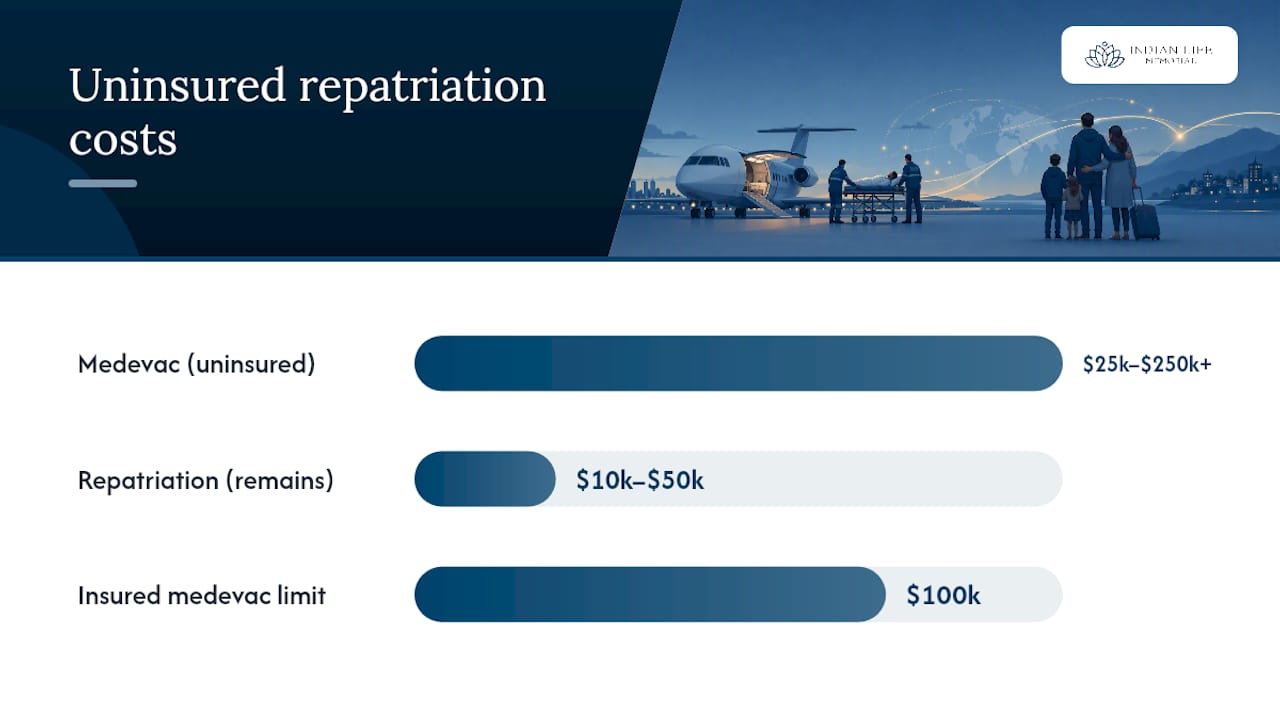
Repatriation insurance pays to bring a seriously ill traveler home and to return a deceased traveler's remains — and it manages the cross-border logistics your family otherwise must handle alone, in grief, across time zones What Is Repatriation Insurance? Coverage, Cost & Claims - LegalClarity. Research indicates that the U.S. government does not cover these costs for citizens who die abroad. A single air ambulance can cost anywhere from $25,000 to over $250,000; returning remains internationally commonly runs $10,000 to $50,000 depending on distance and required preparations. Without specific coverage, your family bears every dollar and every phone call.
The two core benefits are:
- Medical evacuation: transports a critically ill or injured traveler to the nearest adequate facility or back home, including air ambulance, medical escort, and hospital-to-hospital transfer.
- Repatriation of remains: prepares and ships a deceased person's body home, covering embalming, a hermetically sealed container, transit permits, airline freight, and consular paperwork.
Some policies bundle both; others sell them separately. Knowing which you have before you travel is the only way to avoid a devastating gap.
Key Takeaways
Repatriation insurance covers both medical evacuation and return of remains, and without it, U.S. families bear costs ranging from $25,000 to over $250,000 for evacuation and $10,000–$50,000 for returning remains.
| Point | Details |
|---|---|
| Two core benefits | Medical evacuation and repatriation of remains are distinct; confirm your policy includes both. |
| Financial exposure | Air ambulance costs $25,000–$250,000+; returning remains internationally commonly runs $10,000–$50,000 depending on distance and preparation. |
| Pre-authorization is mandatory | Never arrange transport independently — unauthorized evacuations are frequently denied. |
| Claims deadlines are strict | Submit all itemized invoices and certified documents within 30–90 days of the incident. |
| Coverage limits by trip type | $100,000 medevac for standard travel; $250,000+ for remote or cruise itineraries. |
Table of Contents
- What do repatriation insurance benefits actually cover?
- Why does the financial risk matter so much without coverage?
- How does the process work after a serious illness or death abroad?
- How do you choose the right policy and coverage limits?
- What exclusions and red flags should you watch for?
- What documents do you need to file a repatriation insurance claim?
- How do professional coordinators help families through repatriation?
- What should you do before your next international trip?
- What families often underestimate about repatriation coverage
- Sources
What do repatriation insurance benefits actually cover?
Medical evacuation and repatriation of remains are distinct services with different triggers, providers, and documentation requirements. Understanding overseas body shipment helps families map policy language to real logistics.
| Service | Medical Evacuation | Repatriation of Remains |
|---|---|---|
| Trigger | Serious illness or injury requiring care unavailable locally | Death abroad |
| Transport | Air ambulance, stretcher seat, commercial medical escort | Airline freight (cargo or accompanied) |
| Preparation | Medical stabilization, hospital-to-hospital transfer | Embalming, hermetic container, body preparation |
| Documentation | Medical records, pre-authorization from insurer's medical team | Official death certificate, transit permits, consular paperwork |
| Who coordinates | Insurer's 24/7 alarm center | Insurer plus local and receiving funeral homes |
Cost signal: Air ambulance alone typically costs between $25,000 and $250,000+. Returning remains internationally commonly runs $10,000–$50,000 depending on distance and preparation required.
Insurers require their medical team to pre-authorize evacuations before transport is arranged. For a death, coordination begins only after the insurer verifies an official death certificate. Neither process moves without that verification step.
Why does the financial risk matter so much without coverage?
Standard domestic health plans, including Medicare, generally do not cover international medical evacuation or repatriation costs. A U.S. traveler who suffers a cardiac event in a remote region of Southeast Asia or on a cruise in the Mediterranean faces a bill that no domestic insurer will touch.
Consider a realistic scenario: a traveler collapses in a rural area with no cardiac surgery capability. A medevac flight to a regional hospital, followed by a second transfer home, can easily exceed $150,000. If the traveler dies abroad, the family then faces additional expense of $10,000–$50,000 to return the remains — plus embalming, container preparation, and consular fees that accumulate quickly.
Some countries add a compliance dimension. Schengen visa applicants, for example, often must show travel insurance covering substantial medical expenses, which prompts travelers to purchase coverage they might otherwise skip. For most U.S. families, though, the driver is purely financial exposure.
Many providers pay evacuation providers directly rather than reimbursing families after the fact, which matters enormously when a hospital abroad demands a payment guarantee before releasing a patient.
How does the process work after a serious illness or death abroad?
Speed and sequence matter. Here is what your family should do:
- Call the insurer's 24/7 emergency assistance line immediately. Have the policy number, passport number, and exact location ready. Do not wait until morning or until you have more information.
- Do not arrange your own transport. Insurers frequently deny reimbursement for evacuations or shipments arranged without pre-authorization. The alarm center exists precisely to coordinate this on your behalf.
- For a medical evacuation: the insurer's medical team reviews records and determines the appropriate facility and transport mode. They issue pre-authorization before any movement.
- For a death: secure the official death certificate from local authorities as quickly as possible. The insurer cannot begin coordinating transit permits, embalming, or freight until that document is verified. Consular registration steps for U.S. families are covered in this international death registration guide.
- Let the insurer coordinate logistics. Transit permits, ground transport, consular paperwork, and freight booking all flow through the alarm center once verification is complete.
- Keep every document. Foreign providers do not always retain records long-term. Secure originals of the death certificate, medical reports, itemized invoices, and transport receipts before leaving the country.
Pro Tip: Store your insurer's emergency number and policy number separately from your phone — in your wallet and with a trusted contact at home. If your phone is lost or damaged during a medical emergency, that number is the single most important piece of information your family needs.
How do you choose the right policy and coverage limits?
Not all travel insurance includes meaningful repatriation coverage. "Medical coverage" does not automatically mean full medevac services — many travel medical plans cap or exclude evacuation benefits entirely. Read the policy wording, not the marketing summary.
Recommended minimums by trip type:
Policy checklist before purchase:
- Geographic scope: does it cover your specific destination, including remote areas?
- Pre-existing condition look-back period and waiver availability (waivers typically require purchase within a short window after booking)
- Activity exclusions: adventure sports, diving, or trekking often require a rider
- Pre-authorization requirements: what triggers the obligation to call first?
- Claim submission deadline: commonly 30–90 days from the incident
- Whether embalming, hermetic container, and consular fees are included or reimbursed separately
Understanding the four plan types:
- Travel insurance bundles trip cancellation, medical, and evacuation — convenient but limits may be lower.
- Travel medical insurance focuses on health coverage abroad; evacuation may be capped or excluded.
- Medevac-only plans (such as those from dedicated air ambulance membership programs) cover evacuation but not remains.
- Long-term international health insurance suits expatriates and long-stay travelers; repatriation of remains is often a separate rider.
Pre-existing condition waivers are available on many plans but require purchase within a defined window after your initial trip deposit and proof you were medically fit at purchase time.
What exclusions and red flags should you watch for?
Denied claims almost always trace back to one of a handful of predictable causes.
Common exclusions:
- Pre-existing conditions outside the look-back waiver window
- Acts of war, civil unrest, or travel to destinations under active government advisories
- Adventure sports or high-risk activities without a specific rider
- Substance use or self-inflicted injury
- Publicly known risks at the time of policy purchase (a declared epidemic, for example)
Administrative red flags that void or delay claims:
- Arranging transport without insurer pre-authorization
- Missing itemized invoices from every service provider
- Submitting documents after the 30–90 day deadline
- Providing uncertified translations of foreign-language documents
- Filing on behalf of an estate without notarized next-of-kin authorization
Watch for this wording: Policies that say "medically necessary as determined by our medical team" give the insurer significant discretion. Ask specifically what that determination process looks like and how quickly it moves before you purchase.
What documents do you need to file a repatriation insurance claim?
A complete, timely submission is the difference between a paid claim and a prolonged dispute.
- Notify the insurer immediately — even before all documents are gathered. Prompt notification protects your claim regardless of what comes next.
- Secure the official death certificate (or full medical records for an evacuation) from local authorities. Get multiple certified copies.
- Collect itemized invoices from every provider: local funeral home, embalming service, transport company, airline freight, and receiving funeral home.
- Obtain certified translations of any foreign-language documents. Uncertified translations are routinely rejected.
- Gather consular documentation copies: transit permits, export/import permits, and any consular death registration paperwork.
- Prepare notarized next-of-kin authorization if you are filing on behalf of the estate rather than as the insured.
- Submit within the deadline — typically 30–90 days from the incident date. Missing this window is one of the most common reasons claims are denied.
Timeline note: From incident to completed claim submission, the typical sequence runs: incident → insurer notification (day 1) → verification/pre-authorization (days 1–3) → transport coordination (days 2–7) → invoice collection (days 7–30) → claim submission (within 30–90 days).
If a claim is denied, request the specific reason in writing. Most policies include an internal appeal process; if that fails, arbitration or mediation options may be available under the policy terms.
How do professional coordinators help families through repatriation?
The real value of repatriation coverage is not only financial. Industry experts consistently note that the primary benefit is access to professionals who manage a complex international process that grieving families are rarely equipped to handle alone.
A professional repatriation coordinator handles:
- Liaising with the foreign funeral home and local authorities
- Arranging embalming and hermetically sealed container preparation to meet international transport standards
- Securing transit permits and export/import documentation
- Booking airline freight space and ground transport at both ends
- Coordinating with consulates and the receiving funeral home
Families retain legal responsibility throughout; coordinators act on their behalf. That distinction matters when signing permits or authorizing transport.
Pro Tip: Before engaging a repatriation coordinator, ask three questions: Are your fees itemized and fixed? What is your typical timeline from notification to arrival? Do you have experience with the specific country of origin?
Indianlifememorial's repatriation services offer full-service coordination for families returning remains to or from Singapore, with faith-sensitive options, transparent pricing, and 24/7 availability. For families navigating Hindu or Indian funeral rites alongside international logistics, that combination of cultural knowledge and logistical experience reduces friction at every step. Details on funeral home coordination steps can help families understand exactly what to expect.
What should you do before your next international trip?
A few deliberate steps before departure protect your family from the worst-case scenario.
- Purchase medevac and repatriation-of-remains coverage before every international trip, not just long ones.
- Verify geographic scope — confirm your destination is explicitly covered, including any remote areas or cruise itineraries.
- Buy the pre-existing condition waiver if you are eligible; purchase it within the required window after booking.
- Store your insurer's emergency number and policy details with your passport, and leave a copy with a trusted contact at home.
- Pre-document end-of-life preferences and designate a next-of-kin who can authorize transport and sign documents quickly.
One decision rule: if your destination has limited medical infrastructure or requires more than a commercial flight to reach, choose $250,000+ medevac coverage. For standard city travel in developed countries, $100,000 is a reasonable floor.
When Indianlifememorial supports a family with international repatriation, transparent pricing and compassionate guidance are available from the first call. Explore full-suite funeral and repatriation services or review package options to understand what is included at every stage.

What families often underestimate about repatriation coverage
Most articles on this topic focus on the dollar amounts, and the numbers are genuinely alarming. But the financial exposure is actually the easier part to explain. What families consistently underestimate is the operational weight of a death abroad.
When a loved one dies in another country, someone must navigate foreign bureaucracy, source a compliant container, arrange embalming that meets international standards, secure transit permits from two governments, book freight space, and coordinate handoff to a receiving funeral home — all while managing grief and time-zone differences. The insurer's alarm center exists to absorb that burden. The money is secondary to the fact that a trained team picks up the phone at 2 AM and starts moving.

The conventional advice to "just buy travel insurance" falls short here because most travelers assume medical coverage includes evacuation, and most evacuation coverage is assumed to include remains. Neither assumption holds reliably. The only protection is reading the policy wording before departure, not after an emergency.
For families with ties to India or Singapore, there is an additional layer: faith-sensitive handling of remains is not a standard service. Vedic rites, specific embalming considerations, and culturally appropriate preparation require a coordinator who understands those requirements, not just one who can book a freight slot. That specificity is where a provider like Indianlifememorial adds value that a generic insurer coordination service cannot replicate.
Buy the coverage. Read the wording. And know who you will call at both ends of the journey.
This article is general information, not a substitute for advice from a qualified financial advisor. Consult a qualified financial professional about your own circumstances before acting on anything here.
Sources
- What Is Repatriation Insurance? Coverage, Cost & Claims - LegalClarity