

An embalming certificate is required by most airlines and destination-country authorities for the international air transport of human remains, and it functions as the official attestation that a body was prepared to accepted sanitary standards for cross-border shipment. If you are arranging repatriation from the U.S., your first call is to a licensed funeral director, who will prepare the certificate and guide the documentation process. Your second call is to the receiving country's embassy or consulate, which will confirm the exact paperwork that destination requires. The airline's cargo desk is the third contact, and their written acceptance is what keeps the process moving.
Gather these documents from the start:
- Embalming certificate (or sanitization certificate if embalming was not possible)
- Certified copy of the U.S. death certificate
- Burial transit permit issued by the local health department
- Consular or embassy paperwork specific to the destination country
- Airline cargo booking confirmation listing required documents
Table of Contents
- What is an embalming certificate and who issues it in the U.S.?
- When is an embalming certificate required for international export?
- What details does the embalming certificate normally need to include?
- What other documents are commonly required alongside an embalming certificate?
- How do casket rules and airline cargo requirements interact with the certificate?
- How do you authenticate the certificate: health department stamps, consular certification, and apostilles?
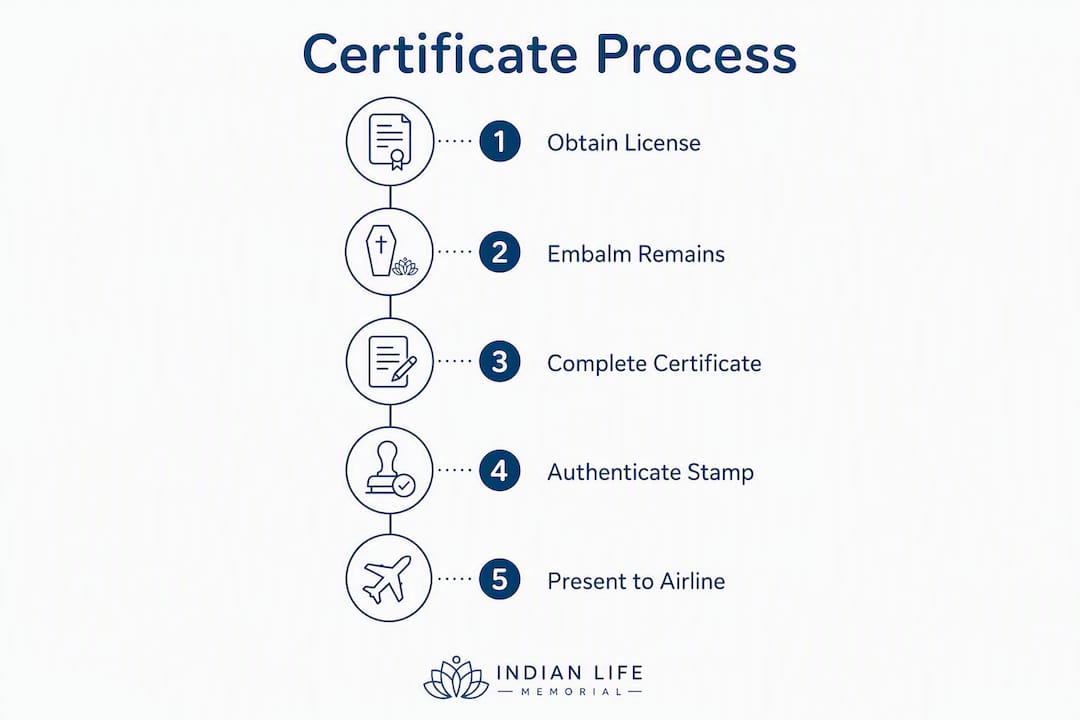
- Step-by-step process to obtain the certificate and complete export from the U.S.
- What are the typical timelines and costs for embalming certificates and export?
- Key Takeaways
- A perspective on what families and professionals often underestimate
- Indianlifememorial is here to guide your family through repatriation
- Authoritative resources to confirm rules for your route
What is an embalming certificate and who issues it in the U.S.?
An embalming certificate is an official document confirming that human remains were prepared to international hygiene standards for transportation. Depending on the jurisdiction and the airline, you may also see it called an embalmer's affidavit, a sanitization certificate, or a mortuary affidavit. The terminology varies, but the document serves the same purpose: it provides written evidence that a qualified professional treated the remains in a way that meets transport requirements.
In the United States, only a licensed funeral director or licensed embalmer may sign and issue this certificate. Licensing is state-regulated, and each state's board sets the qualifying examinations and continuing education requirements that practitioners must meet. The certificate must carry the embalmer's full name, their state license number, the funeral home's name and address, and a dated signature. Many airlines and embassies will reject a certificate that omits any of these identifiers.
When embalming is not possible, such as after certain autopsies or specific body conditions, a sanitization certificate or equivalent document serves as the functional substitute for export purposes. The U.S. Embassy in the United Kingdom, for example, explicitly recognizes this alternative in its guidance for shipment of remains from England and Wales.
When is an embalming certificate required for international export?
There is no single global rule. Whether an embalming certificate is mandatory depends on the destination country's law, the airline's conditions of carriage, and sometimes the cause of death. Understanding which authority takes precedence for your specific route is the most important early step.
Common triggers that make the certificate mandatory:
- Airline policy: Most major carriers require an embalming certificate for international air transport of human remains, even when neither the origin nor the destination country legally mandates embalming.
- Destination-country law: Some countries require proof of embalming as a condition of entry for human remains. Others, such as France in certain contagious-disease cases, actually prohibit embalming and require different health clearance documentation instead.
- Cause of death: When death resulted from a communicable disease, standard embalming rules may not apply. Some embassies require a CDC import permit and specific health clearances in place of, or in addition to, the standard embalming certificate.
- Route requirements: Certain transit countries impose their own conditions, even when the final destination does not.
The receiving country's embassy or consulate is the most authoritative source for route-specific requirements. Their guidance overrides general checklists because they know what their own customs and health authorities will accept. After confirming embassy requirements, check the airline's cargo acceptance policy in writing. Then contact your local health department, which issues the transit permit that airlines also require.
Immediate checks to make:
- Call the destination country's embassy or consulate in Washington, D.C.
- Contact the airline's cargo or special shipments desk
- Reach your county or state health department for the transit permit
What details does the embalming certificate normally need to include?
A compliant embalming certificate covers specific fields that airlines and consular offices check at acceptance. Missing even one field can cause a carrier to refuse the shipment.
Required fields on a standard certificate:
- Full legal name of the deceased
- Funeral home name, street address, city, state, and ZIP code
- Licensed embalmer's full name and state license number
- Date and location where embalming was performed
- A clear statement that the remains were prepared for international transport, naming the destination country
- Embalmer's original signature
The statement of treatment is the most scrutinized part. A concise, direct phrasing that meets common airline and embassy expectations reads something like: "The remains of [full name] were embalmed on [date] at [funeral home name and address] in accordance with accepted sanitary standards for international air transport to [destination country]." Some carriers ask for additional language confirming the remains are not a public health risk.
Most airlines and embassies expect the certificate on funeral home letterhead with an original ink signature. A photocopy or digital signature is often insufficient for consular legalization. Confirm the exact format with both the airline and the destination embassy before the document is finalized, since phrasing requirements do vary by carrier and by country.
What other documents are commonly required alongside an embalming certificate?
The embalming certificate is one piece of a larger documentation package. The National Funeral Directors Association recommends a standard bundle when destination-country rules are not fully specified, and U.S. Embassy guidance for multiple countries reflects a similar core set.
| Document | Who Issues It | Typical Lead Time |
|---|---|---|
| Certified death certificate | State vital records office | 1–3 business days for certified copies |
| Burial/transit permit | County or state health department | Same day to 1 business day |
| Embalmer's affidavit / embalming certificate | Licensed funeral director | Same day as embalming |
| Letter of non-contagious cause of death | Attending physician or coroner | 1–2 business days |
| Passport of the deceased | Already issued; locate original | Immediate |
| Airline cargo documentation | Airline cargo desk | At booking confirmation |
| Consular mortuary certificate or legalization | Destination country's embassy/consulate | 1–5 business days |
| Certified translation (if required) | Accredited translator | 1–2 business days |
A few practical notes on sequencing: the death certificate and transit permit are the foundation. You cannot complete most other steps without them. The consular mortuary certificate, which some embassies such as the British Embassy prepare as a consolidated document incorporating the local death certificate, funeral director's affidavit, and embalming certificate, typically takes the longest to obtain. Start that process as early as possible.
For certified translations, use a translator accredited by the American Translators Association when the destination country requires it. For apostilles, contact the Secretary of State's office in the state where the document was issued. Apostilles apply only when both the U.S. and the destination country are parties to the Hague Convention.
How do casket rules and airline cargo requirements interact with the certificate?
Airlines do not accept human remains in any container. The packaging requirements are specific, and the embalming certificate often functions as the document that unlocks carrier acceptance of the shipment.
Standard container requirements for international air transport:
- A leak-proof inner container, typically a zinc-lined or CadSeal inner shell
- A wooden outer coffin or an airline-approved casket that meets IATA cargo specifications
- Hermetic sealing of the inner container for international carriage
- Exterior labeling identifying the contents as human remains
Airlines will refuse to load remains that arrive without both an embalming certificate and a burial transit permit. The carrier's cargo desk will check these documents at acceptance, not at the gate. Some airlines also require "known shipper" status from the funeral home, meaning the funeral home must be registered with the carrier as an approved shipper of human remains before the booking is confirmed.
Pro Tip: Request written carrier acceptance, either by email or as a formal booking confirmation, that lists every document the airline will require at cargo check-in. Verbal confirmations are not sufficient. A written list protects your family from last-minute refusals and gives the funeral director a clear checklist to work from.

How do you authenticate the certificate: health department stamps, consular certification, and apostilles?
Authentication adds official credibility to the embalming certificate so that foreign authorities accept it. The workflow has three potential layers, and not every shipment requires all three.
Typical U.S. authentication workflow:
-
Local health department or coroner stamp: The funeral director presents the embalming certificate to the county or state health department. Some jurisdictions stamp the certificate directly; others issue a separate health clearance letter. This step is usually required before any consular submission.
-
Consular legalization: For countries that are not party to the Hague Convention, or that require it regardless, the destination country's embassy or consulate in the U.S. must legalize the document. This means a consular officer reviews and stamps the certificate, confirming it meets their country's import requirements. Some embassies prepare their own consolidated mortuary certificate that incorporates the embalming statement.
-
Apostille: When both the U.S. and the destination country are Hague Convention members and the destination requires it, an apostille from the issuing state's Secretary of State office replaces consular legalization. Apostille processing times vary by state, ranging from same-day in some offices to several business days in others.
Timeline estimate: health department stamping typically takes one business day or less. Consular legalization commonly takes one to five business days, depending on the embassy's workload and whether an appointment is required. Build at least a full week into your planning for authentication steps, and contact the embassy early to confirm their current processing time.
Step-by-step process to obtain the certificate and complete export from the U.S.
Following a clear sequence reduces delays and protects your family from preventable setbacks. For urgent funeral arrangements, every hour matters.
-
Immediately after death: Secure the death certificate from the attending physician or medical examiner. This document triggers every subsequent step.
-
Contact a licensed funeral director (within hours): The funeral director takes custody of the remains, confirms cause-of-death documentation, and advises on whether embalming is required or permitted given the cause of death.
-
Confirm cause-of-death documentation (same day): If death involved a communicable disease, notify the funeral director immediately. Different rules apply, and some destinations require CDC import permits rather than standard embalming certificates.
-
Perform embalming (within hours to one day): The licensed embalmer prepares the remains and issues the embalming certificate on funeral home letterhead, signed with their license number.
-
Obtain the transit permit (same day to one business day): The funeral director applies to the county or state health department for the burial/transit permit. This is a legal requirement before remains can be transported across state or national borders.
-
Secure supporting documents (one to three business days): Gather certified copies of the death certificate, the letter of non-contagious cause of death, the deceased's passport, and any required certified translations.
-
Contact the destination country's embassy (as early as possible): Confirm the exact document package they require, ask about consular legalization or a consular mortuary certificate, and get their current processing time.
-
Contact the airline cargo desk (same day as embassy contact): Confirm the carrier's specific requirements, obtain written booking confirmation, and verify known-shipper status for the funeral home.
-
Authenticate the embalming certificate (one to five business days): Obtain the health department stamp, then proceed to consular legalization or apostille as required.
-
Coordinate with the receiving funeral home (ongoing): The funeral home at the destination should be contacted early. They often know the local customs authority's expectations and can flag any country-specific requirements the embassy may not have mentioned.
-
Finalize packaging and book cargo (one to two days before flight): Confirm the zinc-lined or CadSeal inner container and outer coffin meet airline specifications. Present all documents at cargo check-in.
Pro Tip: Ask the airline three specific questions in writing: (1) What documents do you require at cargo check-in for human remains? (2) Do you require known-shipper registration from the funeral home? (3) Will you accept a sanitization certificate in place of an embalming certificate if embalming was not possible? Getting these answers in writing before booking prevents last-minute complications.
For a detailed breakdown of repatriation coordination steps, including how to work with funeral homes across borders, that resource covers the logistics in depth.
What are the typical timelines and costs for embalming certificates and export?
Planning realistically for both time and cost reduces stress during an already difficult period.
Typical timeline ranges:
- Embalming and certificate issuance: within hours to one day of death
- Death certificate and transit permit: same day to three business days
- Consular legalization or mortuary certificate: one to five business days
- Apostille (where required): varies by state, commonly one to five business days
- Airline cargo booking and acceptance: one to two days once documents are complete
- Total process from death to departure: commonly five to ten business days for straightforward cases; longer when autopsy, contagious disease, or religious objections are involved
Cost drivers to budget for:
- Embalming fee (set by the funeral home)
- Funeral home administrative and certification fee for preparing the embalming certificate
- Consular or embassy legalization fees (vary by country)
- Certified translation costs (per document, per language)
- Apostille fees (set by the state Secretary of State office)
- Zinc-lined casket or CadSeal inner container (significantly more expensive than a standard casket)
- Airline cargo fees for human remains (priced by weight and route)
- TSA or cargo-handling surcharges
To reduce delays and unexpected costs:
- Use a funeral home that already holds known-shipper status with major carriers
- Pre-clear the document package with the embassy before finalizing wording
- Order multiple certified copies of the death certificate upfront — you will need more than one
- Ask the funeral home about bundled repatriation service packages that include documentation handling
Key Takeaways
An embalming certificate for international export must be issued by a licensed funeral director, authenticated by the local health department, and accepted in writing by the airline before remains can be transported across borders.
| Point | Details |
|---|---|
| Role of the certificate | It attests that remains were prepared to international hygiene standards; airlines and most destination authorities require it. |
| Who issues it | A licensed funeral director or embalmer in the U.S., signed with their state license number on funeral home letterhead. |
| First contacts to make | Call the receiving country's embassy, then the airline cargo desk, then your local health department for the transit permit. |
| Supporting documents needed | Death certificate, transit permit, letter of non-contagious cause of death, passport, consular paperwork, and airline cargo documentation. |
| Indianlifememorial's role | Indianlifememorial provides full-service repatriation support, including documentation guidance and coordination, for families arranging international transfer of remains. |
A perspective on what families and professionals often underestimate
The paperwork for international repatriation looks manageable on a checklist. In practice, the hardest part is not obtaining any single document. It is the sequencing problem: each authority has its own timeline, its own format requirements, and its own definition of what "complete documentation" means. A consulate may accept a certificate that an airline rejects. An airline may accept a format that the destination country's customs authority does not.
The advice that actually saves families from preventable delays is this: treat the receiving country's embassy as your primary authority, not the airline and not general checklists. Embassies know what their own customs and health officials will accept at the other end. Everything else, including the airline's requirements, should be confirmed after you have the embassy's list in hand.
Religious and cultural considerations add another layer. When a family has sincere objections to embalming, the process does not end there. Some destinations will accept a sanitization certificate with additional health clearances. Others will not accept non-embalmed remains at all. Documenting the family's position in writing, and getting a consulate statement confirming what alternatives are accepted, protects the family and the funeral director from being caught between conflicting obligations.
The one habit that experienced repatriation professionals share is this: get everything in writing, including carrier acceptance, consulate confirmation, and receiving funeral home acknowledgment. A phone call is a conversation. A written confirmation is a record that travels with the remains.
Indianlifememorial is here to guide your family through repatriation
When a loved one passes away far from home, the documentation process can feel like a second burden on top of grief. Indianlifememorial offers full-service repatriation support for families in Singapore, handling the coordination between funeral directors, embassies, airlines, and receiving funeral homes so your family can focus on honoring your loved one with the dignity they deserve.
From embalming and certification to consular paperwork and cargo arrangements, Indianlifememorial's team is available 24/7 with transparent, fixed-price packages and no hidden fees. Whether your family follows Hindu, Indian, or other faith traditions, the team brings culturally sensitive care to every step of the process. Explore full-suite funeral services to see how Indianlifememorial supports families through international repatriation, or reach out now to speak with a compassionate advisor who can walk you through the exact documents your route requires.
Authoritative resources to confirm rules for your route
Always verify requirements directly with the receiving country's embassy and your chosen airline. Rules change, and no general guide replaces a direct confirmation for your specific route and cause of death.
| Resource | What It Covers | How to Use It |
|---|---|---|
| U.S. Embassy / U.S. Consulate (destination country) | Country-specific document requirements, consular mortuary certificates, legalization | First call for route-specific rules; search "U.S. Embassy [country] shipment of remains" |
| IATA (International Air Transport Association) | Airline cargo standards for human remains, container specifications | Reference for packaging and carrier acceptance requirements |
| NFDA (National Funeral Directors Association) | Default document package recommendations, country-specific shipping guidance | Use when destination-country rules are unclear or unspecified |
| CDC (Centers for Disease Control and Prevention) | Import permits for remains involving communicable diseases | Required when cause of death involves a reportable communicable disease |
| State Secretary of State office | Apostille processing for authenticated documents | Use when destination country requires apostille under the Hague Convention |
| State health department | Transit permits, health clearance letters | Required before remains cross state or national borders |
| Indianlifememorial repatriation services | Full-service coordination, documentation support, culturally sensitive care | Repatriation services for families arranging international transfer from Singapore |