
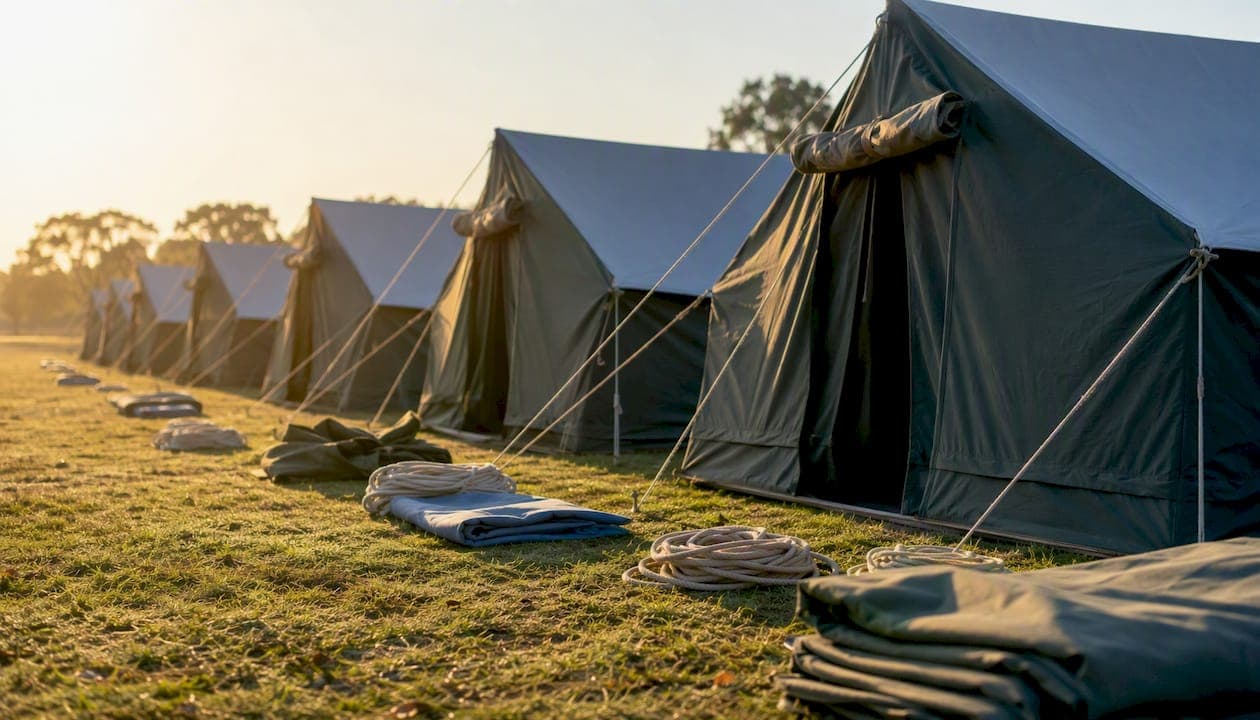
Tentage is a noun meaning a collection of tents or a supply of tenting equipment, used to describe tents as an aggregate rather than as individual objects.
Key Takeaways
Tentage is a mass noun meaning a collective supply of tents or tenting equipment, best reserved for military, logistical, or historical writing where inventory precision matters.
| Point | Details |
|---|---|
| Core definition | A collective noun for tents or tenting equipment as an aggregate supply, not a single tent. |
| Part of speech | Mass noun; the plural "tentages" is attested but rarely used in modern writing. |
| Pronunciation | /ˈtɛntɪdʒ/, stressed on the first syllable: TEN-tij. |
| Register | Specialized or mildly archaic; common in military and logistics writing, rare in everyday speech. |
| Best-use guidance | Use "tents" or "camping equipment" for general audiences; reserve "tentage" for formal logistical contexts. |
Table of Contents
- What does "tentage meaning" tell you about the word?
- Quick-reference facts at a glance
- Expanded senses and the contexts where each appears
- How do you pronounce and spell "tentage" correctly?
- Where does the word come from?
- Synonyms and near-synonyms: which word fits your context?
- Example sentences showing tentage in natural use
- Usage notes: countability, register, and practical guidance
- How has the use of "tentage" changed over time?
- A writer's honest take on when to use "tentage"
- Useful sources for further reading
What does "tentage meaning" tell you about the word?
The tentage definition is straightforward: it refers to tents collectively, the way "baggage" refers to bags collectively. Merriam-Webster defines it as a collection of tents or tent equipment. Collins English Dictionary adds a logistics-oriented sense, describing it as a supply of tents or tenting equipment. Both framings point to the same core idea: tentage names an inventory or stock, not a single shelter.
Dictionary.com lists two senses side by side: tents collectively, and a supply of tents or tenting equipment. The Oxford English Dictionary treats it as a mass or collective noun, noting that the plural form "tentages" is attested but rare in modern usage.
Quick-reference facts at a glance
- Part of speech: Noun (mass noun / collective noun)
- IPA pronunciation: /ˈtɛntɪdʒ/
- Simple respelling: TEN-tij
- Syllables: ten·tage (two syllables)
- Plural: "tentages" exists but is rarely used; writers typically say "supplies of tentage" instead
- Countability: Usually uncountable; treated as a mass noun like "baggage" or "tonnage"
Expanded senses and the contexts where each appears
The word carries three overlapping senses depending on context.
Sense 1 — Tents collectively. This is the primary meaning. When a military report states that a unit moved with all its tentage, it means the entire stock of tents belonging to that unit. The word functions the same way "footage" functions for film: it names the aggregate, not any single piece.
Sense 2 — A supply or inventory of tenting equipment. This logistics-oriented sense appears in procurement documents, event-planning records, and military manuals. Here, tentage includes not just the tent fabric but poles, stakes, ropes, and related hardware. WordWeb captures this well with the example: "The military tentage sprawled across the field."
Sense 3 — Accommodation in the form of tents. Wiktionary records this occasional sense, which surfaces in travel writing or historical narrative. A passage might describe pilgrims relying on tentage for shelter during a long march. This sense is the least common of the three and the most literary.
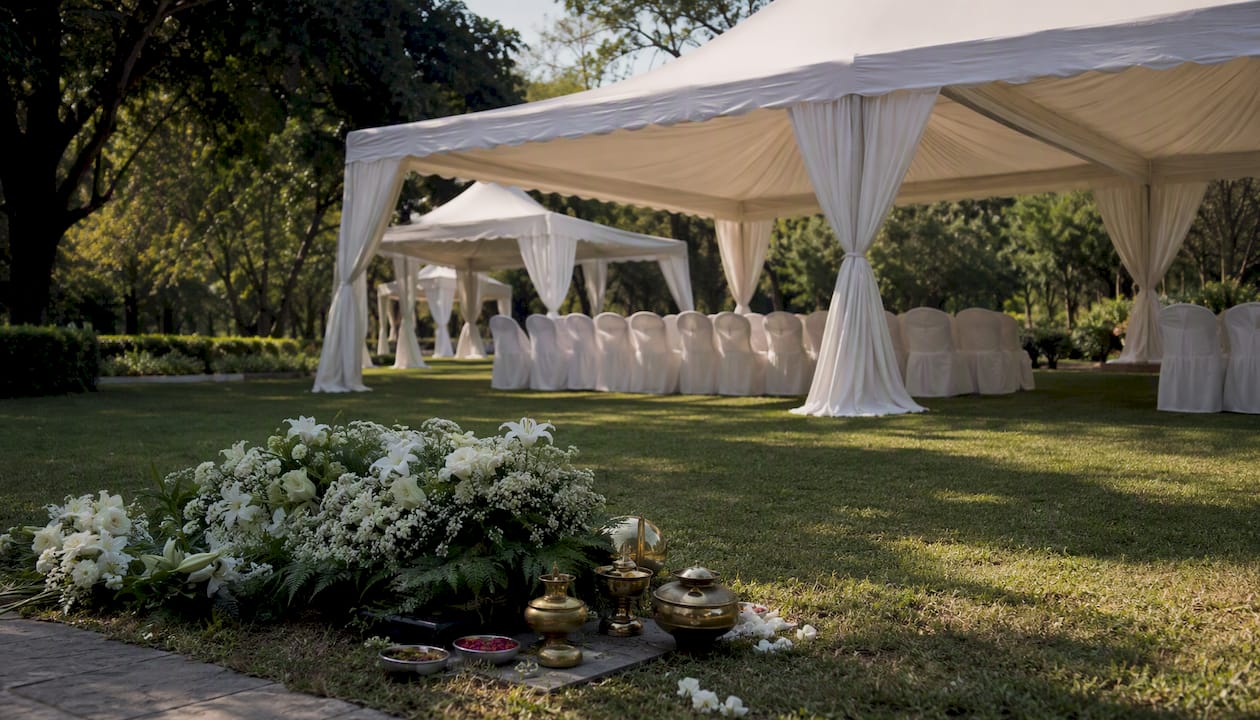
Understanding which sense is active usually depends on whether the surrounding text is logistical (Sense 2), descriptive of a scene (Sense 1), or focused on shelter as accommodation (Sense 3). In funeral tent arrangements, for instance, the word applies in Sense 2: the tentage is the physical supply of tent structures set up for a wake or gathering.
How do you pronounce and spell "tentage" correctly?
Pronunciation is consistent across American and British English, with only minor vowel variation.
- American English IPA: /ˈtɛntɪdʒ/
- British English IPA: /ˈtɛntɪdʒ/ (essentially the same)
- Stress: Falls on the first syllable: TEN-tij
- Common misspellings: "tentidge," "tentedge," "tentege" — all incorrect
- Correct spelling: t-e-n-t-a-g-e, always one word, no hyphen
The "-age" ending is pronounced like the "-age" in "baggage" or "tonnage," not like the "-age" in "garage" (which carries a French-influenced stress on the second syllable). Keeping that analogy in mind makes the pronunciation easy to remember.
Where does the word come from?
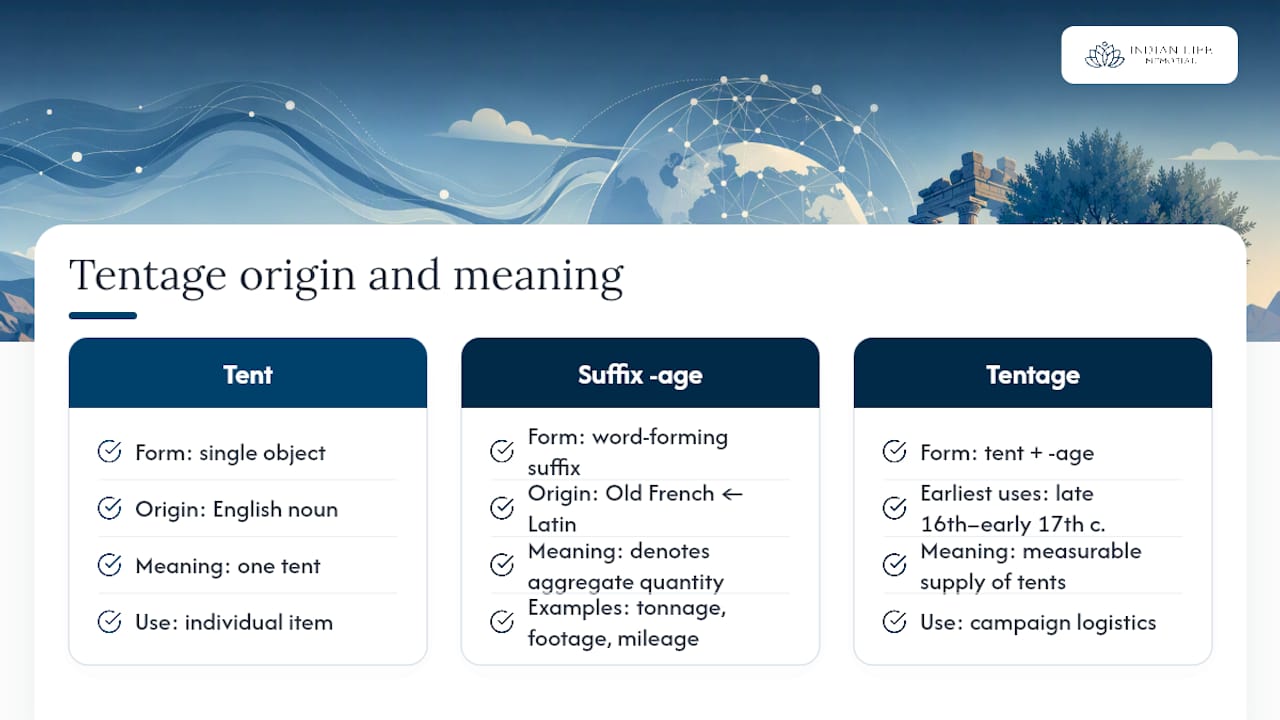
Tentage is formed from the English noun "tent" plus the suffix "-age." That suffix is a productive word-forming element borrowed from Old French "-age," itself from Latin "-aticum." Collins and Dictionary.com both note that "-age" in this role produces nouns denoting an aggregate or collective quantity, exactly as it does in "tonnage" (aggregate weight), "footage" (aggregate length of film), and "mileage" (aggregate distance).
The earliest recorded uses of "tentage" date to the late 16th and early 17th centuries, a period when English military writing was formalizing its vocabulary for campaign logistics. Writers needed a single word to describe the entire stock of tents a regiment carried, and "tentage" filled that gap precisely.
The suffix is what gives the word its logistical flavor. "Tent" names one object; "tentage" names the measurable supply of those objects. Historically, writers paired it with quantities: "sufficient tentage for 2,000 men" is the kind of phrase that appears in accounts of large military campaigns.
Synonyms and near-synonyms: which word fits your context?
Choosing the right synonym depends on register and what exactly you want to describe.
- Tents — the simplest and most widely understood option; use it in any general-audience context
- Tent equipment / tent supplies — clearer than "tentage" when writing for readers unfamiliar with the term; covers poles, stakes, and fabric together
- Encampment — describes the place where tents are set up, not the tents themselves; use it when location matters more than inventory
- Bivouac — military term for a temporary camp, often without tents; register is formal and specifically military
- Campsite — informal; refers to the location, not the equipment
Tentage is the right choice when you are writing about the inventory or physical stock of tent structures, particularly in a logistical, military, or formal historical context. It is not a synonym for the activity of camping, and it does not describe the experience of being in a tent. If your sentence is about what it feels like to sleep under canvas, "tentage" is the wrong word.
Example sentences showing tentage in natural use
These short sentences show how the word behaves across different writing contexts.
- Military: "The quartermaster confirmed that tentage for the entire battalion had been loaded onto the supply wagons."
- Event logistics: "The festival organizers inventoried their tentage two weeks before the event to identify damaged poles and torn canopies."
- Historical narrative: "The army's tentage stretched for nearly a mile along the riverbank, visible from the opposite shore."
- Camping/outdoor supply: "The outfitter's warehouse held tentage sufficient for a group of forty, including rain flies and ground cloths."
Notice that in each sentence, "tentage" could be replaced by "tents" without changing the core meaning, but the substitution would lose the inventory-and-supply connotation that makes "tentage" precise in formal writing. Landed outdoor services offer a practical example of how tentage is managed as a coordinated supply rather than a collection of individual items.
Usage notes: countability, register, and practical guidance
Countability. Tentage is almost always a mass noun. You would not write "three tentages" the way you might write "three tents." The OED confirms that "tentages" is an attested plural, but it is rare enough that most readers will find it awkward. When you need to express quantity, use a construction like "a large supply of tentage" or "sufficient tentage for the regiment."
Register. The word sits in a specialized or mildly archaic register. It is at home in military manuals, procurement documents, historical accounts, and formal event-logistics writing. Outside those contexts, it can read as unnecessarily technical or old-fashioned.
Pro Tip: Reserve "tentage" for formal logistical or military writing. In general-audience copy, "tents" or "camping equipment" communicates the same idea more clearly and without the risk of confusing your reader.
How has the use of "tentage" changed over time?
OED-derived frequency data shows a clear decline. In the 1920s, "tentage" appeared at approximately 0.04 occurrences per million words in English-language corpora. By 2010, that rate had dropped to around 0.013 per million words, a reduction of roughly two-thirds over the course of the 20th century.
| Period | Occurrences per million words |
|---|---|
| 1920s | 0.04 |
| 2010 | 0.013 |
The word did not disappear; it narrowed. Military manuals, historical accounts of campaigns, and specialist outdoor-industry documents still use it. General fiction, journalism, and everyday speech largely replaced it with "tents" or "camping gear." That narrowing is consistent with how many logistical terms behave: they survive in the professional registers that need precision and fade from casual use.
A writer's honest take on when to use "tentage"
The word earns its place in exactly one situation: when you are writing about tents as a managed supply rather than as individual objects. A military logistics report, a procurement checklist, a historical account of a campaign encampment — those are the contexts where "tentage" does work that "tents" cannot do as cleanly. The moment you step outside that register, the word starts to feel like a costume. General readers will pause, look it up, and wonder why you did not just say "tents."
The distinction matters for anyone writing about ceremonial or event contexts, too. When tent structures are arranged for a gathering, what is being managed is a supply of tentage in the logistical sense, not simply "some tents." That precision is worth preserving in formal writing. For everything else, plain language serves your reader better.
Useful sources for further reading
The following reference works carry the primary entries for "tentage" and are worth consulting for original definitions, pronunciation audio, and etymology detail.
- Merriam-Webster — the standard American English dictionary entry, with pronunciation and the primary definition
- Oxford English Dictionary (OED) — the most detailed historical record, including earliest attestations, the attested plural, and frequency data
- Wiktionary — useful for etymology breakdown and the accommodation sense