
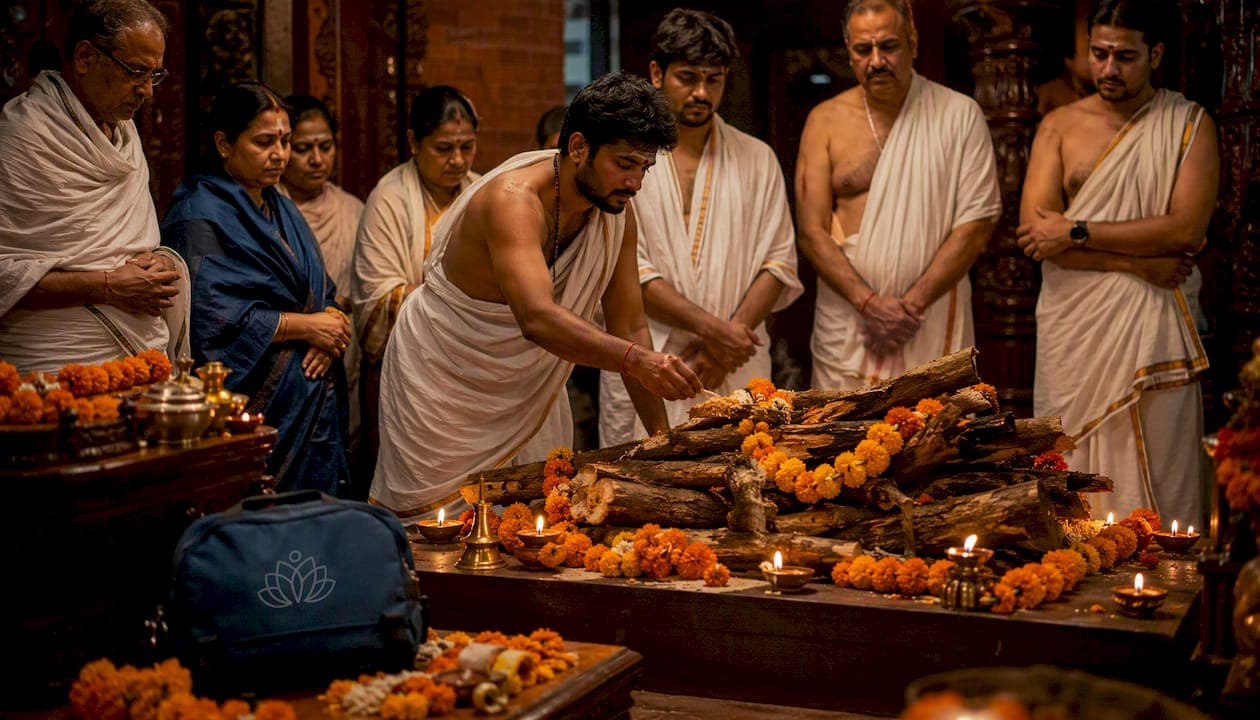
Antyesti rituals are performed to release the atman (soul) from its earthly body, return the physical form to the five elements of nature, and support the soul's onward journey toward moksha or its next life. These sacred rites, rooted in Vedic tradition and affirmed throughout the Bhagavad Gita, serve both the departed and the living simultaneously.
- For the soul: Antyesti severs the soul's attachment to the body, purifies it through Agni (sacred fire), and eases its passage toward rebirth or liberation.
- For the family: The structured mourning period and communal rites give grief a sacred container, helping survivors process loss within a recognized spiritual framework.
"Just as a person puts on new garments, giving up old ones, similarly, the soul accepts new material bodies, giving up the old and useless ones." — Bhagavad Gita 2.22
This passage captures the heart of why Antyesti is performed: not as an ending, but as a sacred transition that the living can actively support through devotion, ritual, and prayer.
Table of Contents
- What does Antyesti mean, and where does it fit among the samskaras?
- Why are Antyesti rituals performed? The core spiritual reasons
- Why is fire (Agni) so central to Antyesti?
- How is the body prepared, and who performs those rites?
- What happens during the cremation ceremony?
- How are ashes collected, handled, and dispersed?
- Post-funeral rites, mourning, and what happens if rites aren't performed
- Who participates, and what is the etiquette for mourners?
- Regional, sectarian, and personal variations in Antyesti
- Practical matters for arranging Antyesti in the United States
- Why these rituals matter: scriptural and psychosocial perspectives
- Key Takeaways
- A respectful perspective on Antyesti for non-Hindu readers and diaspora families
- Recommended sources and further reading
What does Antyesti mean, and where does it fit among the samskaras?
The word Antyesti comes from Sanskrit: antya (last) and ishthi (sacrifice or offering). Together, they translate roughly as "last sacrifice" or "final rite." In English, you will also see it rendered as antyeshti or simply "Hindu funeral rites."
Antyesti is the sixteenth and final samskara in the Hindu tradition. The samskaras are life-cycle rites that mark every significant transition from conception to death, and Antyesti closes that sacred arc. As the terminal rite, it carries particular weight: it is the last act of devotion a family can perform for one of its own.
Key facts about Antyesti's place in tradition:
- It belongs to the Grhyasutras (household ritual texts) and is described in the Dharmashastra literature as a sacred obligation.
- Cremation is the most common form, though burial is practiced for infants, young children, and certain renunciates.
- Customs vary meaningfully by region, caste, and denomination — there is no single uniform ceremony across all Hindu communities.
Why are Antyesti rituals performed? The core spiritual reasons
The spiritual logic of Antyesti rests on three interlocking beliefs: the immortality of the atman, the cycle of samsara (birth, death, and rebirth), and the law of karma.
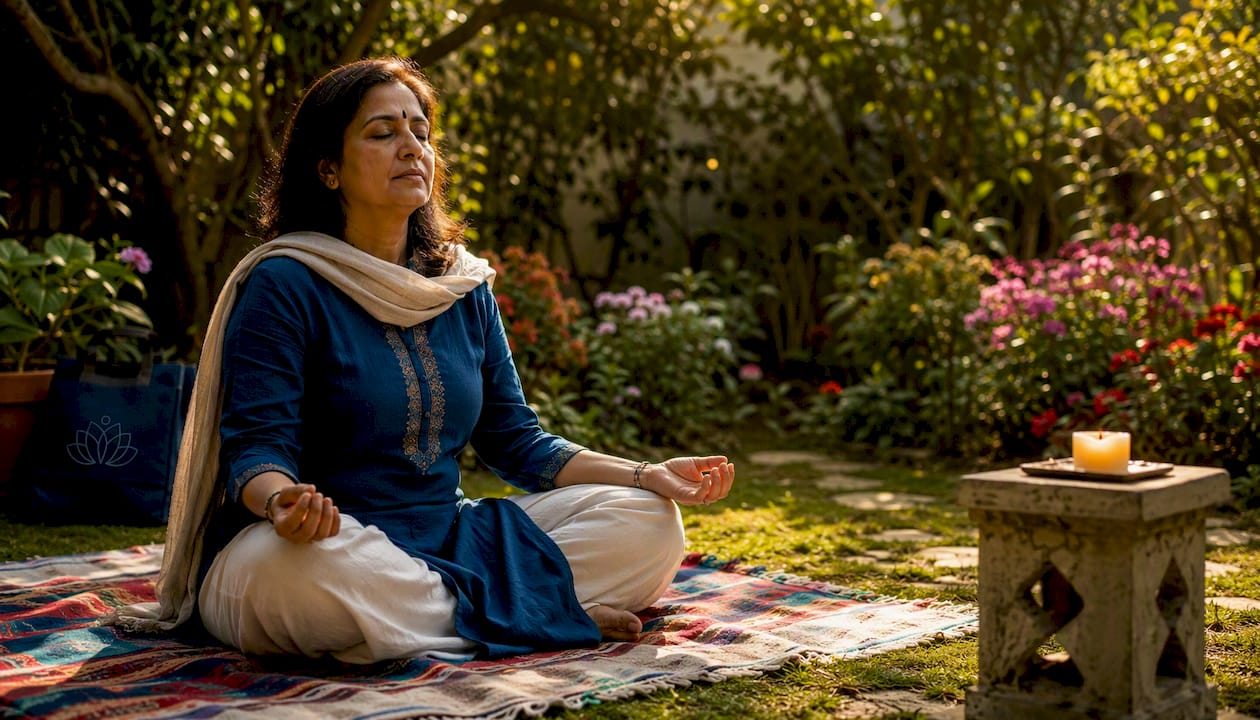
Hindu teaching holds that the atman never dies. What ends at death is only the body, the temporary vessel the soul has occupied. The Bhagavad Gita frames this with striking clarity, describing the soul shedding a worn-out body the way a person discards old clothing. Antyesti rituals are designed to help that shedding happen cleanly, so the atman is not held back by earthly attachments.
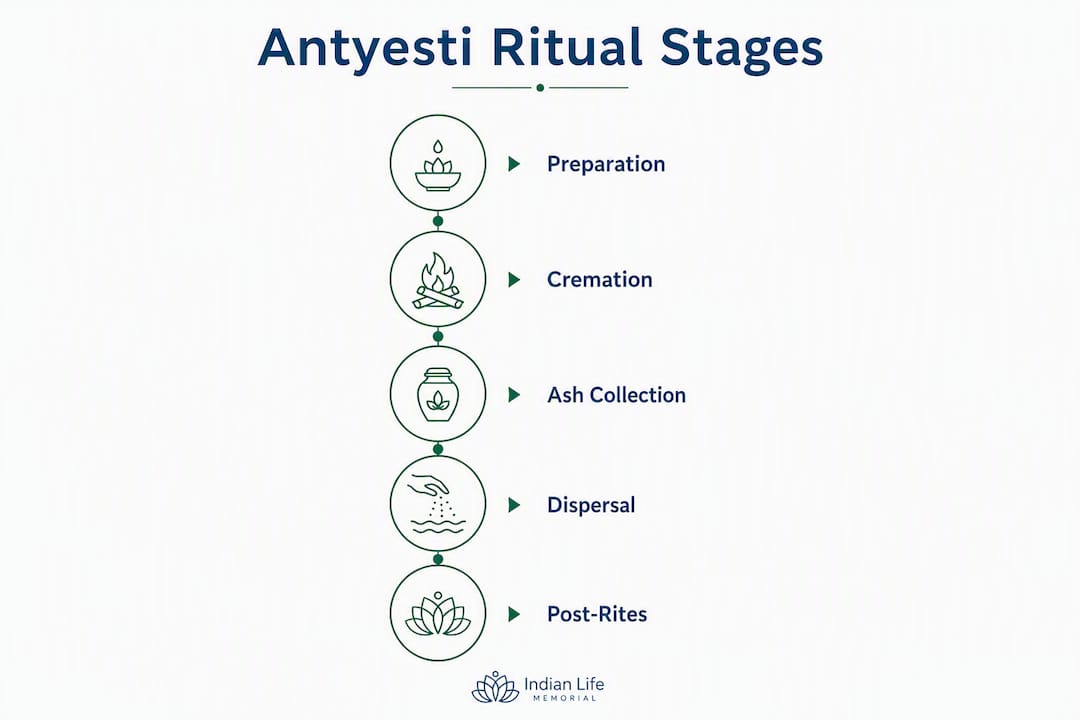
Karma shapes what comes next. The accumulated moral weight of a person's actions determines the nature of their next life or, for those who have achieved sufficient spiritual development, whether they attain moksha, liberation from the cycle entirely. Antyesti does not alter a person's karma, but it removes obstacles to the soul's forward movement and expresses the family's sincere wish for the departed's wellbeing.
The body itself is understood as a temporary combination of the five elements: earth (prithvi), water (jal), fire (agni), air (vayu), and space (akasha). Cremation returns each element to its source, completing a natural cycle that mirrors the soul's own return to the divine.
- Atman release: Ritual acts help detach the soul from its identification with the physical body.
- Karmic continuity: Prayers, mantras, and offerings support the soul's moral journey forward.
- Elemental return: The body dissolves back into the five elements from which it was formed.
- Moksha or rebirth: The rites express the family's hope that the soul finds peace, liberation, or a favorable next life.
Why is fire (Agni) so central to Antyesti?
Fire is not incidental to Antyesti. Agni, the Vedic fire deity, is the messenger who carries offerings from the human realm to the divine. In the context of Antyesti, the cremation fire performs that same function: it conveys the deceased toward the next realm of existence while simultaneously purifying the body of its earthly attachments.
Vedic-era texts recast the funeral itself as a sacrifice, the last ishti (ritual offering) a person makes. In that frame, the body becomes the offering, Agni becomes the priest, and the cremation ground becomes the altar. That ancient understanding explains why so many small ritual choices still carry symbolic weight today.
- Ghee (clarified butter): Poured into the fire to feed and honor Agni, intensifying the sacred flame.
- Mantras: Chanted to guide Agni's action and invoke divine witnesses.
- Direction: The body is traditionally oriented with the head pointing south, toward the realm of Yama, the god of death.
- Circumambulation: Mourners walk around the pyre counterclockwise, reversing the direction of life's rituals.
Pro Tip: If your family is using an electric crematorium rather than a wood pyre, a pandit can still perform the full mantra sequence and symbolic fire-lighting with a small flame or lamp. The spiritual intention behind each act remains intact even when the physical form adapts.
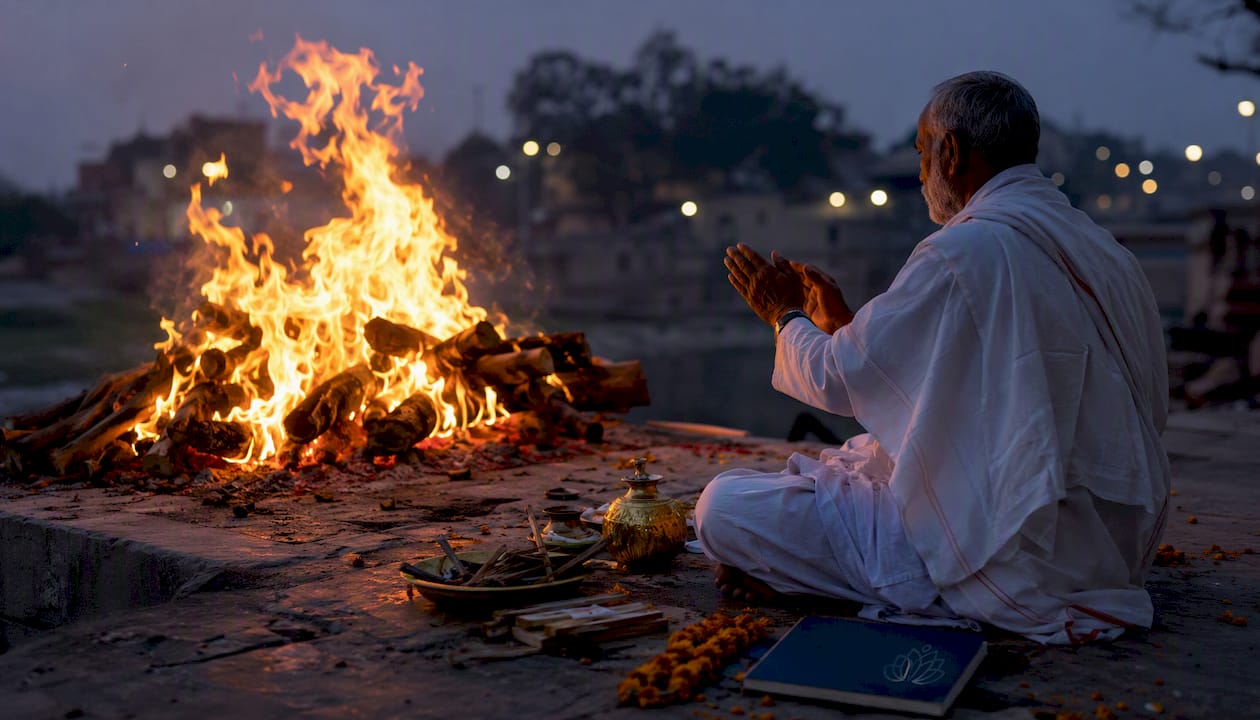
How is the body prepared, and who performs those rites?
Preparation of the body follows a clear sequence, though specific customs vary by family and regional tradition. The goal is to present the deceased with dignity and ritual purity before the cremation.
Typical preparation steps:
- The body is bathed with water, often mixed with Ganges water or other sacred substances, by close family members of the same gender where possible.
- The body is dressed in simple white or unstitched cloth. Elaborate or colorful clothing is generally avoided.
- Tulasi (holy basil) leaves and, in some traditions, a few drops of Ganges water are placed in the mouth.
- Sesame seeds or rice may be placed with the body as symbolic offerings.
- The body is garlanded with flowers and placed on a bier, feet pointing south.
The eldest son traditionally serves as the chief mourner and leads the rites, though many families today share duties among children regardless of gender. A pandit (Hindu priest) guides the ceremony, chanting the appropriate Vedic mantras and directing the family through each step.
Timing matters. Hindu tradition calls for cremation ideally within 24 hours of death. Outside South Asia, that timeline often requires coordination with local authorities for death certificates and permits, which can extend the window by several days. Embalming is generally avoided but may be necessary for repatriation of remains.
What happens during the cremation ceremony?
The cremation ceremony, called Dahana Kriya, moves through several distinct acts, each carrying its own meaning.
The procession to the cremation ground is led by the chief mourner, with the bier carried by male relatives. Mourners chant "Ram naam satya hai" (the name of Ram is truth), affirming the soul's divine nature even in grief.
At the cremation ground or crematorium:
- The body is placed on the pyre or in the cremation chamber, with the head oriented toward the south.
- The chief mourner circles the pyre three or five times, carrying a pot of water that is eventually broken to symbolize the release of earthly bonds.
- Ghee and sacred wood (often sandalwood) are placed on the pyre.
- The chief mourner lights the pyre, traditionally at the head, while the pandit recites mantras.
Kapala-bheda (skull breaking): This act, sometimes called kapal kriya, involves cracking or piercing the skull during cremation. Its purpose is to symbolically open a passage for the soul to exit the body. In wood-pyre cremations, this is performed by the chief mourner using a bamboo stick. In electric crematoria, the act is often performed symbolically with a small ritual gesture before the cremation begins, since the chamber is sealed. Families sometimes feel uncertain about this rite; a pandit can explain exactly how it will be handled at your specific facility.
How are ashes collected, handled, and dispersed?
After cremation, the remaining bones and ash, called asthi, are collected in a ritual known as asthisanchayana. This typically takes place on the third day after cremation, once the remains have cooled completely.
Common dispersal practices and their meanings:
- Immersion in a sacred river: The Ganges at Varanasi, Haridwar, or Allahabad is the most revered destination. Immersion symbolizes the soul's final purification and release.
- Ocean scattering: Widely practiced in diaspora communities, ocean scattering carries the same symbolic weight as river immersion.
- Burial of ashes: Some families bury the asthi on family land or in a garden, particularly when travel to India is not possible.
- Keeping ashes at home: Permitted temporarily in most traditions, though immersion is considered the spiritually complete act.
In the United States, ocean scattering requires compliance with the Environmental Protection Agency's Marine Protection, Research, and Sanctuaries Act, which mandates that scattering occur at least three nautical miles from shore. River scattering is subject to state-specific regulations and often requires a permit.
Pro Tip: If your family plans to repatriate ashes to India for immersion, work with a funeral provider experienced in international transport of cremated remains. Documentation requirements vary by airline and destination state in India, so confirm the paperwork at least a week before travel.
Post-funeral rites, mourning, and what happens if rites aren't performed
The period immediately following cremation is called ashauca, a state of ritual impurity observed by the immediate family. Its duration varies by community and regional custom, ranging from 3 to 13 days. During ashauca, family members typically avoid festivals, certain foods, and participation in public religious ceremonies. These restrictions are not punitive; they create protected space for grief.
Key post-funeral rites:
- Pinda offerings: Rice balls offered to the deceased on specific days during the mourning period, providing symbolic nourishment for the soul's journey.
- Shraddha: Annual remembrance rites performed on the death anniversary, reaffirming the family's connection to the departed and supporting the soul's continued wellbeing.
- Sapindi-karana: A rite performed on the twelfth or thirteenth day that formally integrates the deceased's soul into the community of ancestors (pitrs).
If rites cannot be completed on schedule, as often happens for diaspora families navigating permit delays or travel distances, most pandits and Hindu scholars agree that the intention and sincerity behind the rites matter more than strict timing. Abbreviated ceremonies, proxy performances by a pandit, or delayed observances are all recognized accommodations. Consulting a knowledgeable pandit early gives your family the clearest guidance for your specific situation.
Traditional teaching holds that incomplete rites may leave the soul in an unsettled state, which is why families feel genuine urgency. Communities generally respond with support rather than judgment when practical constraints cause delays.
Who participates, and what is the etiquette for mourners?
Traditional roles:
- Chief mourner (usually the eldest son): Lights the pyre, leads circumambulation, and performs the primary ritual acts.
- Pandit: Guides the ceremony, chants mantras, and advises the family on each step.
- Pallbearers: Male relatives who carry the bier to the cremation ground.
- Female relatives: Traditionally remained at home in some communities, though many families today include women fully in all rites.
Etiquette for visitors and mourners:
- Wear white or muted, plain colors. Avoid bright colors, patterns, and jewelry. For detailed guidance, the Hindu funeral attire dress code resource offers practical specifics.
- Remove shoes before entering the home or prayer space.
- Offer condolences quietly and briefly. "Om Shanti" (peace) is a respectful phrase. Avoid loud conversation or laughter.
- Follow the family's lead on whether to view the body, join the procession, or participate in any ritual act.
- Bring practical support: food for the household (vegetarian, as the family often observes dietary restrictions during ashauca), help with logistics, or simply your presence.
Pro Tip: If you are unsure whether to attend a cremation or how to help, ask a family member directly. Families almost always appreciate the question more than a well-intentioned but mistimed gesture.
Regional, sectarian, and personal variations in Antyesti
Antyesti is not a single fixed ceremony. Across India's regions and denominations, meaningful differences exist.
Burial instead of cremation is practiced for:
- Infants and young children, whose bodies are considered inherently pure and therefore do not require fire's cleansing role.
- Certain renunciates (sannyasis) and saints, whose spiritual advancement is understood to have already purified the soul.
- Some tribal and folk communities with distinct ancestral traditions.
Denominational differences:
- Shaiva traditions often emphasize Shiva's role as lord of death and transformation; specific mantras and ritual objects reflect this.
- Vaishnava traditions center on Vishnu or Krishna, with different mantra selections and sometimes different timing conventions.
- Regional customs across Tamil Nadu, Bengal, Maharashtra, and other states can differ in procession order, the number of circumambulations, and the specific pinda offerings made.
For families navigating mixed-faith households or conversion, the guiding principle is the family's sincere intention. A pandit experienced with diaspora communities can adapt the core rites while preserving their spiritual integrity. For infant loss specifically, Indianlifememorial's baby funeral services address the particular sensitivities involved with compassion and care.
Practical matters for arranging Antyesti in the United States
Arranging Antyesti outside India requires navigating both spiritual requirements and U.S. legal processes. The two are compatible, but planning ahead reduces stress significantly.
Legal and logistical checklist for most U.S. jurisdictions:
- Obtain a certified death certificate from the attending physician or medical examiner.
- File for a cremation permit through the local vital records office (requirements vary by state).
- Confirm the crematorium's policies on family participation, open-flame use, and timing of the ceremony.
- If scattering ashes at sea, verify EPA distance requirements and any state-specific permits.
- For repatriation to India, arrange documentation with the funeral home and the relevant consulate.
Adapting the ceremony at U.S. crematoria:
Most modern crematoria in the United States can accommodate Hindu rites with advance notice. Families can typically request time for mantras, symbolic fire-lighting, and the chief mourner's ritual acts before the chamber is sealed. Kapala-bheda is performed symbolically in these settings, and a pandit can guide the family through an equivalent gesture.
Eco-alternatives: Green burial and alkaline hydrolysis (water cremation) are available in several U.S. states. Alkaline hydrolysis returns the body to liquid and bone ash, which can then be immersed or scattered. Some families find this compatible with the elemental-return principle of Antyesti; others prefer traditional fire cremation. Consulting your pandit before choosing an alternative method is advisable.
Pro Tip: Contact the crematorium at least 48 hours before the ceremony to confirm what family participation is permitted. Ask specifically about open flames, incense, and the number of mourners allowed in the cremation room.
Why these rituals matter: scriptural and psychosocial perspectives
The authority behind Antyesti comes from two directions: ancient scripture and the lived experience of communities across generations.
"For the soul there is never birth nor death at any time. It has not come into being, does not come into being, and will not come into being. It is unborn, eternal, ever-existing, and primeval." — Bhagavad Gita 2.20
This verse grounds the entire ritual framework. If the soul is eternal, then death is a transition, not an ending, and the family's role is to support that transition with devotion. Practitioners consistently emphasize that Antyesti rites are primarily for the benefit of the departed soul, with communal healing as a secondary but genuine purpose.
The psychosocial dimension is equally real. The structured mourning period of ashauca, lasting up to thirteen days depending on local custom, gives grief a recognized shape. Mourners know what is expected of them, what to avoid, and when the formal period ends. That structure reduces the disorientation that often accompanies sudden loss. Ethnographic studies of Hindu communities consistently find that ritual participation supports social cohesion and helps families integrate loss without isolation.
For diaspora families in the United States, understanding how Indian funeral needs differ from those in India can help you plan rites that honor both tradition and your current circumstances.
Key Takeaways
Antyesti rituals are performed to release the atman, return the body to the five elements, and provide both the soul and the surviving family with a sacred, structured path through death.
| Point | Details |
|---|---|
| Core spiritual purpose | Antyesti releases the atman from the body and supports its journey toward moksha or rebirth. |
| Role of Agni | Fire purifies the body, returns its elemental fire to nature, and conveys the soul toward the next realm. |
| Mourning period | Ashauca lasts 3–13 days depending on community custom, giving grief a recognized and supported structure. |
| U.S. legal steps | Families need a death certificate, cremation permit, and crematorium approval before the ceremony can proceed. |
| Variations exist | Infants and renunciates are often buried; denominational and regional customs differ meaningfully across communities. |
A respectful perspective on Antyesti for non-Hindu readers and diaspora families
What strikes me most about Antyesti, having studied these traditions carefully, is how little it resembles the Western assumption that funeral rites are primarily for the living. In Hindu practice, the living are participants in something the soul genuinely needs. That reorientation changes everything about how you approach the ceremony.
Non-Hindu friends and colleagues sometimes worry about doing or saying the wrong thing. The honest answer is that presence and sincerity matter far more than procedural correctness. Follow the family's lead, ask before you act, and resist the urge to compare the ceremony to what you know. The rites are not symbolic in the diminished sense of "merely symbolic." Practitioners understand them as effective actions with real consequences for the soul.
For diaspora families, the tension between tradition and practicality is real but not irresolvable. Communities have adapted Antyesti across centuries and across continents. What remains constant is the intention: to honor the departed with devotion, to return the body to nature with gratitude, and to release the soul with love. Every adaptation that preserves that intention preserves the heart of the rite.
If your family is navigating grief and needs support that honors these traditions with genuine care, Indianlifememorial's Hindu funeral services are available around the clock, with experienced pandits and transparent guidance at every step.
Recommended sources and further reading
The sources below represent a range of perspectives, from primary scripture to practical funeral guides, for readers who want to go deeper.
| Source type | Resource | What it offers |
|---|---|---|
| Scriptural | Bhagavad Gita (multiple translations available online) | Primary text for understanding the soul, death, and transition |
| Encyclopedic | Britannica — Hinduism and funeral rites entries | Reliable overview of Hindu death practices and their historical context |
| Practitioner guide | ISKCON Educational Services — Heart of Hinduism | Accessible explanation of Antyesti steps, exceptions, and spiritual aims |
| Scholarly reference | Hindupedia — Antyesti entry | Detailed Dharmashastra-based description of samskaras and shraddha rites |
| Funeral services | Indianlifememorial — Hindu Indian services | Practical support for families arranging rites in Singapore and beyond |
For grief support that integrates ritual elements into the bereavement process, the Grief and Loss Release Ritual offered by MotherOdessa provides a structured ceremonial framework for those processing loss.