
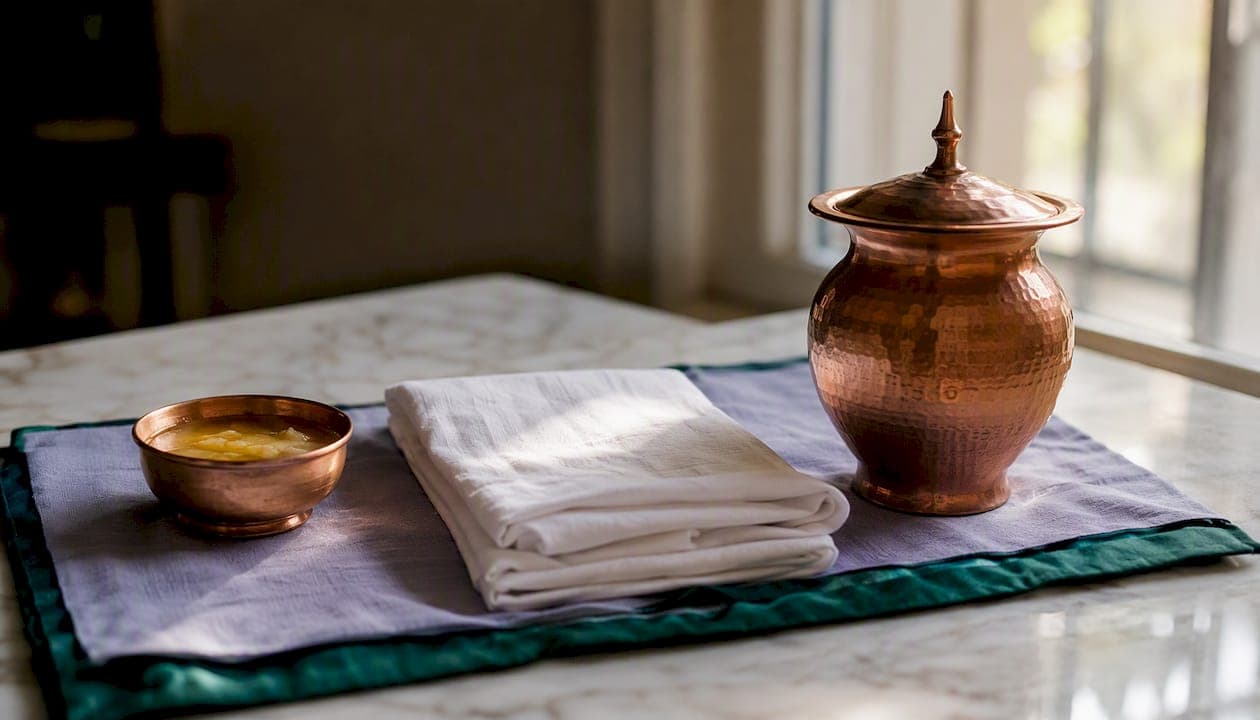
The core antyesti ritual components list includes these saamagri items, each with its immediate purpose.
- Ghee (clarified butter) — poured on the pyre to aid combustion and as a sacred offering to Agni
- Plain rice / pind material — shaped into rice balls (pind) offered to nourish the departing soul
- Black or white sesame seeds (til) — placed as a protective offering and used in tarpanam water rites
- Gangajal or pure water — sprinkled on the body and used in ritual bathing and purification
- Sandalwood paste (chandan) — applied to the body as an anointing and purifying agent
- Camphor (karpoor) — burned to intensify the flame and symbolize the dissolution of ego
- Incense sticks (agarbatti) — lit to purify the atmosphere and honor the sacred space
- Fresh flowers (marigold or jasmine) — placed on the body and bier as offerings of devotion
- Shroud cloth (white or saffron) — used to wrap the body with dignity before procession
- String — tied around the big toes and wrists to keep the body composed during transport
- Darbha / kusha grass — placed beneath the body and used in purification rites
- Havan kund plate — an 8-inch earthen plate wrapped in foil, placed on the chest during cremation
- Clay pot for ashes — used to collect and store the remains after cremation
- Copper or brass vessels — for holding sacred water and ritual offerings
- Matches or lighter — for the chief mourner to light the pyre or symbolic flame
- Cotton wicks / diyas — small oil lamps kept burning near the body
Three items to source first if you are in the United States: ghee (available at most South Asian grocery stores and many mainstream supermarkets), a plain white cotton shroud, and a clean copper or clay vessel for the ashes. These three are used at the earliest and most critical moments of the rite and are hardest to improvise.
Key Takeaways
The most critical preparation for an Antyesti ceremony is assembling the correct saamagri before the rite begins, with ghee, a white shroud, and a clean vessel for ashes as the three highest-priority items to source first.
| Point | Details |
|---|---|
| Source three items first | Ghee, a plain white cotton shroud, and a clean clay or copper vessel for ashes are needed earliest and hardest to improvise. |
| Confirm crematorium rules | U.S. electric cremation chambers restrict large quantities of ghee and wood; confirm permitted items in writing before the ceremony. |
| Quantities to plan for | Traditional checklists call for approximately 1 kg of ghee as a starting quantity; confirm with your Pandit. |
| Ask about regional variation | Shroud color, pind schedule, and sect-specific offerings differ; confirm your family's tradition with elders or your Pandit before purchasing specialty items. |
| Plan post-cremation rites | Ash collection typically occurs on day 3; pind-daan and tarpanam continue through day 10 or 13, requiring daily supplies of rice, sesame, and water. |
Three questions to ask your funeral director or Pandit:
- Which ritual items does your crematorium permit inside the electric chamber, and can the family perform a symbolic flame-lighting before the chamber closes?
- What is the earliest the ashes can be collected, and can the timing align with the day-3 tradition?
- What are the legally permitted options for ash immersion in this state, and can you help coordinate overseas dispersal if the family prefers immersion in a sacred river?
Table of Contents
- What is Antyesti and why does it matter?
- The full antyesti ritual components list with quantities and sourcing
- How does the Antyesti ceremony unfold step by step?
- Why are ghee, camphor, sesame, and other key items used?
- What do U.S. families need to know about logistics and legal requirements?
- How do regional and sect differences change the components list?
- What happens after the cremation: ash immersion and mourning rites
- Approaching these preparations with care and compassion
- Useful sources and references
What is Antyesti and why does it matter?
Antyesti, sometimes spelled Antyeshti, literally means "last sacrifice" in Sanskrit and refers to the final samskara (sacred rite of passage) performed for a Hindu person at death. The ceremony's central purpose is threefold: to return the body's five elements (panch bhutas) to nature through cremation; to help the Atman (soul) transition peacefully toward its next state of existence; and to fulfill the sacred duty of the surviving family toward the deceased.
Cremation is the dominant form because fire, embodied by Agni, is understood as the divine messenger who carries the soul onward. The rites are traditionally completed as quickly as possible, often within 24 hours of death, though in the United States legal requirements for death certification sometimes extend this window slightly. The eldest son or a designated lead mourner typically performs the key ritual acts, guided by a qualified priest (Pandit or Purohit). Families seeking deeper background on the theological reasoning behind cremation will find the significance of Hindu cremation explored in detail elsewhere.
Two reliable source types anchor any preparation: traditional Vedic texts and ritual manuals (such as the Garuda Purana, which addresses death rites directly) and practical funeral-service guides produced by Hindu funeral providers, which translate those texts into actionable checklists for modern families.
The full antyesti ritual components list with quantities and sourcing
The table below draws on traditional saamagri checklists and funeral-service guides to give each item's ritual use, a customary quantity where sources converge, and practical notes for families sourcing items in the United States. Quantities vary by community and priest; treat these as starting points to confirm with your Pandit.
Less obvious items families often overlook: the foil-wrapped 8-inch earthen havan plate, a small packet of sand (used for clean-up at the cremation site), and a few rolls of paper. Ritual manuals list these alongside the more familiar items, yet families frequently arrive without them.
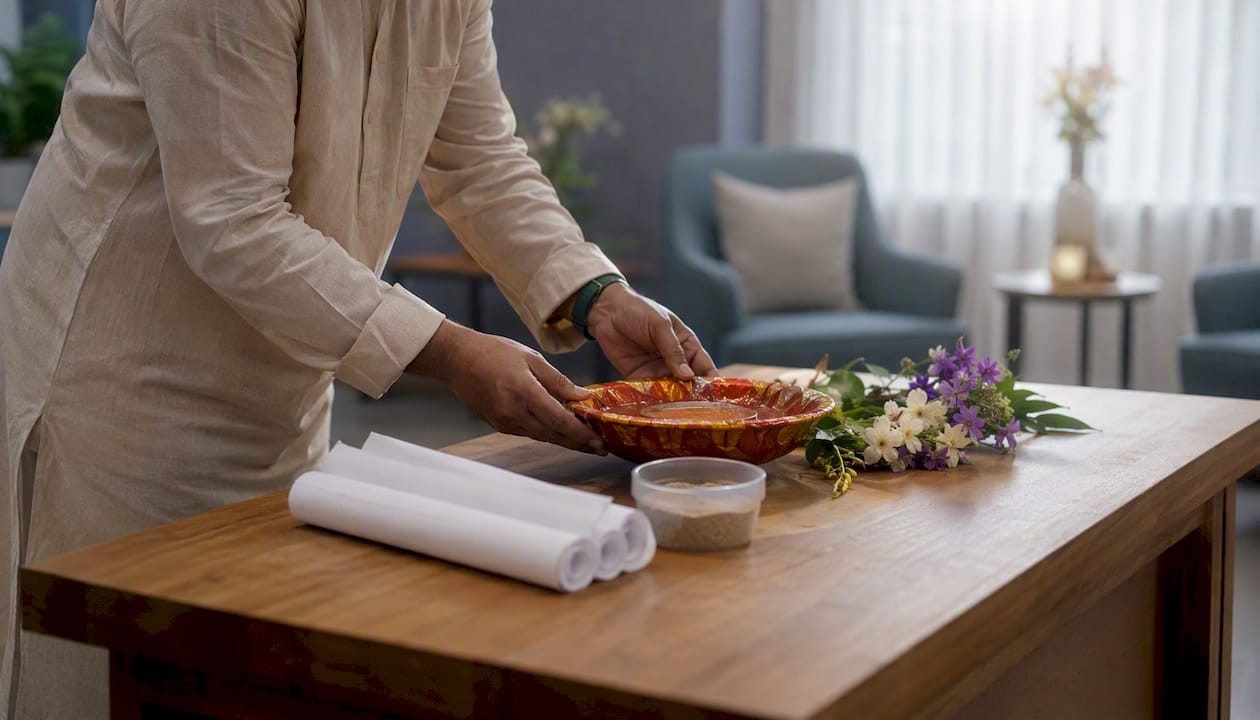
Pro Tip: Many Hindu funeral suppliers and some temple organizations offer pre-assembled saamagri kits. In diaspora communities across the United States, these kits are a practical way to confirm you have culturally correct items without sourcing each piece separately. Ask your Pandit or funeral director whether a kit is available before purchasing individually.
For guidance on flowers specifically, including which varieties carry the most traditional significance, the Hindu funeral flowers and offerings guide covers sourcing and etiquette in detail.
How does the Antyesti ceremony unfold step by step?
The ritual sequence moves from preparation and bathing through dressing, procession, cremation, and post-cremation rites. Here is how each step maps to the components your family will use.
-
Preparation and bathing (30–90 minutes). The body is placed on a clean surface, ideally on darbha grass. Family members bathe the deceased with Gangajal mixed with water, then apply turmeric and sandalwood paste. Cotton wicks and diyas are lit nearby. String is tied around the big toes and wrists.
-
Dressing and anointing (15–30 minutes). The body is wrapped in the white or saffron shroud. Tulsi leaves may be placed in the mouth or on the chest. The foil-wrapped havan plate is placed on the chest. Fresh flower garlands are arranged on the body.
-
Procession to the cremation site (variable). The body is carried on the bamboo bier, traditionally by male family members. Incense is burned throughout. The chief mourner leads, often carrying a clay pot of water or fire.
-
Pyre preparation and cremation lighting (30–60 minutes for setup; cremation time varies). Sandalwood pieces, camphor, and ghee are arranged on or around the pyre. The chief mourner (traditionally the eldest son) circles the pyre and lights it. Additional ghee is poured at intervals to sustain the flame. In electric cremation, the family performs a symbolic flame-lighting with a diya before the body enters the chamber.
-
Kapala kriya (during cremation, open pyre only). In open-pyre traditions, a designated mourner uses a long bamboo pole to pierce the skull at the moment the fire reaches the head. This act, known as kapala kriya, is understood as releasing the spirit from the body. In electric cremation, this physical act is not performed; some families and priests perform a symbolic equivalent or omit it entirely, which is widely accepted.
-
Ash collection / astisanchayan (typically day 3). Once the pyre has cooled, family members collect the bones and ashes using the copper or brass vessels and transfer them to the clay pot. The pot is sealed and stored in a clean, respectful location until immersion.
-
Post-cremation purification. Family members bathe, change clothes, and return home for initial mourning observances. The home is cleaned and a lamp is kept burning.
For a broader overview of the full ritual sequence and family roles, the Hindu funeral rites family guide provides additional context.
Why are ghee, camphor, sesame, and other key items used?
Six items in the saamagri carry the most weight in terms of how their symbolism shapes ritual practice: ghee, camphor, sesame (til), pind/rice, Gangajal, and sandalwood.
Ghee serves a dual role. Practically, it helps the fire burn evenly and sustain the cremation flame. Symbolically, it represents purity and a direct offering to Agni, the fire deity who acts as the divine messenger between the living and the departed. These two functions reinforce each other: the act of feeding the fire with a pure substance is simultaneously a practical necessity and a sacred gesture.
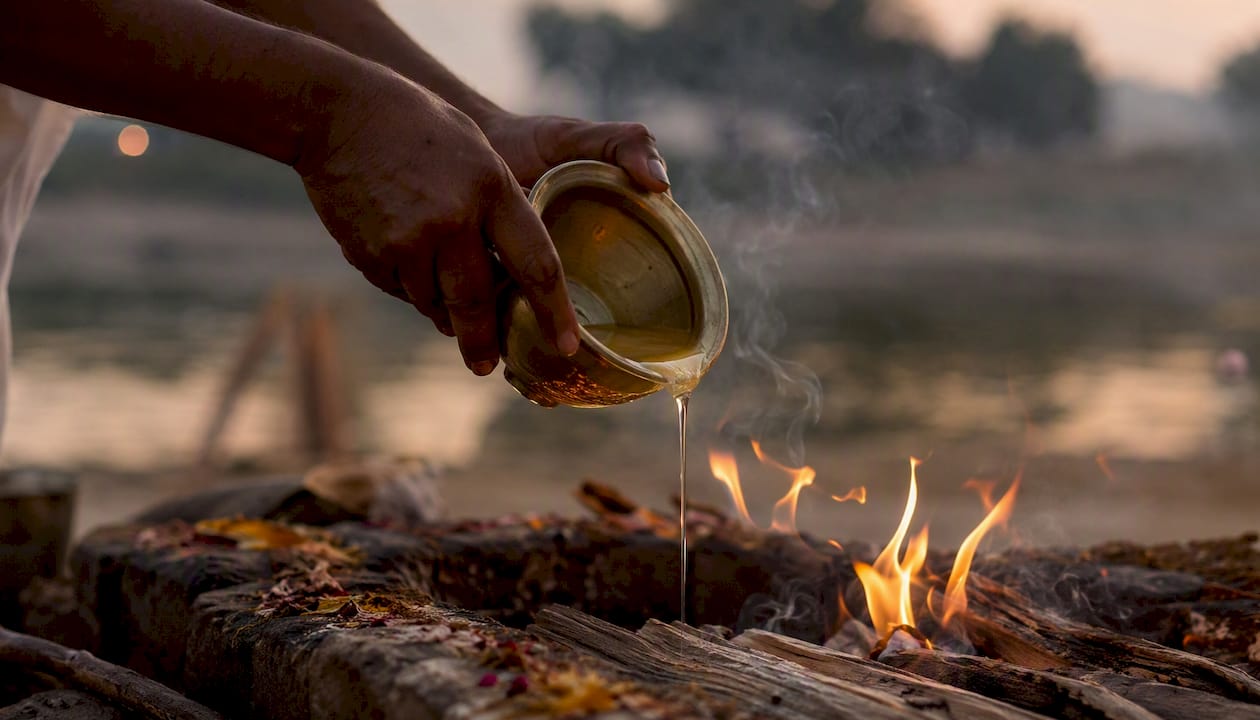
Camphor intensifies the flame and burns without residue, which is why it symbolizes the complete dissolution of the ego and the physical self. Nothing remains after camphor burns, making it a fitting metaphor for the soul's release from the body.
Sesame seeds (til) are considered protective and purifying. They appear in tarpanam (water offerings to ancestors) and are placed with the body because traditional belief holds that til repels negative energies and aids the soul's safe passage.
Pind (rice balls) are the primary offering to nourish the soul during its transition. Families prepare pind from cooked rice, sesame, and sometimes barley, shaping them into small balls offered at each stage of the post-cremation rites.
Gangajal carries the sanctity of the Ganges River. Sprinkling it on the body and mixing it into ritual water is understood as purifying the deceased and preparing the Atman for its journey. In the United States, small bottles of Gangajal are available at many Hindu temples and Indian grocery stores.
Sandalwood (chandan) is anointed on the body for its cooling, purifying properties and its association with divine worship. Its fragrance is considered pleasing to the divine and respectful to the deceased.
Pro Tip: When explaining the significance of these items to non-Hindu attendees or younger family members, a brief, written one-page summary prepared with your Pandit's help can prevent confusion and allow everyone to participate with understanding and respect. Ask your funeral director if they can provide or help prepare such a summary.
What do U.S. families need to know about logistics and legal requirements?
The immediate action items for families in the United States: obtain the death certificate, contact the crematorium to confirm what materials are permitted inside the chamber, and reach out to a Pandit or Hindu funeral home experienced with Antyesti rites.
Key logistics to handle quickly:
- Death certificate. Required before any cremation can proceed. The attending physician or medical examiner signs it; the funeral home typically files it with the state.
- Cremation permit. Most U.S. states require a separate cremation authorization permit. The funeral home handles this, but families should confirm the timeline, as it can add 24–48 hours.
- Crematorium policies on ritual items. Electric cremation chambers, which are standard at most U.S. crematoria, have restrictions. Many permit small offerings such as the foil-wrapped havan plate, flowers, and a small amount of ghee placed on the body, but prohibit large quantities of flammable liquids, wood pieces, or metal objects. Confirm in writing what is allowed before the ceremony.
- Transport documentation. If the body is transported across state lines, additional permits are required. Your funeral home coordinates this.
- Ash immersion (asthi visarjan). U.S. federal law (the Marine Protection, Research, and Sanctuaries Act) permits scattering cremated remains at sea at least three nautical miles from shore. Many states also permit scattering in rivers or lakes under specific conditions. Check your state's environmental agency rules before choosing a location.
Electric cremation vs. open pyre: The most significant practical difference is that the havan kund and large wood offerings cannot be used inside an electric chamber. Families typically perform the havan and symbolic fire-lighting with a diya outside the chamber before the body is placed inside. The foil-wrapped earthen plate on the chest is generally permitted and travels with the body into the chamber.
Questions to ask your funeral director or Pandit:
- Which ritual items does your crematorium permit inside the electric chamber?
- Can the family be present for the symbolic flame-lighting before the chamber closes?
- When can we collect the ashes, and in what form will they be returned?
Pro Tip: Choose a funeral home that has direct experience with Hindu Antyesti rites. Ask specifically whether they have worked with a Pandit before and whether they can coordinate ash collection timing to align with the day-3 tradition. A funeral director unfamiliar with these customs may inadvertently schedule ash return in a way that disrupts the ritual sequence.
Note: State and local rules for cremation permits and ash dispersion vary. Confirm current requirements with your crematorium and local authorities before making arrangements.
How do regional and sect differences change the components list?
The single most impactful variables in the antyesti ritual essentials are the family's regional tradition (broadly, North Indian vs. South Indian customs) and their sect affiliation (Shaivite, Vaishnavite, or other).
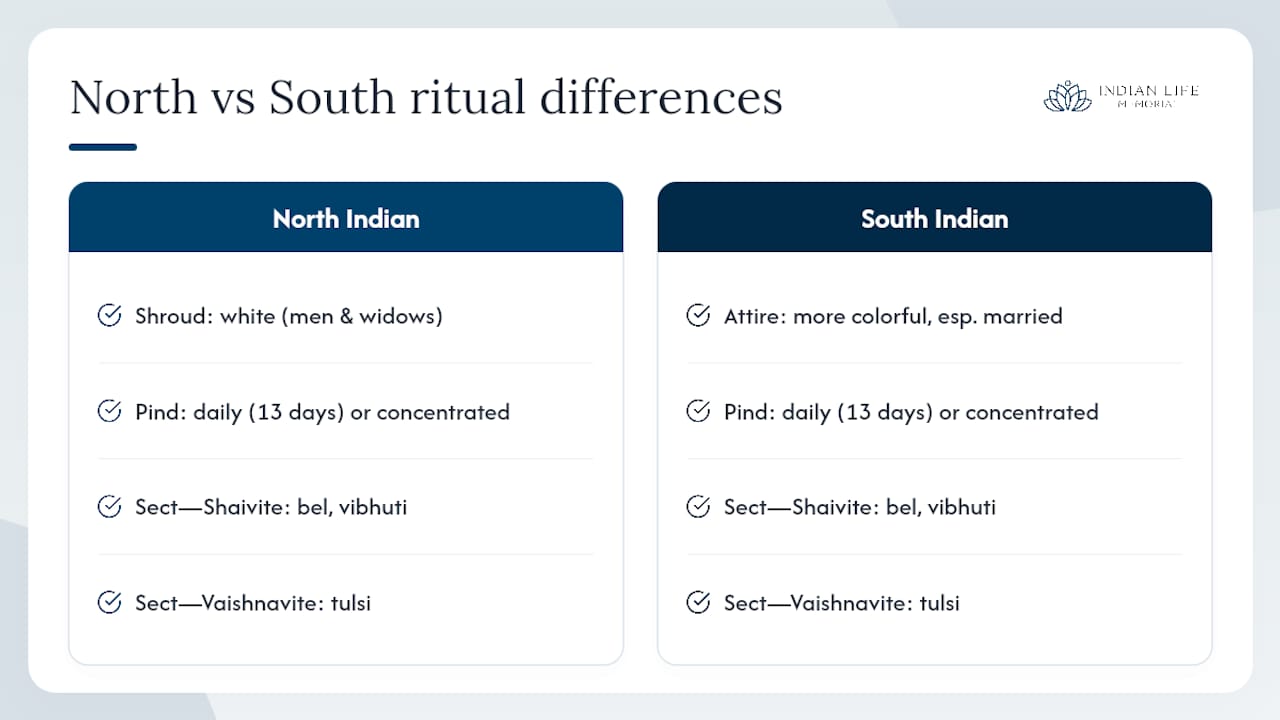
North Indian traditions typically use a white shroud for men and widows, while South Indian customs may dress the deceased in more colorful attire, particularly for married women. The quantity and composition of pind offerings also differ: some communities prepare pind on each of the 13 days of mourning, while others concentrate offerings on specific days.
Shaivite families often incorporate additional items associated with Shiva worship, such as bel (bilva) leaves and vibhuti (sacred ash), while Vaishnavite families may emphasize tulsi leaves and specific Vishnu-related offerings. Neither set of additions replaces the core saamagri; they supplement it.
Burial, rather than cremation, is practiced in some communities, particularly for saints, young children, and certain tribal or folk traditions. When burial is the chosen form, the pyre-related items (ghee for combustion, camphor, havan plate) are set aside, and the focus shifts to the shroud, flowers, and earth-related offerings.
The practice of anustaraṇi, historically the release of a cow to accompany the soul, has largely been replaced in modern urban and diaspora settings. Families typically substitute a monetary donation to a cow shelter, temple, or charitable organization as a symbolic equivalent.
What happens after the cremation: ash immersion and mourning rites
The immediate post-cremation steps are: collect the ashes on or around day 3, store them in a clean clay or copper vessel, plan for immersion (asthi visarjan), and perform pind-daan rites through day 10 or 13.
Post-cremation sequence and materials:
-
Day 1–2: Initial mourning. The family observes mourning at home. A lamp is kept burning. Daily pind offerings begin, using cooked rice, sesame seeds, and water. Black sesame seeds are used specifically in tarpanam, the water offering to ancestors.
-
Day 3: Ash collection (astisanchayan). Family members return to the cremation site or receive the ashes from the funeral home. Ashes are collected using copper or brass vessels and transferred to a clay pot. The pot is sealed with a cloth and kept in a clean, elevated place.
-
Days 4–10 or 4–13: Pind-daan and tarpanam. Daily offerings of pind (rice balls with sesame and water) are made. Black sesame seeds are placed in the water used for tarpanam. Some families observe a 10-day cycle; others follow the full 13-day sequence. The Pandit guides the specific schedule.
-
Day 10–13: Shraddha and final rites. A more formal shraddha ceremony is performed, often with additional food offerings and donations (daan) to the priest and to the poor. This marks the formal close of the primary mourning period.
-
Asthi visarjan (immersion of ashes). Ideally performed in a sacred river such as the Ganges. For families in the United States, practical options include: traveling to India for immersion, immersing ashes in a local river or the ocean under applicable state and federal rules, participating in a temple-organized immersion ceremony, or using a professional service that arranges overseas dispersal of ashes. Many Hindu temples in the United States can advise on locally permitted immersion sites.
Approaching these preparations with care and compassion
The most important thing your family can do right now is speak clearly with your elders and your Pandit before purchasing a single item. The components list in this article reflects the broad consensus across Hindu traditions, but the details that matter most to your family, which shroud color, which pind schedule, which regional prayers, live in the memory of the people who have performed these rites before.
Grief makes logistics feel impossible. Delegate the shopping list to a trusted family friend or community member who is not in the immediate circle of grief. Ask your funeral director whether they can source or confirm the availability of key saamagri items in advance. Inform attendees, especially those unfamiliar with Antyesti, about what they will witness so that the ceremony can proceed without confusion or distress.
Indianlifememorial's team of experienced Pandits and funeral coordinators is available to guide families through every stage of the Antyesti process, from assembling the correct saamagri to coordinating the post-cremation rites. The goal is always the same: to honor your loved one with the full dignity of the tradition, without adding unnecessary burden to your family during an already difficult time.

If your family needs professional support for Hindu funeral arrangements, Indianlifememorial's full-suite Hindu funeral services include experienced Pandits, culturally correct saamagri coordination, and compassionate guidance at every step.
Useful sources and references
The following sources informed this article and are worth consulting directly for additional detail:
- Final Rites: Antyeshti (Hindu Speakers PDF) — A practical ritual manual listing the full saamagri checklist with sample quantities, including less obvious items such as the foil-wrapped havan plate and clean-up supplies. Useful for families who want a printed checklist to bring to the ceremony.