
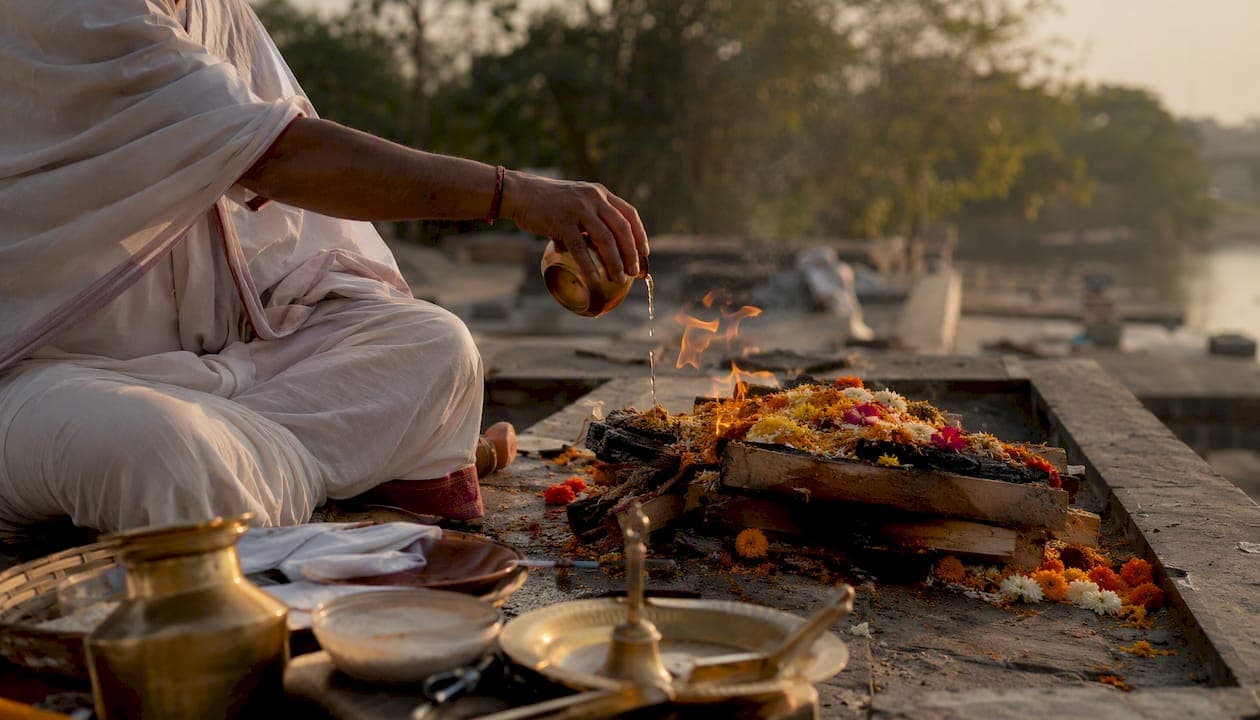
Hindu post-cremation rites are a time-bound sequence of rituals, rooted in the concept of Antyeṣṭi, performed to honor the dead, assist the soul's transition, and support the grieving family. These rites unfold in a specific order, and understanding that order helps a family arrange each step with confidence rather than confusion.
The canonical sequence, drawn from texts like the Garuda Purāṇa and reflected in the Bhagavad Gītā's teachings on the soul's journey, generally moves through these stages:
- Body preparation — washing, anointing, dressing, and placing sacred items before cremation.
- The cremation ceremony — Antyeṣṭi itself, the "last sacrifice," where the body is consigned to fire.
- Ash and bone collection (asthi-sanchaya) — usually one to three days after cremation.
- Immediate purification — bathing, mantras, and the start of ashaucha (ritual impurity).
- The 10 to 13 day mourning period — daily pinda offerings and ceremonies leading to Sapindikarana.
- Ash immersion (asthi-visarjana) — in flowing water, sometimes delayed for logistical reasons.
- Śrāddha and Pitru Paksha — annual and periodic ancestor remembrance rites.
Each stage carries its own purpose and its own set of hands. Knowing what happens at each point, and why, is what turns an overwhelming week into a manageable, meaningful one.
Key Takeaways
Hindu post-cremation rites follow a fixed spiritual sequence from Antyeṣṭi through Sapindikarana, but shastric tradition allows real flexibility for modern circumstances and delayed timing.
| Point | Details |
|---|---|
| Antyeṣṭi is the starting point | The final saṃskāra consigns the body to fire as an offering to Agni, marking the soul's transition. |
| The 13-day window matters most | Daily pinda offerings from day 1 through Sapindikarana around day 12 or 13 guide the soul from preta to ancestor. |
| Electric crematoria are valid | Priests widely accept adapted rites like symbolic kapala-kriya when the core fire offering is preserved. |
| Ash immersion can wait | Asthi-visarjana is often delayed or handled through repatriation without compromising the rite. |
| Indianlifememorial coordinates the full sequence | Fixed pricing from $1,888 and experienced Hindu priests handle rites, permits, and crematorium logistics together. |
Table of Contents
- Why These Hindu Post Cremation Rites Exist
- What Happens Before Cremation: Preparing the Body
- How Does the Cremation Ceremony Actually Work?
- What Happens Right After Cremation?
- What Happens Each Day During the 13-Day Mourning Period?
- Śrāddha, Pitru Paksha, and Yearly Ancestor Rites
- How Do Regional and Modern Variations Change These Rites?
- Practical Checklist for Arranging Post-Cremation Rites
- What Conventional Guides Get Wrong About These Rites
- Arranging These Rites With Support That Understands Them
- Frequently Asked Questions
Why These Hindu Post Cremation Rites Exist
The core purpose of Antyeṣṭi and everything that follows is twofold: helping the soul (ātman) complete its transition, and helping the living family move through grief with structure instead of chaos. Neither goal works without the other.
Classical Hindu thought treats death as a transition, not an ending. The Bhagavad Gītā describes the soul as eternal, discarding the body the way a person changes worn-out clothes. The Garuda Purāṇa builds on this idea with a more detailed map: it describes an intermediate stage where the departed exists as a preta, a transitional being that has not yet joined the ancestors (pitrs). The rites performed over the following days, particularly pinda-dāna (rice-ball offerings) and Sapindikarana, are what shastric tradition holds necessary to move the soul out of that in-between state.
The final saṃskāra is really two rites folded into one: the disposal of the physical body, and a structured sequence of ceremonies over the following days meant to assist the departed's transition while giving the family a defined way to grieve.
The social and psychological side matters just as much as the theological one. A death in the family creates a vacuum, and Hindu mourning customs fill it with obligation, ritual, and community presence. Relatives gather. Neighbors bring food. The kartha (chief mourner) has a job to do every single day for nearly two weeks, which sounds exhausting but often functions as a form of built-in grief processing. There's less room to spiral when you have a pinda to prepare at sunrise. Reading about the karma and afterlife beliefs that underpin these rites can help families understand why each act matters, not just how to perform it.
What Happens Before Cremation: Preparing the Body
The key tasks before cremation are washing and anointing the body, dressing it appropriately, applying tilak, and tying the big toes together, all completed as close to the cremation time as local custom and logistics allow.
Traditionally, Hindu cremations happen within 24 hours of death, a practice rooted partly in climate and partly in the belief that prolonged attachment to the body delays the soul's release. Modern life, especially when family members are flying in from abroad, often stretches that window. Funeral homes experienced in Hindu and Indian rites can hold the body appropriately while relatives gather, without abandoning the spirit of the custom.
- Washing and anointing — the body is bathed, often with a mixture that may include water, milk, or sandalwood paste, performed by family members or, when unavailable, by trained funeral staff.
- Dressing — men are typically wrapped in a plain white cloth; married women are often dressed in a saree, sometimes red or one they wore during their wedding, depending on regional custom.
- Applying tilak — a mark placed on the forehead, varying by sect (Vaishnava, Shaivite, or Shakta traditions each use distinct markings).
- Placing sacred items — a Tulsi leaf or grains of rice may be placed in the mouth; a nose ring or other personal item might be left, depending on family tradition.
- Tying the toes together — a practical and symbolic step said to keep the body composed for its final journey.
- Final viewing and procession preparation — the body is placed on a bier or in a coffin, ready to be carried, feet-first, toward the cremation ground or crematorium.
The eldest son, or a designated kartha, traditionally leads these rites and performs the central acts at cremation, including circling the pyre and lighting it. Priests (pandits) usually guide the mantras and confirm each step follows the correct order. Women's involvement varies significantly by region and community. Some families welcome daughters and wives into every stage; others, following more conservative custom, keep women from the immediate cremation ground while including them fully in the days that follow. Our guide on the role of women in Hindu funeral rites covers this variation in more depth.
When the kartha cannot be physically present, whether stuck overseas or unable to travel in time, a priest can guide a designated relative through the same responsibilities, or in some cases perform the rites on the family's behalf with the kartha participating remotely through prayer.
Pro Tip: Ask your funeral provider whether they can coordinate timing with overseas relatives before finalizing the cremation slot. A one or two-hour delay to let a son or daughter land and change clothes is almost always workable and preserves the ritual's integrity far better than rushing it.
How Does the Cremation Ceremony Actually Work?
The cremation itself is the final saṃskāra, the act of consigning the body to fire as an offering to Agni, the fire deity who is believed to carry the body's elements back to their source while releasing the soul for its onward journey.
The ceremony follows a fairly consistent order, whether it happens at an open-air cremation ground or a modern electric facility. The body is carried in procession, usually by male relatives, chanting mantras or the name of a deity along the way. At the cremation site, the body is placed on the pyre or moved into the cremation chamber. A priest invokes Agni through mantras, and the kartha offers ghee (clarified butter), which is meant to purify and consecrate the offering.
One of the more solemn moments is kapala-kriya, sometimes called the "skull-breaking" rite, traditionally performed with a bamboo stick struck against the skull midway through cremation to symbolically release the soul from any remaining attachment to the body. This act is deeply significant in the traditional open-pyre setting; in electric crematoria, it's typically replaced with a symbolic gesture or omitted with the priest's guidance, since the body isn't accessible mid-cremation the same way.
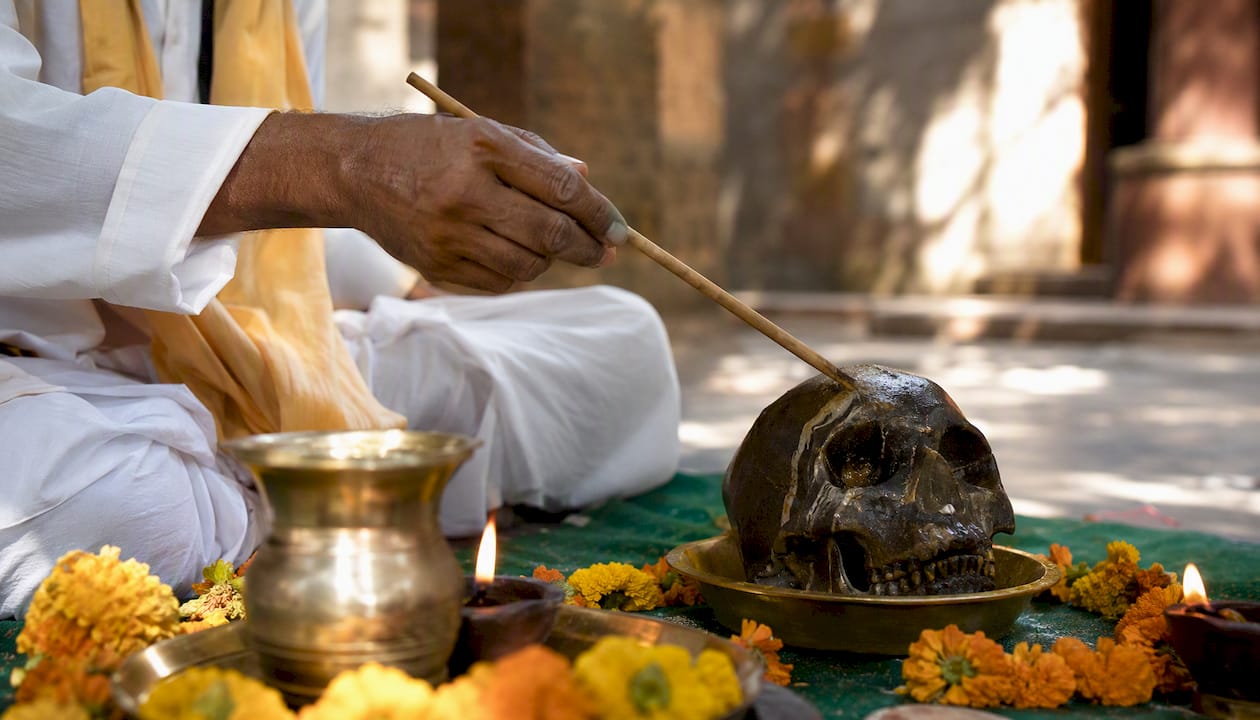
Immediately after, the kartha and close relatives take a purificatory bath, marking the start of ashaucha, the period of ritual impurity that governs behavior for the days ahead.
Traditional pyre versus electric cremation
| Aspect | Open-air wood pyre | Electric or gas crematorium |
|---|---|---|
| Fuel or medium | Wood, ghee, and sandalwood offerings | Electric heating elements or gas flame |
| Ritual acceptability | Considered the classical form described in ancient texts | Widely accepted by contemporary priests as valid when core rites are preserved |
| Kapala-kriya | Performed directly on the body mid-cremation | Usually adapted into a symbolic gesture, or performed before the chamber is sealed |
| Typical availability | Rare in urban settings, more common in parts of India | Standard in cities and required by law in many countries, including Singapore |
| Family role during rite | Full physical proximity throughout | Family completes rites at the chamber entrance, then waits during processing |
Neither format changes the theological outcome. A full-suite funeral arrangement with an experienced Hindu priest ensures the adapted steps still follow scriptural order rather than being skipped altogether.
What Happens Right After Cremation?
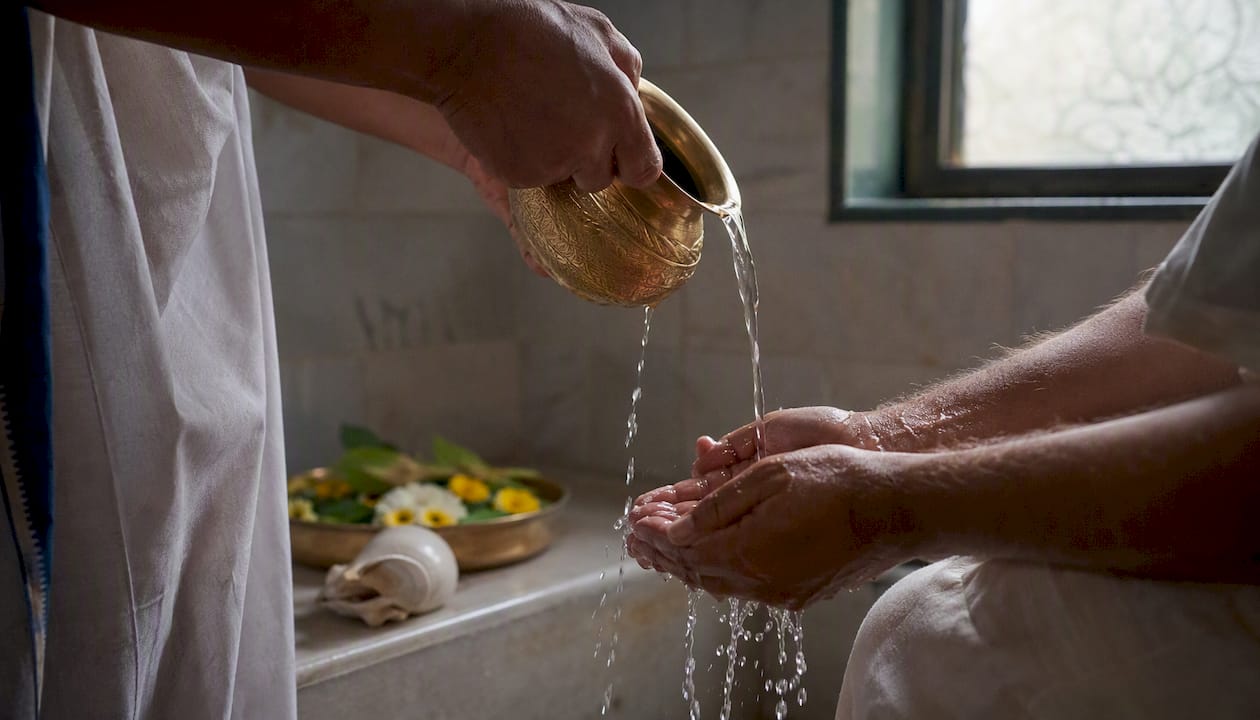
The first actions after cremation are collecting the asthi (bones and ash), taking a purificatory bath, and beginning the earliest offerings that mark the start of the mourning period proper.
Asthi-sanchaya, the collection of bone fragments and ashes, typically happens one to three days after cremation, once the remains have cooled. In many traditions, this task falls to the same close male relatives who performed the cremation. The collected asthi is placed in an urn and kept until asthi-visarjana, the immersion in flowing water such as a river or the sea, which shastric tradition treats as the final release of the physical remains back to the elements.
Modern diaspora practice often separates the timing of cremation and asthi-visarjana. Cremation happens locally, while immersion or repatriation of the ashes can occur weeks or months later, and ritual compensations for that delay are accepted within shastric practice.
That's a meaningful point for families living outside India. If flying to a sacred river isn't realistic right away, tradition doesn't demand it happen instantly. Ashes can be respectfully kept, and immersion arranged when travel is feasible, without compromising the rite's validity.
Two terms come up constantly in this window:
Niravapañjali refers to the offering of water and sesame seeds made at the cremation site or shortly after, an early gesture of respect toward the departed before the more elaborate pinda rites begin.
Tarpana is the broader practice of offering water to ancestors and departed souls, performed by the kartha or officiating priest, and repeated at various points, including later in life during Pitru Paksha.
Formal mourning obligations for the immediate family can extend up to a full year, though the most restrictive phase, ashaucha, generally lasts through the 13-day period. During this stretch, many families avoid temple visits, festive events, and certain foods, while close relatives may skip work commitments to focus on daily rites.
What Happens Each Day During the 13-Day Mourning Period?
The typical mourning window runs with intense daily ritual through day 10 to 13, tapering into lighter, periodic observances that continue for up to a year.
Here's how the days generally break down, though families should expect some regional and sectarian variation:
| Day | Typical ceremony | Purpose |
|---|---|---|
| Day 1 | Cremation (Antyeṣṭi) | Consigns the body to fire, begins ashaucha |
| Day 2–3 | Asthi-sanchaya | Collection of bones and ashes for later immersion |
| Days 1–10 | Daily pinda offerings | Rice-ball offerings sustain the preta through its transitional stage |
| Day 10 or 11 | Ekoddishta shraddha | A dedicated rite marking the soul's continued journey, sometimes combined with hair-shaving for the chief mourner |
| Day 12–13 | Sapindikarana (Terahvin) | Formally unites the departed with the ancestors; the pivotal closing rite |
| Day 16 (some traditions) | Additional shraddha | Observed in certain regional and sectarian customs as a final closing rite |
| Annually thereafter | Śrāddha | Yearly remembrance tied to the lunar death anniversary |
A few questions come up again and again from families navigating this timeline:
- What happens on day 12? In most traditions, day 12 falls within the Sapindikarana window, sometimes called Terahvin or Pind Sammelan, when the individual pinda offered to the preta is symbolically merged with three pindas representing the father, grandfather, and great-grandfather. This is the ritual moment the soul is considered to formally join the ancestors.
- How long is the soul considered "in transition"? Classical texts frame the preta stage as lasting through the mourning period, generally understood as ending with Sapindikarana around day 12 or 13, after which the departed is addressed as a pitr (ancestor) rather than a preta.
- Why do some days have limited or no puja? Certain days within the 10-day window are reserved purely for pinda offerings without an elaborate ceremony, since the daily rite is cumulative. Each day builds toward Sapindikarana rather than standing as its own independent event.
When timing gets disrupted, whether by international repatriation of the body, visa delays, or a kartha who can't travel immediately, priests can guide families through adjusted schedules. The pinda sequence can be compressed or the kartha can participate by phone or video for portions of the rite, with a local relative or priest completing the physical acts. It's not the ideal, but shastric flexibility exists precisely because families and circumstances have never been uniform.
Śrāddha, Pitru Paksha, and Yearly Ancestor Rites
Śrāddha and Pitru Paksha exist to keep the connection between the living and their ancestors active, through annual remembrance rites and acts of charity performed on a fixed lunar schedule.
Once Sapindikarana concludes the transitional period, the departed is formally counted among the family's pitrs. From that point forward, the primary ritual obligation shifts to annual Śrāddha, performed on the lunar tithi (date) corresponding to the death anniversary each year. The core acts remain consistent: pinda-dāna (offering rice balls), tarpana (water offerings), and feeding brahmins or members of the community in the departed's honor.
Sapindikarana marks the change from offering pindas to an individual preta to offerings made to the broader class of ancestors, a shift that redefines how the family relates to the departed from that point forward.
Pitru Paksha, a 16-day period each year (typically in the lunar month of Bhadrapada), is when many Hindu families perform Śrāddha for all ancestors collectively, not just the most recently departed. It's treated as an especially auspicious window for tarpana and charitable giving, and many families who can't observe individual anniversaries precisely will still make an effort during Pitru Paksha.
Families living outside India often adapt who performs these rites and how. A priest local to Singapore or another diaspora community can conduct Śrāddha with the same scriptural accuracy as one in Varanasi; what matters is the correct lunar timing and the presence of an officiant who knows the liturgy. Our guide to Hindu death anniversary traditions walks through how families typically organize this yearly observance.
How Do Regional and Modern Variations Change These Rites?
Hindu post-cremation practices vary considerably by region, sampradāya (sectarian tradition), and local law, and none of that variation makes a family's version less authentic.
North Indian communities often favor the 13-day (Terahvin) framework, while some South Indian traditions compress certain rites into a 10 or 11-day sequence, or extend to 16 days depending on caste and community custom. Sectarian differences show up in the specific mantras used, whether a priest from a particular tradition is required, and how strictly certain food or clothing restrictions are observed during ashaucha. None of this reflects disagreement about what matters, just different liturgical lineages arriving at the same destination by different paths.
Modern crematoria have reshaped several practical elements. Electric and gas cremation is now standard in most cities, including Singapore, where open-pyre cremation isn't legally practiced. Priests experienced in Hindu and Indian funeral customs have adapted rites like kapala-kriya into forms compatible with sealed chambers, without abandoning their symbolic core. Remote participation by a kartha overseas, delayed asthi-visarjana, and even symbolic rites when a body is unrecoverable (in accident or disaster situations) are all accepted under shastric flexibility, guided by a knowledgeable priest.
Practical adaptations exist for diaspora families: modern crematoria are widely accepted as valid for Antyeṣṭi when the basic rite of consigning the body to fire is preserved, and immersion or repatriation of ashes can happen on a delayed timeline.
Pro Tip: If your kartha is overseas and can't arrive before local cremation rules force a decision, ask the priest to record or video the invocation portion of the ceremony so the kartha can review or participate in real time. It won't replace physical presence, but it preserves a sense of direct participation that matters more to grieving families than logistics alone would suggest.
Practical Checklist for Arranging Post-Cremation Rites
What a family needs to arrange right away includes the death certificate and cremation permit, a priest familiar with the correct sequence of rites, transport for the remains, and a plan for eventual ash immersion.
Getting these pieces in place early removes most of the stress that otherwise builds up in the first 48 hours after a death.
- Secure the death certificate from the attending physician or hospital, required before any cremation permit can be issued.
- Obtain the cremation permit through the relevant local authority or through your funeral provider, who typically handles this on the family's behalf.
- Confirm the crematorium slot and ask whether the facility accommodates Hindu rites, including space for a priest and family to perform invocations before the chamber is sealed.
- Arrange a priest experienced specifically in Hindu and Indian funeral rites, not a generalist, since mantra sequence and regional custom vary.
- Gather ritual items: white cloth, ghee, sandalwood, flowers, a Tulsi leaf, and any sect-specific items your priest recommends.
- Identify the kartha and confirm their availability, or arrange a backup relative if travel is delayed.
- Plan asthi handling: decide whether immersion will happen locally, be delayed, or involve repatriation to India.
- Notify extended family and community so pinda offerings and daily attendance can be coordinated for the following 10 to 13 days.
Questions worth asking a priest or funeral provider directly: What is the exact sequence of rites you'll perform, and by what scriptural names? How will kapala-kriya be handled given the crematorium's format? What happens to the asthi if we can't immerse them locally? Are there permissible substitutes if a specific ritual item isn't available?
Pro Tip: Most crematoria have strict scheduling windows. Ask your priest in advance which rites can be compressed into the time allotted at the facility, and which ones can be completed afterward at home or a temple. This keeps the ceremony from feeling rushed at the one moment families most want to slow down.
Cost and service structure matter too, particularly for families making arrangements under time pressure. Understanding the difference between funeral tiers available to Hindu and Indian families helps you choose a package that includes the right priest support without paying for elements you don't need.
What Conventional Guides Get Wrong About These Rites
Most explanations of Hindu post-cremation rites treat the 13-day sequence as a rigid checklist, when the deeper truth is that shastric tradition has always built in flexibility for disrupted timing, absent karthas, and adapted settings.
That flexibility gets underplayed constantly, and it does families a disservice. I've seen the anxiety it creates firsthand in how often people ask whether a delayed flight or an electric crematorium somehow invalidates what they're doing. It doesn't. The texts themselves, through concepts like ritual compensation for delayed rites, anticipate that life doesn't always cooperate with a fixed calendar. What actually matters is intention, correct sequence where possible, and a priest who understands both the classical framework and how to adapt it honestly.
Where families go wrong isn't in missing a day or adjusting a ritual for modern circumstances. It's in skipping the guidance of someone who actually knows the difference between an adaptation and an omission. A priest who can tell you why kapala-kriya changes shape in an electric crematorium, but insists the invocation of Agni still happens correctly, is worth more than any generic checklist. Prioritize finding that person first. Everything else, timing, logistics, even which day Sapindikarana falls on, can be built around a priest who genuinely understands the sequence rather than reciting it by rote.
Arranging These Rites With Support That Understands Them
Indianlifememorial exists for exactly the situation this article walks through: a family that needs the sequence done correctly, without having to become ritual experts overnight. Unlike piecing together a priest, a crematorium slot, and permit paperwork on your own during the hardest week of your life, our team coordinates all of it under one roof, with experienced Hindu priests who know how kapala-kriya, pinda offerings, and Sapindikarana adapt across regional traditions.

Every arrangement starts at a transparent $1,888, with no hidden fees added later, so a grieving family can focus on the rites themselves instead of negotiating costs mid-process. Our Hindu and Indian rites service covers everything from body preparation through the 13-day ceremonies, and our team is reachable 24/7 for families who need to move quickly. If you're weighing your options, take a look at our available packages or reach out directly to arrange a priest and crematorium slot that respects both the tradition and your timeline.
Frequently Asked Questions
What are Hindu post-cremation rites? They are the structured sequence of rituals that follow Antyeṣṭi (the cremation ceremony), including ash collection, daily pinda offerings, and Sapindikarana performed over roughly 10 to 13 days to assist the soul's transition and support the grieving family.
How long do Hindu mourning rites typically last? The most intensive phase runs through day 10 to 13, culminating in Sapindikarana. Formal mourning restrictions for close family can extend up to a year, with annual Śrāddha continuing indefinitely afterward.
Can Hindu post-cremation rites be performed with an electric crematorium? Yes. Most contemporary priests consider electric or gas cremation valid for Antyeṣṭi as long as the core fire offering and invocations are preserved, with certain acts like kapala-kriya adapted into symbolic form.
What happens if the eldest son or kartha cannot attend the cremation? A designated relative can perform the physical rites under a priest's guidance, while the kartha participates remotely through prayer or, in some arrangements, by video during key invocations.
Why is ash immersion sometimes delayed? Shastric tradition accepts delayed asthi-visarjana when travel to a suitable body of water, or repatriation to India, isn't immediately feasible. The ashes can be respectfully kept until logistics allow immersion.
What is Sapindikarana and why does it matter? Sapindikarana is the rite, usually performed around day 12 or 13, that formally merges the departed's individual offering with those made to the ancestors, marking the shift from preta to pitr status.
This article provides general cultural and religious information and isn't a substitute for personalized guidance from a qualified priest or funeral professional familiar with your family's specific tradition and local requirements.