
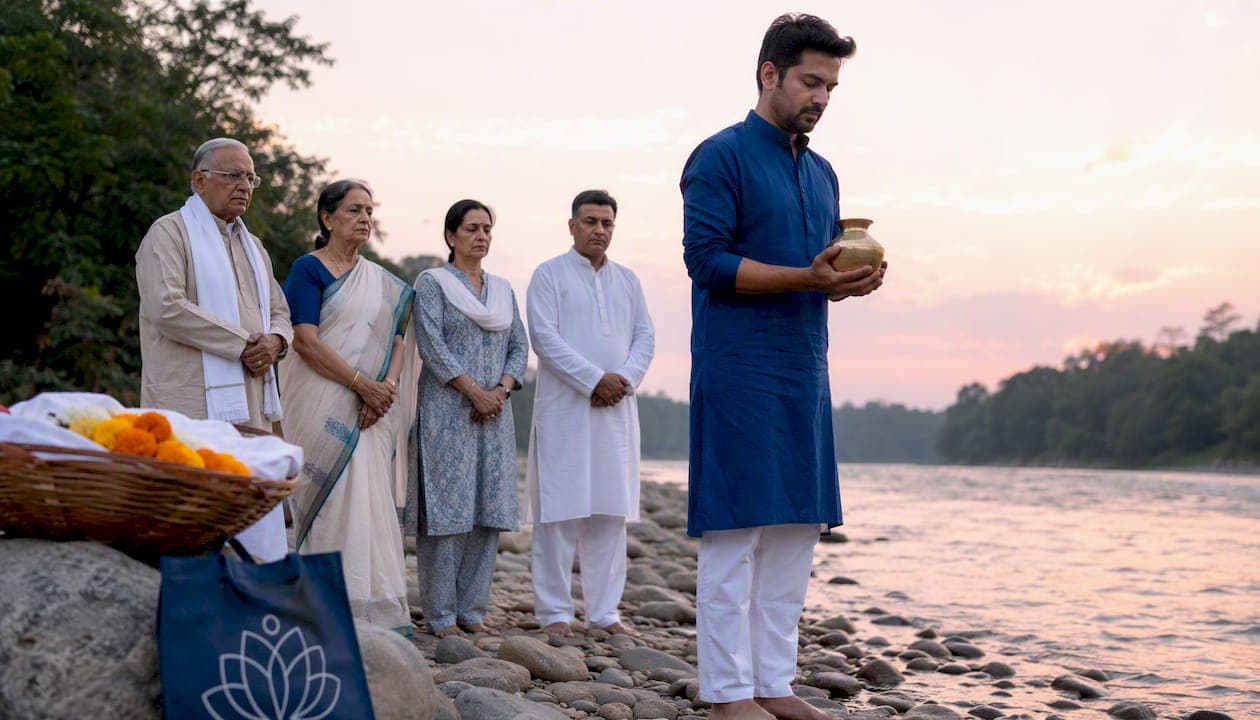
Asthi Visarjan is the Hindu ritual of immersing cremated remains — ashes and remaining bone fragments — in flowing sacred water to complete Antim Sanskar and assist the soul toward moksha. It is the final act of Antyesti, the last rite of passage, and one of the most spiritually significant moments in the Hindu funeral tradition.
Here is what you need to know at a glance:
- When it is done: The immersion is typically performed within 3–13 days after cremation, though family circumstances and logistics can affect the timing.
- Who performs it: The karta (primary mourner, usually the eldest son or closest male relative) carries out the immersion while a pandit chants Vedic mantras.
- For families in the United States: Local flowing rivers, sea scattering, temple-managed rituals, or sending ashes to India are all accepted alternatives when travel to the Ganges is not possible.
The sections below cover the spiritual meaning, scriptural grounding, step-by-step procedure, U.S. legal and environmental rules, and practical arrangement guidance for diaspora families.
Table of Contents
- What is the Asthi Visarjan ceremony and why does it matter?
- Scriptural and historical grounding: the Garuda Purana and Antim Sanskar
- Where Asthi Visarjan fits in the Hindu funeral sequence
- What actually happens during an Asthi Visarjan ceremony
- Where are ashes traditionally immersed, and what are the alternatives?
- How to participate respectfully: dress, behavior, and gender roles
- Practical steps for families in the United States
- Legal and environmental rules for ash immersion in the United States
- How Asthi Visarjan supports grief and how you can help
- Key Takeaways
- What the ceremony asks of us, beyond the ritual
- Helpful resources and next steps
What is the Asthi Visarjan ceremony and why does it matter?
Asthi Visarjan, which literally translates to "immersion or release of bones and ashes," is far more than a method of disposing of cremated remains. In Hindu belief, the human body is composed of the Panch Mahabhuta — the five elements of earth, water, fire, air, and space. Cremation returns the body to fire. Asthi Visarjan returns what remains to water and, through it, to the earth and the cycle of creation. The soul, or Atman, is understood to be released from its earthly attachment through this act.
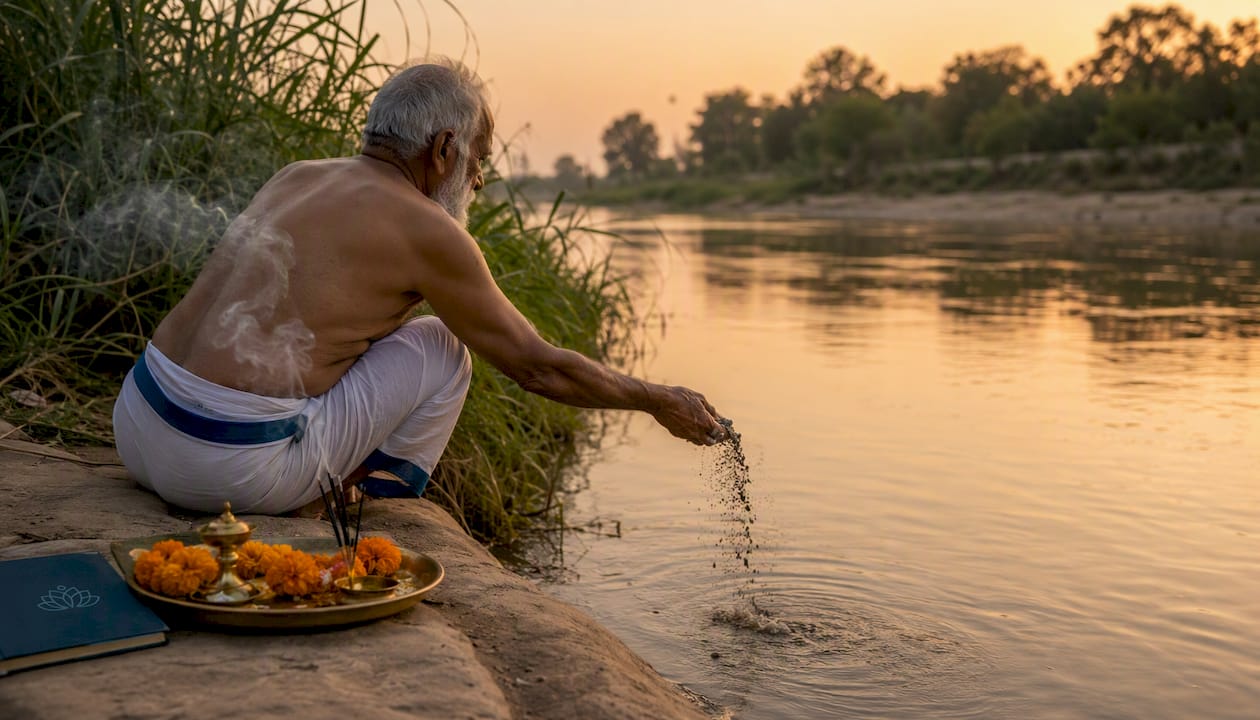
For the family, the ceremony serves a second, equally important purpose: it creates a defined, communal moment of farewell. Grief in Hindu tradition is not meant to be private or suppressed. Gathering at the water's edge, reciting mantras, and releasing the remains together gives mourners a shared threshold to cross. Many families describe the immersion moment as the point at which loss becomes real and healing can begin.
The significance of Asthi Visarjan also extends to the concept of Pitru Loka, the realm of ancestors. Correct performance of the rite is believed to ensure the soul's smooth passage and to honor the bond between the living and the departed. Understanding karma and afterlife beliefs in Hindu tradition helps clarify why this final act carries such weight.
Scriptural and historical grounding: the Garuda Purana and Antim Sanskar
The Garuda Purana is the primary classical text that describes post-cremation rites in detail. It situates Asthi Visarjan within the broader framework of Antim Sanskar — the final Samskara, or sacred rite of passage — and links the correct performance of these rites to the soul's journey after death. The text describes how the soul's experience in the period immediately following death is shaped by the sincerity and completeness of the funeral rites performed by the family.
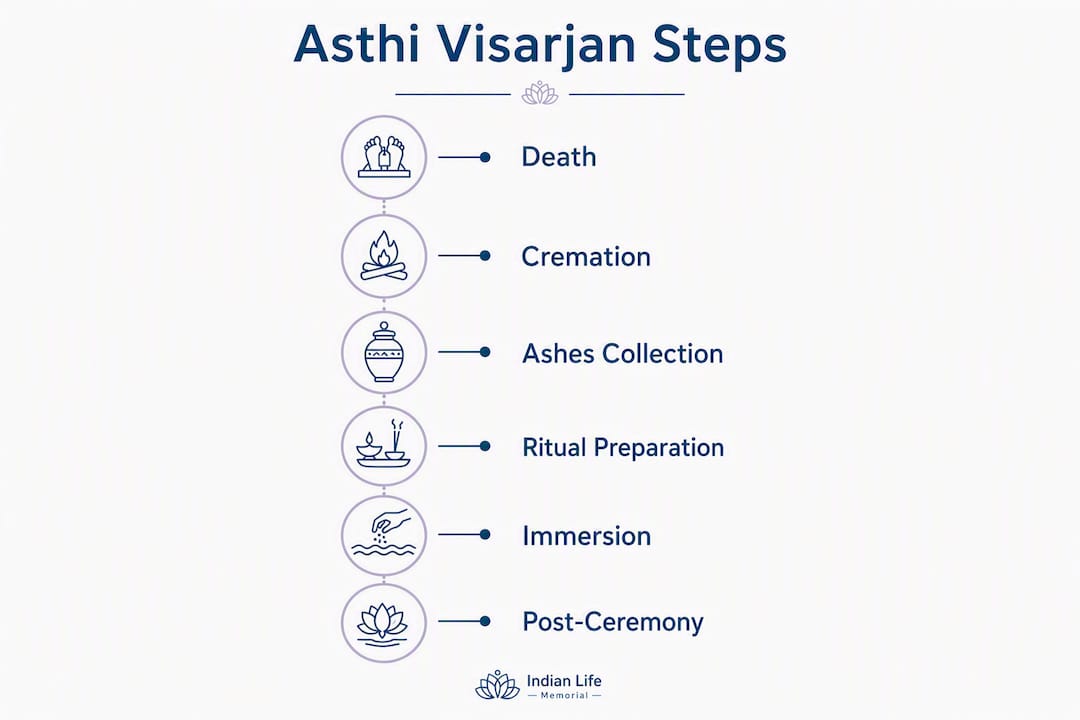
Antim Sanskar encompasses the full sequence of final rites: from the moment of death through the preparation of the body, the cremation itself, and the post-cremation rituals that follow. Asthi Visarjan is the concluding act of this sequence. Without it, the Antim Sanskar is considered incomplete.
Historically, the Ganges River held a singular place in this tradition because of its status as the most sacred river in Hindu cosmology. Ancient pilgrimage routes to Varanasi, Haridwar, and Prayagraj developed specifically to serve families seeking to perform these rites at the most auspicious sites. Over centuries, as the Indian diaspora spread across the world, the practice adapted. Today, authoritative practitioners widely accept that the spirit of the rite — correct mantras, ritual purity, and sincere intention — matters more than the specific geography. That adaptation is not a modern compromise; it reflects the Garuda Purana's own emphasis on the quality of devotion over the location of performance.
Where Asthi Visarjan fits in the Hindu funeral sequence
Understanding the ceremony's place in the larger funeral rites helps families plan with clarity. For a deeper look at the full sequence, the guide on Hindu funeral rites covers each stage in detail.
| Stage | Timing | Who Is Responsible |
|---|---|---|
| Death and body preparation | Immediately after death | Family, funeral director |
| Cremation (Antyesti) | Within a few days where possible | Karta, pandit, funeral home |
| Ash collection (Asthi Sanchayan) | Day after cremation or shortly after | Karta and close male relatives |
| Asthi Visarjan (immersion) | Within 3–13 days after cremation | Karta, guided by pandit |
| Shraddha and mourning rites | Days 1–13 and beyond | Family, pandit |
When the immersion cannot happen within the standard 3–13 day window — due to travel, logistics, or family circumstances — specific compensatory rites are recommended. Tirth Shraddh and Narayan Bali are the most commonly cited remedial rituals, performed to address the delay and restore the completeness of the Antim Sanskar. A qualified pandit can advise your family on which rite applies based on your regional and family tradition.
The karta carries the primary ritual responsibility throughout. In many families, this role falls to the eldest son, though the specific designation varies by regional custom and family structure. The pandit's role is to guide the karta through each step, recite the correct Vedic mantras, and ensure the Sankalp — the formal declaration of intent — is stated correctly using the deceased's name and gotra (ancestral lineage).
What actually happens during an Asthi Visarjan ceremony
The ceremony follows a clear sequence. Knowing each step in advance helps the karta and family prepare both practically and emotionally.
The step-by-step process
- Ash collection (Asthi Sanchayan): Unburnt bone fragments and ashes are carefully collected from the cremation pyre, usually the day after cremation. The karta performs this with reverence.
- Purification: The collected remains are washed with milk and Ganga jal (Ganges water) if available. This purification step is a standard practitioner requirement.
- Placement in the kalash: The purified ashes are placed in an earthen pot (kalash) or wrapped in natural, biodegradable cloth. The kalash must not touch the ground during the procession — this is a frequently cited ritual requirement.
- Procession to the water: The family proceeds to the chosen water body — a sacred river, local flowing river, or the sea. The mood is solemn and focused.
- Sankalp: The pandit leads the karta in reciting the Sankalp, a formal declaration of intent that includes the deceased's name, gotra, and the purpose of the rite. This step anchors the ritual spiritually.
- Mantra recitation: The pandit chants the prescribed Vedic mantras. The karta and family listen and participate as directed.
- Immersion: The karta wades into the water or stands at the ghat's edge and releases the ashes and bone fragments into the flowing water. Flowers and natural offerings may accompany the release.
- Closing prayers: The pandit leads closing prayers and the family observes a moment of silence or collective prayer before departing.
Materials checklist
- Earthen pot (kalash) or biodegradable cloth bag
- Milk and Ganga jal for purification
- Natural flowers (marigold or white flowers are traditional)
- Incense sticks
- Sesame seeds (til) and other offerings as directed by the pandit
- Pandit's dakshina (offering/fee) and puja materials
Pro Tip: Prepare for the immersion moment to be more emotionally intense than expected. Many families find the act of releasing the remains into the water unexpectedly overwhelming. Ask a trusted family member or friend to stand beside the karta as quiet support — not to intervene, but simply to be present.
Where are ashes traditionally immersed, and what are the alternatives?
The Ganges River holds the highest spiritual status for Asthi Visarjan. The ghats at Varanasi, Haridwar, and Prayagraj — where the Ganges, Yamuna, and the mythical Saraswati converge at the Triveni Sangam — have served as immersion sites for centuries. Gaya, in Bihar, is also considered especially sacred because of its association with ancestral rites (Pitru Tarpan). Families who can travel to these sites often feel the journey itself is part of the mourning and healing process.
For families in the United States and across the Indian diaspora, travel to India is not always possible within the recommended timeframe. The table below outlines the main options.
| Option | Spiritual Acceptability | Practical Notes |
|---|---|---|
| Ganges at Varanasi, Haridwar, or Prayagraj | Highest traditional status | Requires travel to India; local pandits available at ghats |
| Other sacred rivers in India (Godavari, Krishna, Kaveri) | Widely accepted | Regional tradition may favor specific rivers |
| Local flowing river (U.S.) | Accepted with correct mantras | Check state and local water-body regulations first |
| Sea scattering (U.S. coast) | Accepted with correct mantras | Charter services available; EPA rules apply |
| Temple-managed immersion ritual | Accepted | Many U.S. Hindu temples offer guided ceremonies |
| Sending ashes to India for immersion | Fully traditional | Requires proper documentation and a trusted representative |
Authoritative practitioners consistently affirm that when travel to India is not feasible, immersion in local flowing water with correct Vedic mantras and ritual purity is spiritually valid. The unique needs of diaspora families around these decisions are worth understanding before you plan.
How to participate respectfully: dress, behavior, and gender roles
Attending or performing Asthi Visarjan calls for a specific kind of presence — quiet, focused, and free of distraction. The following guidance applies to most community and regional traditions, though your family's pandit is the final authority on any custom specific to your lineage.
Dress and behavior:
- Wear simple, modest clothing. White is the traditional color for Hindu mourners and is widely appropriate.
- Avoid bright colors, patterns, or festive attire.
- Remove footwear before entering the ghat area or any sacred water space.
- Keep mobile phones silent and put away. Photography at the water's edge is considered disrespectful in most traditions.
- Speak quietly and avoid unrelated conversation during the ritual.
Gender and family roles:
- The karta is traditionally a male relative, most often the eldest son. However, when no male relative is available or willing, women can and do perform Asthi Visarjan. Many authoritative voices in the Hindu tradition confirm this.
- Regional and family customs vary. Some families follow stricter traditional roles; others are more flexible. Consult your pandit for guidance specific to your tradition.
- Women who are menstruating are traditionally asked to step back from direct ritual participation in some communities, though this varies.
For a thorough discussion of gender roles in Hindu funeral rites, the article on women's roles in Hindu funeral rites addresses this directly. Dress guidance is covered in detail in the Hindu funeral attire guide.
Practical steps for families in the United States
Arranging Asthi Visarjan from within the United States requires coordination across several channels. The process is manageable with the right contacts and a clear sequence of steps.
Who to contact first:
- Your funeral director, to confirm how ashes are stored, transferred, and documented
- Your local Hindu temple, which may offer immersion services or can refer you to a qualified pandit
- A pandit who specializes in Antim Sanskar rites — book early, as experienced priests are in high demand
- A sea-scattering charter service if ocean immersion is your chosen option
Action steps:
- Preserve ashes in a sealed, respectful container until the ceremony is arranged.
- Confirm local regulations for your chosen immersion site (river, lake, or sea).
- Book a pandit and confirm the Sankalp details: the deceased's full name, gotra, and date of cremation.
- Arrange transport for the family to the immersion site.
- Prepare the materials checklist from the step-by-step section above.
- If sending ashes to India, contact the Indian consulate or a repatriation specialist for documentation requirements.
Cost considerations:
Costs vary widely depending on location and choices made. Pandit fees for a full Asthi Visarjan ceremony typically range based on region and the length of the ritual. Sea-scattering charters in the U.S. carry their own fees, as do any required permits. International repatriation of ashes involves shipping, documentation, and receiving-end coordination costs. Indianlifememorial's funeral service packages offer transparent, fixed-price options that include Vedic ceremony coordination, which can simplify planning considerably for families managing these arrangements.
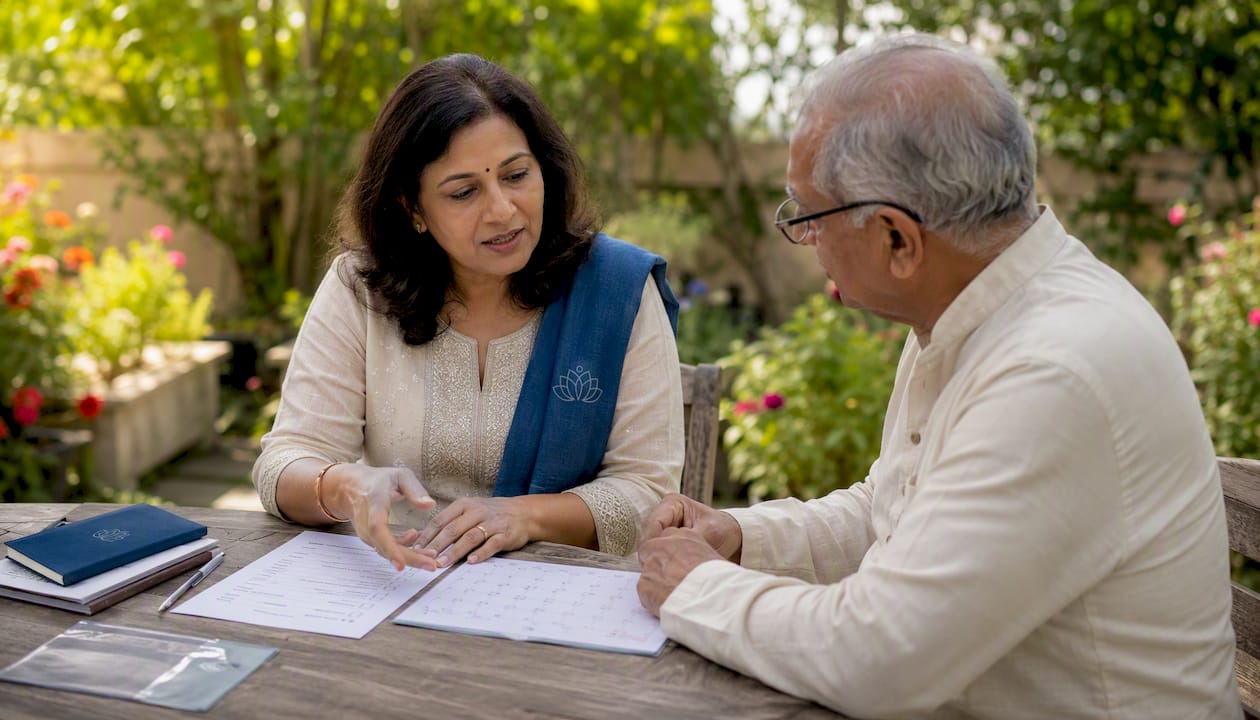
Pro Tip: Book your pandit before finalizing the date and location. Experienced pandits who specialize in end-of-life Vedic rites are often scheduled weeks in advance. Confirming the pandit first lets you build the rest of the logistics around a confirmed ritual time.
Legal and environmental rules for ash immersion in the United States
U.S. law and environmental regulations affect where and how you can scatter or immerse ashes. These rules vary by state, county, and the type of water body involved.
At sea: The U.S. Environmental Protection Agency (EPA) and the U.S. Coast Guard both regulate the scattering of human remains at sea under the Marine Protection, Research, and Sanctuaries Act. Scattering is generally permitted at least three nautical miles from shore. Families must notify the EPA within 30 days of the scattering. Non-biodegradable materials — plastic containers, synthetic flower arrangements, or non-natural offerings — may not be placed in the water.
At rivers and lakes: Fresh-water sites are governed by state and local health departments, as well as any park or recreation authority that manages the specific water body. Some states require a permit; others prohibit ash scattering in certain waterways entirely. Rules change, and enforcement varies by jurisdiction.
Environmental considerations:
- Use only biodegradable containers, natural flowers, and organic offerings at any water site.
- Avoid plastic bags, synthetic garlands, or non-natural materials.
- Check whether the specific site has posted rules about ritual activities or offerings.
Note: This is general information, not legal advice. Confirm current rules with your local health department, the relevant park authority, or a funeral professional before scheduling the ceremony.
Pro Tip: Call the managing authority for your chosen site at least two weeks before the ceremony. Rules at public parks and waterways can change seasonally, and some sites require advance notice or a simple permit that takes only a few days to obtain.
How Asthi Visarjan supports grief and how you can help
The immersion ceremony gives grief a physical form. There is a moment — when the ashes leave the karta's hands and enter the water — that many families describe as the most visceral experience of the entire mourning period. Funeral advisors who work with Hindu families consistently note that this moment arrives with unexpected emotional force, even for those who felt composed throughout the earlier rites.
That intensity is not a problem to be managed. It is the ceremony working as intended: creating a clear threshold between the period of acute loss and the beginning of mourning's longer arc. The ritual's structure — the mantras, the procession, the Sankalp, the release — holds the family through that threshold with purpose and dignity.
For friends and extended family supporting the bereaved, the most useful actions are practical and quiet:
- Offer to handle transport logistics so the karta and immediate family can focus entirely on the ritual.
- Prepare a meal or arrange food for the family's return home.
- Stay available in the days after the ceremony, when the emotional weight often settles more heavily.
- Ask the family whether a follow-up puja or memorial prayer would be welcome, rather than assuming.
Pro Tip: Plan a small, quiet gathering for the family in the hours after the immersion — a shared meal at home, not a formal event. The transition from the water's edge back to ordinary life is abrupt, and a gentle communal space helps mourners process what they have just experienced.
Key Takeaways
Asthi Visarjan completes Antim Sanskar by returning cremated remains to sacred water, and it is spiritually valid anywhere in the world when performed with correct Vedic mantras and sincere intention.
| Point | Details |
|---|---|
| Definition and timing | Immersion of ashes in flowing water, typically within 3–13 days after cremation. |
| Who performs the rite | The karta carries out the immersion; a pandit recites the Vedic mantras and leads the Sankalp. |
| Acceptable alternatives | Local rivers, sea scattering, temple rituals, or sending ashes to India are all spiritually valid options. |
| U.S. legal requirements | Sea scattering requires EPA notification; fresh-water sites need state or local permits — confirm before scheduling. |
| Intention over geography | Correct mantras, ritual purity, and sincere devotion matter more than the specific water body chosen. |
What the ceremony asks of us, beyond the ritual
There is a tendency, especially among diaspora families navigating unfamiliar logistics, to focus so heavily on the procedural correctness of Asthi Visarjan that the deeper purpose gets lost in the planning. The Garuda Purana's emphasis on sincerity is not incidental — it is the point. A ceremony performed at a local river in New Jersey with a qualified pandit, proper mantras, and a family gathered in genuine mourning honors the tradition fully. A rushed immersion at a famous ghat, performed without a Sankalp or with a pandit who does not know the deceased's gotra, does not.
What families in the diaspora often underestimate is how much the ceremony does for the living, not just the departed. The act of gathering, of holding the kalash, of standing at the water's edge together — these create a shared memory that anchors the family's grief in something real and sacred. That anchor matters for months afterward.
The practical mistake most commonly observed is leaving the pandit booking too late. Experienced pandits who specialize in end-of-life Vedic rites are not interchangeable with general temple priests. The Sankalp recitation, the specific mantras for Asthi Visarjan, and the guidance through compensatory rites like Narayan Bali when timing is delayed — these require genuine expertise. Book early, prepare the deceased's gotra and full name in advance, and let the pandit lead. Your family's role is to be present, not to manage.
Helpful resources and next steps
For families arranging Asthi Visarjan, the following sources and services offer reliable guidance:
- Garuda Purana: — The primary scriptural reference for post-cremation rites. Many translated editions are available through academic publishers and Hindu religious organizations.
- U.S. EPA (Environmental Protection Agency): — The EPA's guidelines on the scattering of cremated remains at sea are available through the agency's official website and cover notification requirements and distance rules.
- Funeral homes with Hindu rites experience: — A funeral director experienced with Hindu families can coordinate ash preservation, documentation for international repatriation, and local immersion logistics.
Indianlifememorial provides full-suite Hindu funeral services, including Vedic ceremony coordination, qualified pandit engagement, and guidance through every stage of Antim Sanskar. For families managing these arrangements, having a single point of contact who understands both the ritual requirements and the practical logistics makes a meaningful difference during an already demanding time.